Key Takeaways
- Healthcare supply chain costs account for nearly 40% of total hospital operating expenditure, making supply chain software one of the highest-ROI technology investments in healthcare.
- Generic ERP systems lack pharmaceutical-grade traceability features; healthcare organizations need dedicated software for serialization, recall management, and cold chain monitoring to meet compliance requirements.
- The Drug Supply Chain Security Act (DSCSA) requires pharmaceutical manufacturers, distributors, and dispensers in the U.S. to implement electronic, interoperable systems for tracking prescription drugs at the package level.
- GS1 serialization standards assign unique identifiers to pharmaceutical products, enabling end-to-end traceability from manufacturing to dispensing and reducing counterfeit drug risk.
- AI-driven demand forecasting integrated into healthcare supply chain software can reduce stockouts and inventory waste by identifying usage patterns before shortages occur.
- Custom healthcare supply chain software development costs vary by scope: MVP builds address core inventory and tracking needs, while enterprise builds add multi-facility integration, AI forecasting, and full regulatory compliance modules.
- AleaIT Solutions builds healthcare supply chain management software with pharmaceutical traceability, AI-driven forecasting, and DSCSA/GS1 compliance built into the core architecture.
Hospital supply costs now account for roughly 13% of total hospital expenses, according to the American Hospital Association’s 2024 “Cost of Caring” report, and that figure climbs even higher once distribution, storage, and expired-inventory losses are factored in.
At the same time, counterfeit and diverted drugs continue to put patients at risk and manufacturers at legal exposure.
Healthcare supply chain management software development is how hospitals, pharmaceutical manufacturers, and distributors are answering both problems at once combining inventory, procurement, and logistics control with pharmaceutical traceability built directly into the system architecture, rather than bolted on afterward.
This guide walks through what these systems actually do, the compliance rules they need to be built around, the tech stack decisions that matter, and what the investment typically looks like whether you’re a hospital system replacing a fragmented set of point tools, a manufacturer preparing for the next phase of DSCSA enforcement, or a distributor trying to give trading partners real-time visibility instead of end-of-day batch reports.
What Is Healthcare Supply Chain Management Software?
Healthcare supply chain management software development produces platforms that govern the flow of medical products pharmaceuticals, devices, and consumables from manufacturer to point of patient care, capturing the data needed for regulatory traceability.
Unlike a general logistics tool, it’s built for lot-level tracking, expiration management, cold chain conditions, and drug-pedigree documentation required by law.
How It Differs From a Generic ERP
A generic ERP module can handle purchase orders and warehouse counts, but it typically has no native concept of a National Drug Code, a Global Trade Item Number, or a chain-of-custody transaction record.
That gap matters at audit time an organization relying on ERP alone often can’t produce package-level traceability data when regulators or trading partners request it.
Custom healthcare supply chain software is built around these identifiers from day one, which is what makes item-level traceability and compliance reporting possible without constant workarounds or last-minute custom fixes.
Why Pharmaceutical Traceability Is the Missing Piece in Most Supply Chain Systems
Most legacy supply chain platforms were designed to answer “how much do we have and where,” not “can we prove where this exact package has been.” That gap is exactly where counterfeit products, unreported recalls, and diversion incidents slip through.
Pharmaceutical traceability software development closes it by recording a verifiable, package-level chain of custody at every handoff manufacturer to distributor to pharmacy to patient.
Three regulatory frameworks define what that traceability layer has to do:
Framework |
What It Requires |
|---|---|
| DSCSA | Electronic exchange of transaction data and package-level verification between trading partners; enforcement is already active for large partners, with a November 27, 2026 deadline for small dispensers |
| GS1 Serialization | Standardized product and location identifiers (GTINs, GLNs) that DSCSA transaction records depend on |
| 21 CFR Part 11 | Authentication, time-stamping, and tamper-protection for any electronic records tied to drug distribution |
Core Features of a Modern Healthcare Supply Chain System
A custom healthcare supply chain software platform typically needs to combine the following capabilities in a single, integrated system rather than as disconnected point tools:
- Inventory and item-level tracking real-time visibility down to lot, serial number, and expiration date, so staff can see exactly what’s on hand across every storage location without a manual count
- Procurement and order automation auto-generated purchase orders tied to par levels and historical usage trends, reducing both emergency sourcing costs and the manual work of chasing reorders
- Cold chain monitoring continuous temperature logging for biologics, vaccines, and specialty drugs, with automated excursion alerts so a refrigeration failure is caught in minutes, not during the next physical check
- Demand forecasting AI-driven models that flag likely shortages before they happen by combining historical consumption, seasonal patterns, and known supply disruptions; this is a natural fit for AI agents for demand forecasting and inventory automation that continuously learn from consumption patterns rather than relying on static reorder thresholds
- Recall management instant identification of every affected lot or serial number and its current physical location the moment a recall is issued, cutting response time from days to hours
- Pharmaceutical serialization and track-and-trace the DSCSA/GS1-compliant backbone that ties every other feature together, generating the transaction records regulators and trading partners require at each handoff
These features work best when they share a single data model rather than existing as separate modules bolted together after the fact a fragmented approach is exactly what causes traceability gaps during audits and recalls.
What Compliance Requirements Mean for Your System Architecture
Compliance isn’t a feature you add at the end it has to shape the data model, the integration layer, and the audit trail from the architecture stage.
DSCSA compliance software development, GS1 serialization software development, and RAG-based systems for compliance document retrieval form the foundation of modern regulatory technology, alongside two other capabilities that are equally essential.
AI-driven compliance automation helps organizations reduce manual compliance tasks by using artificial intelligence to monitor regulatory changes, validate documentation, automate workflows, and identify potential risks in real time.
1. DSCSA
Beyond package-level verification, the system must support electronic transaction information (TI), transaction statements (TS), and the ability to quarantine and investigate suspect product all retrievable within 24 hours of an FDA request.
2. GS1 Serialization Standards
Products need to carry GTINs, batch/lot numbers, expiration dates, and serial numbers in a format that’s interoperable across every trading partner’s system, not just your own.
3. 21 CFR Part 11
Electronic signatures, audit trails, and system validation documentation all need to be designed in, not retrofitted after a compliance audit flags a gap.
4. HIPAA and Data Security
Where supply chain data intersects with patient-specific dispensing records, HIPAA’s technical safeguards encryption, access controls, audit logging apply on top of the pharma-specific rules above.
ERP vs. Dedicated Healthcare Supply Chain Software
One of the most common early decisions is whether an existing enterprise ERP can be extended, or whether a dedicated system is the better investment.
| Capability | Generic ERP (extended) | Dedicated Healthcare SCM Software |
| Lot/serial-level tracking | Limited, often custom-built | Native |
| DSCSA transaction exchange (TI/TS) | Requires heavy customization | Built-in |
| GS1 GTIN/GLN data model | Not standard | Standard |
| Cold chain monitoring | Third-party bolt-on | Integrated |
| Recall traceability speed | Manual cross-referencing | Automated, real-time |
| Best fit | Distributors with simple, non-serialized goods | Hospitals, pharma manufacturers, and distributors handling regulated drugs |
If your product mix includes serialized pharmaceuticals, cold chain items, or anything subject to DSCSA, a dedicated system or a heavily reworked ERP core is generally the more defensible long-term choice.
Tech Stack for Building Healthcare Supply Chain Software with Traceability
The technical foundation for pharma traceability typically includes:
- RFID, barcode, and UDI scanning at every physical handoff point to capture item-level events automatically
- Blockchain (optional) for organizations that need a tamper-evident, shared ledger across multiple trading partners rather than point-to-point data exchange
- Cloud infrastructure sized for high-volume transaction logging and long-term audit-trail retention
- An integration layer connecting the SCM platform to hospital or manufacturer ERP systems, EHRs, and distributor networks this is often the most underestimated part of the build, and it’s where custom ERP development for healthcare and enterprise operations becomes relevant for organizations that need the two systems to operate as one
Most teams underestimate how much of the total build effort goes into this integration layer rather than the traceability features themselves.
A serialization module that works perfectly in isolation is still a liability if it can’t reconcile transaction data with the ERP’s financial records or a distributor’s own GS1-based system in near real time.
Planning integration architecture before writing feature code not after is one of the more reliable predictors of whether a project stays on budget.
Healthcare Supply Chain Software Development Cost
Cost varies significantly based on compliance scope, integration complexity, and how many trading partners the system needs to interoperate with for a broader breakdown of how these variables affect software pricing generally, see how much it costs to build custom software like this.
Typical ranges:
- MVP / single-facility deployment: Core inventory, procurement, and basic serialization lower five figures to low six figures
- Mid-tier / multi-site deployment: Full DSCSA transaction exchange, cold chain monitoring, ERP integration mid-to-high six figures
- Enterprise / multi-partner network: Full interoperability across manufacturers, distributors, and dispensers, with blockchain or advanced analytics layers — seven figures
Primary cost drivers:
- Compliance validation and 21 CFR Part 11 certification effort
- Number and complexity of ERP, EHR, and distributor integrations
- Scale transaction volume, number of facilities, and trading partner count
Development Process From Requirements to Deployment
- Discovery and compliance mapping defining which DSCSA, GS1, and Part 11 requirements apply to your specific role in the supply chain (manufacturer, distributor, or dispenser)
- Architecture and integration planning designing the data model around GS1 identifiers and mapping every system the platform needs to talk to
- Development and QA building in iterative cycles with continuous testing against real transaction scenarios, not just happy-path data
- Compliance validation and testing formal validation documentation, electronic signature testing, and audit-trail verification before go-live
- Deployment and support phased rollout across facilities or trading partners, with ongoing monitoring as regulatory requirements continue to evolve
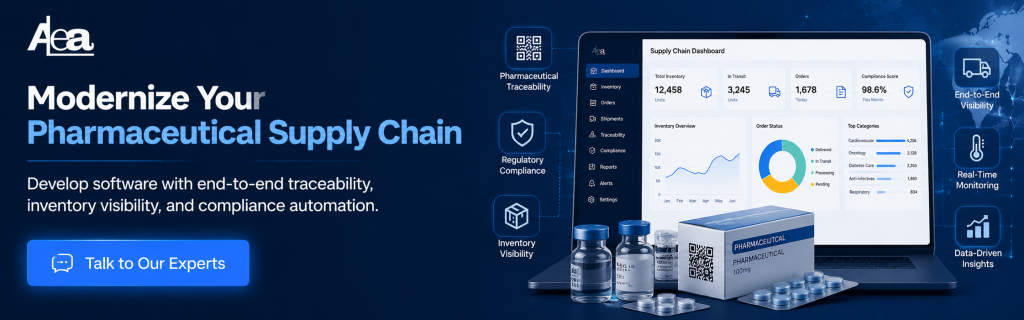
Why Choose AleaIT Solutions for AI-Powered Healthcare Supply Chain Software Development
AleaIT Solutions provides healthcare software development services for hospitals, pharmaceutical manufacturers, and distributors that need custom healthcare supply chain software built around compliance from day one—not retrofitted after an audit finding.
Our teams work across dedicated-team, staff-augmentation, and fixed-scope engagement models, depending on how much of the build you want to own internally versus hand off entirely.
What sets our approach apart is where we place the AI layer. Rather than treating artificial intelligence as a reporting add-on, we embed it directly into the compliance and forecasting functions that matter most:
AI agents that flag demand anomalies before they become shortages, automated cross-checks against DSCSA and GS1 transaction data to catch mismatches before they trigger a compliance failure, and anomaly detection across traceability records to surface potential diversion or counterfeit risk early.
For organizations dealing with dense compliance documentation, we’ve also built RAG-based systems that let internal teams query regulatory requirements and internal SOPs in plain language instead of digging through PDFs.
If your existing supply chain data already tells a story worth acting on, our data strategy consulting for supply chain analytics work can turn it into forecasting and risk models before a single line of new code gets written.
And for teams that want to see this kind of compliance automation applied more broadly, our piece on automation covers the pattern in more depth.
If you’re evaluating healthcare supply chain management software development for your organization, we’d welcome a conversation about where your current systems fall short and what a compliant, AI-enabled build would realistically take.
Frequently Asked Questions
It’s software that records a verifiable chain of custody for drug products at the package or unit level, from manufacturer through to dispenser. It captures serialization data, transaction records, and verification events required under laws like the DSCSA, and it’s what allows a recall or counterfeit investigation to trace a specific unit’s full history in minutes rather than days.
Costs range from the lower five figures for a single-facility MVP to seven figures for an enterprise system with full multi-partner interoperability. The biggest cost drivers are compliance validation effort, the number of ERP or EHR integrations required, and overall transaction volume across the network.
DSCSA compliance means the software can exchange transaction information and transaction statements electronically, verify products at the package level using GS1 identifiers, and support quarantine and investigation workflows for suspect product. Large trading partners are already under enforcement, and small dispensers must comply by November 27, 2026.
Yes, most implementations are built specifically to sit alongside or connect into existing hospital or manufacturer ERP platforms rather than replace them outright. The integration layer typically handles data synchronization for inventory, procurement, and financial records while the dedicated SCM software manages compliance-specific functions like serialization and traceability.
An MVP with core inventory and basic serialization can typically launch in a few months. A mid-tier system with full DSCSA transaction exchange and ERP integration generally takes six to twelve months, while enterprise-scale, multi-partner deployments can extend beyond a year once compliance validation and phased rollout are factored in.