An AI gateway is a middleware layer that sits between your applications and the multiple large language model (LLM) providers they depend on, centralizing routing, authentication, observability, and cost control into a single control plane.
Most engineering teams don’t set out to build one they grow into needing one. Once a product touches three or four different LLM providers, API keys get duplicated across services, rate limits become unpredictable, nobody can answer “how much did we spend on GPT-4 last month,” and a single provider outage takes down every feature wired to it.
That’s the operational chaos AI gateway development exists to solve, and it’s why this has quietly become a foundational layer of enterprise AI infrastructure rather than a nice-to-have. The market reflects the shift: the enterprise AI gateway market was valued at $0.88 billion in 2025 and is projected to reach $11.32 billion by 2035, growing at a CAGR of 29.12%, as enterprises race to centralize routing, governance, and cost control across multiple LLM providers.
What Is an AI Gateway? (Definition + Why It Exists)
An AI gateway is an abstraction layer that standardizes how every application in your organization talks to LLMs regardless of which provider is actually doing the inference.
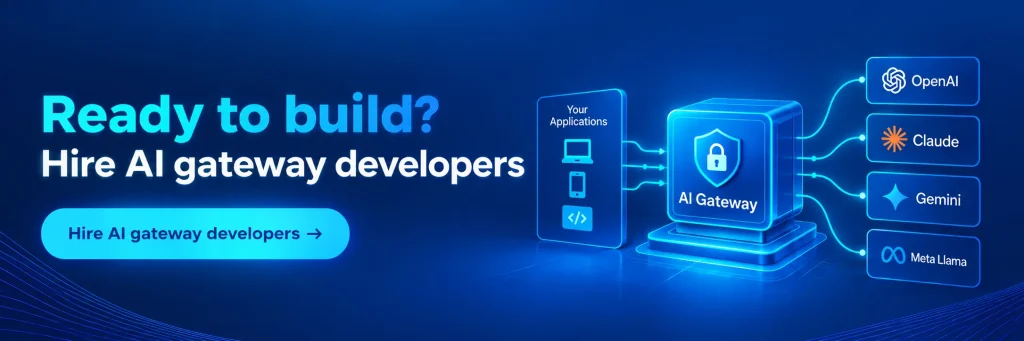
Instead of each team hardcoding calls to OpenAI, Anthropic, or an open-source model, every request flows through one gateway that handles authentication, load balancing across providers, usage tracking, and fallback logic if a provider goes down or hits capacity.
It exists because the alternative every team managing its own provider integrations, keys, and rate limits doesn’t scale past a handful of use cases before it becomes a governance and reliability problem.
This isn’t just a hype term. In 2026, Palo Alto Networks moved to acquire AI gateway platform Portkey to power its own Prisma AIRS security suite (SNS Insider / GlobeNewswire, 2026), underscoring how central this infrastructure has become to enterprise AI strategy.
AI Gateway vs. API Gateway – What’s the Difference
They look similar on a diagram but solve different problems.
| Traditional API Gateway | AI Gateway | |
| Primary job | Route requests to internal/external REST or GraphQL services | Route requests to multiple LLM providers and models |
| Core concerns | Rate limiting, auth, request/response transformation | Token-based cost tracking, prompt/response logging, model fallback, semantic caching |
| Failure handling | Retries, circuit breakers on service endpoints | Automatic failover between LLM providers/models when one degrades or errors |
| Observability | Latency, status codes, throughput | Token usage, cost per request, model quality drift, hallucination/guardrail flags |
| Governance | Role-based API access | Model access policy, data residency, PII redaction, compliance logging |
An API gateway assumes the backend behaves deterministically. An AI gateway is built around the assumption that model behavior, latency, and pricing are all variable and that you need to manage that variability centrally.
Core Problems an AI Gateway Solves
- Cost control – Without centralized tracking, LLM spend is invisible until the invoice arrives. A gateway attributes token usage down to the team, feature, or customer.
- Routing – A multi-LLM gateway can send requests to the cheapest or fastest suitable model for a given task, instead of hardcoding one provider everywhere.
- Governance – Centralized policy enforcement (which teams can access which models, PII redaction, data residency) instead of ad hoc rules per application.
- Observability – One place to see latency, error rates, and output quality across every LLM call in the organization, instead of scattered logs per service.
AI Gateway Architecture: How It Works
At a high level, AI gateway architecture follows a predictable pattern: applications never call an LLM provider directly they call the gateway, and the gateway decides where the request actually goes.
Core Components
- Routing layer – Directs each request to the right model/provider based on cost, latency, capability, or explicit rules (e.g., route all PII-containing requests to a specific compliant model).
- Auth & access control – Issues and manages gateway-level API keys per team or application, so no individual service ever holds a raw provider key.
- Observability layer – Logs prompts, responses, latency, token counts, and cost per request; feeds dashboards and alerting.
- Caching layer – Semantic or exact-match caching to avoid paying for repeated or near-duplicate LLM calls.
- Fallback logic – If a primary provider errors, times out, or is rate-limited, the gateway automatically retries against a secondary model or provider without the calling application needing to know.
Teams building this layer often pair it with broader generative AI development services work the gateway is rarely the only piece; it usually sits alongside retrieval, fine-tuning, and agent orchestration components that also need to talk to the same models through the same control plane.
Build vs. Buy: Should You Build a Custom AI Gateway or Use a Platform?
This is the question that actually determines your roadmap, and it splits into two honest answers depending on what you’re optimizing for.
When Off-the-Shelf (LiteLLM, Portkey, OpenRouter) Makes Sense
Off-the-shelf platforms like LiteLLM, Portkey, or OpenRouter work well if you just need quick multi-model access a unified API surface, basic routing, and cost dashboards without engineering overhead.
If your requirements stop at “call multiple models through one interface and see what we’re spending,” an open source AI gateway vs custom build comparison usually favors the open-source or managed route: faster time to value, active communities, and no maintenance burden on your own team.
When Custom Development Makes Sense
Custom development becomes the better call once your requirements go beyond generic multi-model access deep integration with proprietary infrastructure, compliance regimes that off-the-shelf tools weren’t built for (healthcare, finance, government), fine-grained routing logic tied to your own business rules, or tight coupling with existing systems like a CRM, data warehouse, or internal agent orchestration layer. This is also the honest answer that vendors selling a gateway product have less incentive to give you.
Not sure which fits your stack? Talk to our AI infrastructure team about AI agent development and enterprise LLM deployment →
How to Build an AI Gateway: Step-by-Step
If you land on custom development, the build generally follows five stages.
Step 1 – Define Routing and Provider Requirements
Map out which LLM providers and models you need to support today, which you’re likely to add later, and what determines routing between them (cost, latency, capability, compliance).
Step 2 – Build the Auth/Governance Layer
Issue gateway-level credentials per team or application, define access policies per model, and set up PII redaction and data residency rules before any traffic flows through.
Step 3 – Add Observability and Cost Tracking
Instrument every request for token usage, latency, and cost, and attribute it to the team, feature, or customer that triggered it. This is what makes spend visible instead of a surprise.
Step 4 – Implement Fallback and Reliability Logic
Configure automatic failover so a degraded or unavailable provider doesn’t take down the applications depending on it the gateway should retry against a secondary model transparently.
Step 5 – Test, Deploy, Monitor
Load-test routing and fallback behavior under real failure conditions, deploy behind feature flags per team, and monitor cost and latency dashboards closely for the first weeks of production traffic.
Recommended for You : top AI agent development companies
AI Gateway Development Cost
Cost scales with how much governance, observability, and custom routing logic you actually need. These are rough, directional ranges actual scope varies by provider count, compliance requirements, and existing infrastructure.
| Scope Tier | What’s Included | Rough Range |
| Basic routing | Multi-provider routing, basic auth, simple logging | $15,000 – $40,000 |
| Mid-tier (routing + governance) | Adds access policies, PII redaction, cost attribution, caching | $40,000 – $90,000 |
| Enterprise (full observability + compliance) | Adds compliance logging, data residency controls, advanced fallback, custom dashboards, SLA-backed reliability | $90,000 – $200,000+ |
Budget-qualified teams typically know within a few minutes of reading this table which tier they’re in if you’re unsure, that’s usually a sign it’s worth a scoping conversation before committing to a number.
AI Gateway Use Cases by Industry
- Fintech – Routing sensitive transaction analysis and fraud-detection prompts only to models that meet data residency and audit requirements, with full logging for compliance review.
- Healthcare – Enforcing PII/PHI redaction at the gateway level before any prompt reaches a third-party model, and routing clinical-adjacent queries to models cleared for that use case.
- SaaS – Cost-attributing LLM spend per customer or feature so product teams can price AI features accurately, and failing over between providers to keep uptime high during launches or traffic spikes.
- Retail & E-commerce – Routing product-recommendation, customer-support, and personalization prompts based on latency, cost, and model performance, while applying safeguards to protect customer and payment-related data.
- Insurance – Routing claims-processing and document-analysis prompts to approved models, with sensitive policyholder information redacted at the gateway and complete audit trails maintained for regulatory compliance.
These patterns show up across most of the AI agent use cases we build for clients the gateway is usually the infrastructure layer underneath the agent, not a separate project.
Why Work With AleaIT for AI Gateway Development
- 22 years building production software – this isn’t our first infrastructure layer; we’ve shipped systems that had to survive real production load, not just a demo.
- Compliance-grade experience – we’ve built for regulated industries where data residency and audit logging aren’t optional.
- Multi-agent orchestration expertise – the same teams designing your gateway have built the agent and RAG layers that typically sit on top of it.
- Build-vs-buy honesty – we’ll tell you when an off-the-shelf platform is genuinely the better call, not just when it isn’t.
As a custom AI gateway development company and broader AI development company, we scope gateway work as part of a larger AI infrastructure conversation, not a one-off ticket.
Frequently Asked Questions
It’s used to centralize routing, authentication, cost tracking, and governance across every application in an organization that calls one or more LLM providers, instead of each team managing its own provider integrations.
No. An API gateway routes requests to internal or external services with deterministic behavior; an AI gateway is built around variable model behavior, token-based cost tracking, and LLM-specific failover logic.
Rough ranges run from $15,000–$40,000 for basic routing, $40,000–$90,000 for routing plus governance, and $90,000–$200,000+ for full enterprise observability and compliance actual cost depends on provider count and compliance scope.
Off-the-shelf platforms like LiteLLM, Portkey, or OpenRouter work well for straightforward multi-model access. Custom development makes more sense when you need deep compliance, proprietary infrastructure integration, or routing logic tied to your own business rules.
A model router is one component inside an AI gateway the piece that decides which model handles a given request. The gateway is the broader layer that also handles auth, observability, caching, and governance around that routing decision.