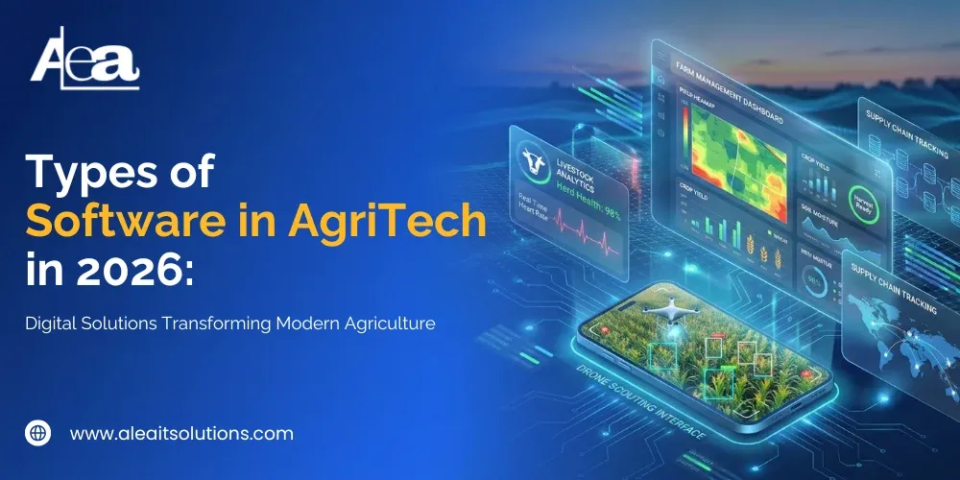
Agriculture Software Development and Agritech Software Development are central to the digital transformation of modern farming. As agriculture faces increasing pressure from climate change, rising food demand, and resource limitations, software-driven solutions have become critical for efficiency and scalability.
Best agritech software refers to digital platforms designed to automate, manage, and optimize agricultural operations for farmers, agribusinesses, suppliers, and government bodies. These solutions leverage data analytics, automation, IoT, and AI to enable real-time monitoring of crops, soil health, weather patterns, and supply chains.
This data-driven approach improves productivity through precision farming, enhances sustainability by reducing water and chemical usage, and boosts profitability by lowering operational costs and improving yield forecasting.
From a market perspective, the global agritech software and platform market was valued at over USD 20 billion in 2024 and is projected to grow at a double-digit CAGR, reaching USD 45–50 billion by 2030, highlighting strong global adoption and investment in agriculture software development.
Why Software Development Is Core to AgriTech Innovation
-
Core of innovation: Software development powers AgriTech growth and enables the best agriculture software solutions.
-
Data transformation: It converts data from sensors, drones, machinery, and weather systems into actionable insights.
-
Scalable & secure platforms: The best agriculture software uses cloud-based, real-time, and secure architectures.
-
Customization & flexibility: Custom development adapts solutions to different crops, regions, and farm sizes.
-
AI-driven efficiency: AI software development enables predictive analytics, automation, and smart farming technologies.
-
Industry integration: Software ensures seamless connectivity across agricultural devices, platforms, and supply chains.
-
Drives modernization: Continuous development transforms AgriTech ideas into scalable and commercially viable solutions.
Major Types of Software in Agritech
1. Agriculture Software & Agritech Software Ecosystem
Agriculture software underpins the global Agritech software ecosystem, enabling data-driven, automated, and AI-powered farming operations. Modern platforms combine cloud computing, IoT, and AI software development to improve efficiency and sustainability across the agricultural value chain.
The global agritech market was valued at over USD 24 billion in 2024 and is expected to reach USD 45–50 billion by 2030, growing at a 12%+ CAGR. This growth is largely driven by demand for custom Agritech solutions developed by specialized Agritech Software Development Companies.
2. Farm Management Software
Farm management software is the most widely adopted category of agriculture software, serving as a centralized system for field activities, crop planning, inputs/outputs, equipment, labor, and analytics.
Many of the best agriculture software platforms are built by the best software companies focusing on scalable farm operations. The global farm management software market was valued at ~USD 4.1 billion in 2024 and is projected to exceed USD 10–11 billion by 2030, reflecting strong adoption among commercial and enterprise farms.
2. Farm Planning Software
Farm planning software enables seasonal planning, crop rotation strategies, field task scheduling, and resource allocation. By reducing planning errors and improving timing, it directly impacts yield stability and cost efficiency. This software segment is seeing steady adoption as part of integrated Agritech software platforms, especially in large-scale farms managing hundreds to thousands of acres.
3. Agronomy Software
Agronomy software uses satellite imagery, remote sensing, and AI-driven analytics to monitor crop health, soil conditions, and nutrient requirements. Advanced AI models help detect pest infestations and disease risks early, reducing crop losses. Closely aligned with precision agriculture, this segment contributes to a market growing at 12–15% CAGR, with precision agriculture software expected to reach USD 8–9 billion by the early 2030s.
4. Business & Financial Farm Software
Business and financial farm software focuses on accounting, inventory management, cost tracking, compliance, and profitability analysis. As farming becomes more capital-intensive, this agriculture software category is increasingly critical for financial transparency. Digitized financial systems can reduce administrative costs by 20–30% and improve margin visibility across farm operations.
5. Mobile Farm Apps
Mobile farm apps extend Agritech software into the field, enabling real-time data capture, weather alerts, and operational updates on smartphones and tablets. With mobile penetration exceeding 85% in rural agricultural regions in many countries, these apps significantly improve workforce productivity and data accuracy.
6. Irrigation Management Software
Irrigation management software optimizes water usage through sensor-based automation and weather-driven scheduling. Agriculture accounts for nearly 70% of global freshwater consumption, and smart irrigation systems can reduce water usage by 20–40% while improving crop yields. This makes irrigation software a high-impact area for custom Agritech solutions.
7. Agriculture Supply Chain Software
Agriculture supply chain software manages procurement, inventory, logistics, forecasting, and traceability from farm to market. Post-harvest losses account for up to 30% of global agricultural output, and digital supply chain platforms can reduce losses by 10–15%, driving strong adoption by agribusiness enterprises.
8. Equipment, Fleet & Asset Management Software
This agriculture software category tracks machinery, vehicles, tools, and assets using GPS and IoT technologies. Equipment downtime can account for 15–25% of operational losses in large farms, and digital fleet management systems help reduce downtime while extending equipment lifespan by 10–20%.
9. Precision Agriculture, Mapping & Drone Software
Precision agriculture software uses AI, predictive analytics, and variable-rate technology to optimize inputs such as fertilizers, pesticides, and irrigation. Agriculture mapping software provides GIS-based spatial insights, while drone software automates aerial monitoring and analytics.
Together, these technologies can increase yield per acre by 5–15% and reduce input costs by 10–20%. This advanced segment of Agritech software is also driving demand for skilled professionals, particularly Software Engineers in Agritech, as AI-driven platforms continue to scale globally.
Read Also: How to Develop Land Management Software
AgriTech Software Ecosystem Overview
| Software Category | Business Impact | Key Market Figures |
|---|---|---|
| Agriculture Software & Agritech Ecosystem | Best agriculture software enables AI-driven, automated farming using cloud, IoT, and AI software development. | USD 24+ B (2024) → USD 45–50 B by 2030, 12%+ CAGR |
| Farm Management Software | Central platform for crops, inputs, labor, equipment, and analytics. | USD 4.1 B (2024) → USD 10–11 B by 2030 |
| Farm Planning Software | Crop rotation, seasonal planning, and task scheduling. | Adopted by farms managing 100s–1000s of acres |
| Agronomy Software | AI and satellite data for crop and soil monitoring. | 12–15% CAGR, USD 8–9 B by 2030s |
| Business & Financial Farm Software | Accounting, inventory, compliance, profitability tracking. | Cuts admin costs 20–30% |
| Farmer-Focused Mobile Apps | Mobile access to real-time farm data and alerts. | Rural mobile use 85%+ |
| Irrigation Management Software | Sensor-based, weather-driven water optimization. | Saves 20–40% water |
| Agriculture Supply Chain Software | Digital procurement, logistics, and traceability. | Reduces losses 10–15% |
| Equipment, Fleet & Asset Software | IoT/GPS tracking to reduce downtime. | Downtime loss 15–25%, lifespan +10–20% |
| Precision, Mapping & Drone Software | AI, GIS, and drones for input optimization. | Yields +5–15%, costs −10–20% |
Emerging Software Categories in Agritech
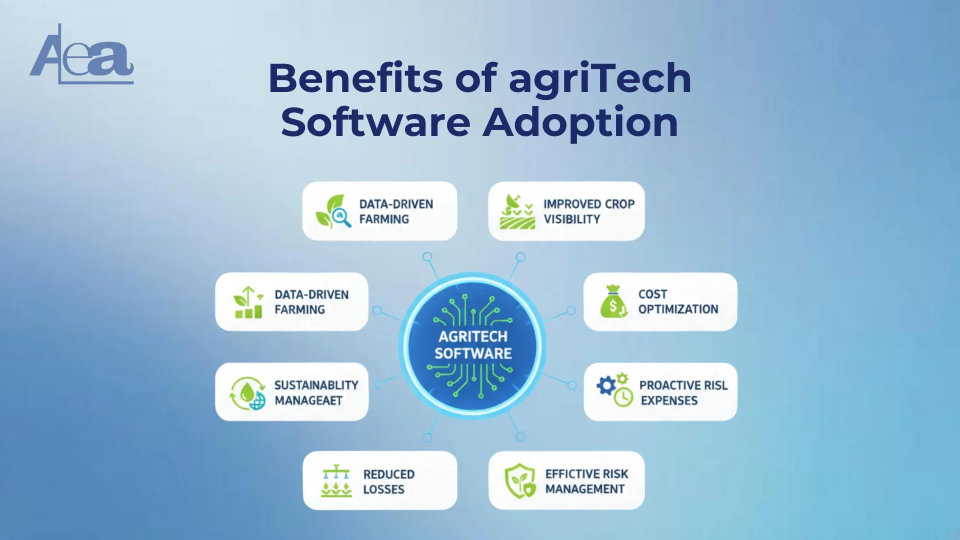
Benefits of Agritech Software Adoption
-
Data-driven farming: Best agriculture software shifts agriculture from experience-based decisions to data-driven operations by integrating farm management systems, precision agriculture tools, AI analytics, and real-time field monitoring.
-
Improved crop visibility: Using best agriculture software, farmers gain deeper insights into crop performance, soil health, and weather patterns for timely and accurate decision-making.
-
Higher yields: Optimized planting schedules, precise fertilizer application, and early detection of crop stress or disease through best agriculture software help increase yields by 5–15%.
-
Cost optimization: Best agriculture software automates workflows and precision input management, reducing labor dependency and minimizing overuse of seeds, fertilizers, pesticides, and water.
-
Lower operational expenses: Equipment, fleet, and asset management features within best agriculture software improve machinery utilization and reduce downtime, cutting operational costs by 15–25%.
-
Proactive risk management: Predictive analytics and real-time alerts powered by best agriculture software forecast weather disruptions, pest outbreaks, diseases, and yield fluctuations in advance.
-
Reduced losses: Proactive planning enabled by best agriculture software lowers crop losses, protects revenue, and improves financial stability across seasons.
-
Sustainability & compliance: Best agriculture software tracks water usage, soil health, emissions, and input application to support sustainable and regulatory-compliant farming.
-
Efficient water management: With agriculture consuming nearly 70% of global freshwater, smart irrigation tools in best agriculture software enable responsible water use and long-term sustainability.
Develop Your Best Agriculture Software with AleaIT Solutions
Developing the best agriculture software requires strong technical expertise, deep Agritech domain knowledge, and scalable system design. AleaIT Solutions delivers high-performance agriculture software that helps farmers, agribusinesses, and Agritech innovators operate smarter, faster, and more sustainably—backed by proven experience as a custom software development company.
We design and build tailored Agritech solutions such as farm management software, precision agriculture platforms, AI-driven analytics, irrigation systems, and supply chain software. By combining advanced AI software development, cloud-native architectures, and secure data pipelines, we transform agricultural data into clear, actionable insights.
AleaIT Solutions focuses on interoperable, scalable, and compliant agriculture software that integrates seamlessly with IoT devices, sensors, drones, and third-party platforms—delivering long-term value and a strong competitive edge across the Agritech ecosystem.
Conclusion
Agritech software is transforming modern, data-driven agriculture by helping farms and agribusinesses improve efficiency, visibility, and decision-making. These outcomes are often achieved with the expertise of an experienced agriculture software development company that understands real-world farming needs.
Choosing the right Agritech solution depends on factors like crop type, farm size, regional conditions, and long-term goals. Whether adopting a ready-made platform or building custom software, alignment with operational challenges is key to maximizing ROI and sustainability.
As Agritech evolves, AI-driven automation, interoperable platforms, and sustainability-focused features will shape the future—making smart agriculture software essential for resilient and profitable farming.
FAQs on Agritech Software
1. What is agritech software?
Agritech software includes digital solutions designed to manage, automate, and optimize agricultural operations using data, AI, and automation.
2. How does agritech software improve farm productivity?
It enables precision farming, real-time monitoring, and data-driven decisions that help improve yields and operational efficiency.
3. Is agritech software suitable for small and medium-sized farms?
Yes, most agriculture software platforms are scalable and can be customized based on farm size and budget.
4. What types of agritech software are most commonly used?
Common types include farm management software, agronomy tools, precision agriculture software, irrigation management systems, and supply chain platforms.
5. How does AI contribute to agritech software?
AI supports predictive analytics, crop health monitoring, yield forecasting, and automated farming operations.
6. Can agritech software reduce farming costs?
Yes, by optimizing inputs and automating processes, it can reduce operational costs by up to 25%.
7. How does agritech software help with risk management?
It provides early alerts for weather risks, pests, diseases, and market changes, enabling proactive action.
8. Does agritech software support sustainability and compliance?
Yes, it helps track water usage, emissions, and inputs, supporting sustainability goals and regulatory compliance.
9. What is the role of mobile apps in agritech software?
Mobile apps enable real-time data capture, alerts, and field-level access to analytics.
10. How do I choose the right agritech software solution?
Choose based on crop type, farm size, operational complexity, and long-term scalability needs.