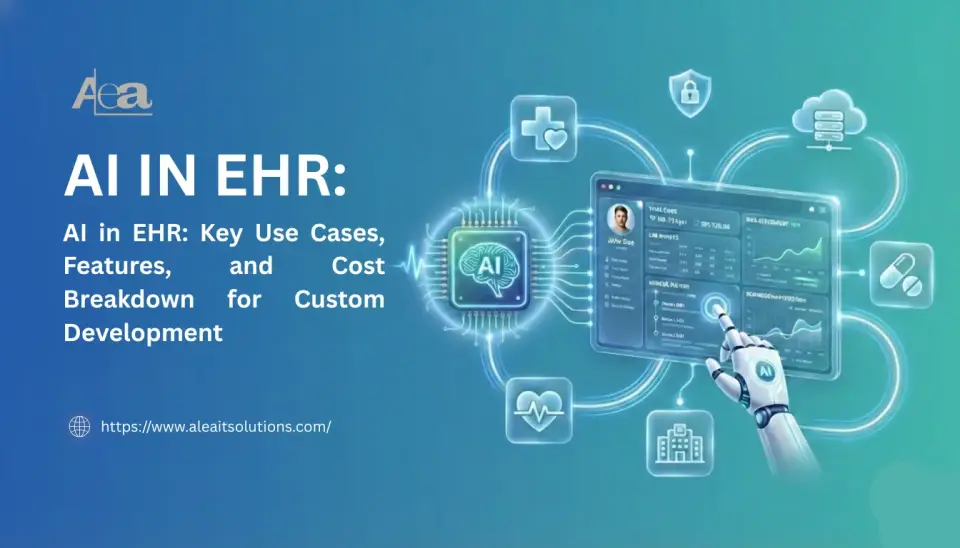
igenceA robust architecture is essential for building an AI-enabled EHR system and successfully implementing artificial intelligence in healthcare.
It brings together secure patient data storage, intuitive clinical and administrative interfaces, standardized medical terminologies (ICD-10, SNOMED CT, LOINC, RxNorm), and a powerful AI engine.
At the core, the AI engine analyzes clinical records, notes, lab results, and historical data using machine learning and NLP to generate real-time insights, diagnostic suggestions, and treatment recommendations.
This scalable, interoperable architecture ensures seamless data flow, regulatory compliance, and effective clinical decision support without disrupting existing workflows.
Market Overview: AI in EHR & Healthcare AI Adoption
The global healthcare industry is rapidly transforming due to the growing adoption of artificial intelligence in healthcare, especially within Electronic Health Record (EHR) systems.
Today, over 90% of hospitals in developed markets use EHRs, creating massive volumes of clinical data that AI can analyze to improve accuracy, efficiency, and decision-making.
The AI-enhanced EHR market was valued at approximately USD 6.57 billion in 2024 and is expected to grow to USD 52.50 billion by 2033, registering a strong CAGR of ~26.2%. This growth is fueled by rising patient data volumes, increased interoperability initiatives, and the demand for real-time clinical insights.
The broader AI in healthcare market shows even faster expansion from USD 29–30 billion in 2024 to an estimated USD 504–505 billion by 2032–2033, reflecting a CAGR of 38–44%. AI adoption is already widespread:
in 2024, 71% of hospitals used predictive AI integrated with EHRs (up from 66% in 2023), while overall healthcare AI adoption now exceeds 70–79% across clinical, operational, and administrative use cases.
Regionally, North America accounts for the largest share of AI-driven EHR adoption, supported by advanced healthcare IT infrastructure, strong regulatory frameworks, and high digital health spending. Europe and Asia-Pacific are also accelerating adoption, driven by government-led digital health initiatives and value-based care models.
How AI Improves EHR Systems
Artificial intelligence is transforming EHR solutions by turning electronic records into intelligent, insight-driven platforms. Traditional EHR software focuses on storing patient data, while AI in healthcare enables automation, predictive analytics, and real-time clinical decision support that improve both care quality and operational efficiency.
Clinically, AI enhances diagnosis and treatment through risk stratification, predictive modeling, and automated alerts. Machine learning algorithms analyze historical and real-time patient data to identify high-risk cases, predict disease progression, and detect potential drug interactions. These capabilities support faster, more accurate clinical decisions and reduce medical errors.
AI also reduces the administrative burden associated with EHR systems. Natural language processing (NLP) and voice recognition automate clinical documentation, minimizing manual data entry and clinician burnout. AI-driven automation improves medical coding, billing accuracy, and claims processing, helping healthcare organizations lower EHR software cost and accelerate revenue cycles.
Operationally, AI optimizes scheduling, resource utilization, and population health management. Advanced analytics uncover care gaps, utilization patterns, and trends across patient populations, enabling proactive and preventive care. When implemented by experienced AI developers or an AI app development company, AI-powered EHR solutions become scalable, secure, interoperable, and compliant—supporting long-term digital healthcare innovation.
Key Benefits of AI-Powered EHR Systems
AI-powered EHR systems are transforming healthcare by making clinical processes smarter, faster, and more efficient. By embedding artificial intelligence in healthcare workflows, providers can improve care quality while reducing operational complexity.
Improved Clinical Decision-Making & Early Disease Detection
AI analyzes patient records, lab results, medical histories, and clinical notes to uncover hidden patterns and risks. This helps clinicians detect diseases earlier, predict complications, and make more confident, data-backed treatment decisions especially in complex or high-risk cases.
Enhanced Administrative Efficiency & Cost Reduction
Routine administrative tasks such as data entry, billing, coding, and scheduling are time-consuming and error-prone. AI automates these workflows, reducing manual effort, minimizing errors, and speeding up operations. This leads to lower administrative costs and better revenue cycle management.
Personalized Patient Care & Predictive Analytics
AI-driven EHRs support personalized care by analyzing individual patient data alongside broader population insights. Predictive analytics enable tailored treatment plans, preventive care strategies, and timely follow-ups, resulting in better outcomes and higher patient satisfaction.
Reduced Physician Burnout Through Automation
Excessive documentation is a major cause of clinician burnout. AI features such as voice recognition, NLP-based clinical documentation, and automated reporting significantly reduce time spent on paperwork. This allows physicians to focus more on patient care and less on administrative tasks.
Core Features of Modern AI EHR Platforms
Modern AI-powered EHR platforms are designed to go beyond basic record-keeping. By embedding artificial intelligence in healthcare systems, these platforms enhance clinical accuracy, streamline workflows, and improve patient engagement through intelligent automation and real-time insights.
NLP for Automated Clinical Notes & Documentation
Natural Language Processing (NLP) enables EHR systems to automatically convert unstructured data such as physician notes, discharge summaries, and clinical conversations into structured, searchable records. This reduces manual documentation, improves data accuracy, and ensures more complete patient records without adding to clinicians’ workload.
Machine Learning–Driven Predictive Modeling
Machine learning algorithms analyze historical and real-time patient data to predict health risks, disease progression, readmissions, and treatment outcomes. These predictive insights help clinicians intervene early, optimize care plans, and improve overall clinical decision-making.
Voice Recognition & Ambient Clinical Intelligence
Voice-enabled EHR features allow clinicians to dictate notes, orders, and observations during patient encounters. Ambient clinical intelligence captures conversations in the background and automatically generates documentation, minimizing disruptions and allowing providers to stay focused on patient care.
Real-Time Data Interpretation & Alerts
AI-powered EHR systems continuously monitor patient data and generate real-time alerts for abnormal lab values, potential drug interactions, or emerging health risks. This proactive approach supports timely interventions and enhances patient safety across care settings.
Integrated Patient Engagement Tools
Modern AI EHR platforms include patient-facing tools such as AI chatbots, appointment reminders, personalized health recommendations, and remote monitoring integration. These features improve communication, increase patient adherence, and support ongoing engagement beyond clinical visits.
Applications of AI in EHR/EMR Systems Healthcare Businesses Should Understand
Automating Data Entry and Documentation
AI-powered EHR systems use NLP and automation to capture clinical notes, patient interactions, and reports with minimal manual input. This reduces documentation time, improves data accuracy, and allows clinicians to focus more on patient care.
Predictive Analytics for Patient Outcomes
By analyzing historical and real-time patient data, AI predicts disease progression, readmission risks, and treatment outcomes. This helps providers take preventive actions and improve clinical results.
Clinical Decision Support
AI-driven clinical decision support systems assist healthcare professionals by offering evidence-based treatment recommendations, diagnostic insights, and risk assessments at the point of care.
Real-Time Risk Alerts and Monitoring
AI continuously monitors patient data to detect abnormal vitals, lab results, or potential complications. Real-time alerts enable faster interventions and enhance patient safety.
AI-Powered Natural Language Processing (NLP) for Patient Records
NLP converts unstructured clinical notes, discharge summaries, and reports into structured EHR data, improving data usability, searchability, and interoperability.
Personalized Treatment Plans Through AI
Artificial Intelligence analyzes patient history, genetics, lifestyle, and clinical data to recommend personalized treatment plans, supporting precision medicine and better health outcomes.
AI for Population Health Management
AI helps healthcare organizations identify population-level health trends, manage chronic diseases, and improve preventive care through data-driven insights.
AI-Enhanced Medical Imaging Integration with EHR Systems
AI-powered imaging tools integrate with EHRs to assist radiologists and clinicians by identifying anomalies, prioritizing critical cases, and attaching insights directly to patient records.
AI-Driven Patient Scheduling and Resource Allocation
AI optimizes appointment scheduling, staff allocation, and resource utilization, reducing wait times and improving operational efficiency.
AI in EHR: Clinical & Operational Use Cases
Clinical Use Cases
Predictive Analytics for Patient Outcomes: AI in healthcare can analyze historical patient data within EHR solutions to predict outcomes, enabling proactive care.
AI-Assisted Diagnosis & Risk Stratification: AI algorithms help healthcare providers make accurate diagnoses and assess patient risk, reducing errors in clinical decision-making. Collaborating with AI developers ensures these tools are tailored to clinical needs.
Drug Interaction & Alert Systems: Integrating AI in EHR software allows automatic alerts for potential drug interactions, enhancing patient safety and reducing adverse events.
Operational & Administrative Use Cases
Automated Data Entry & Coding: AI in healthcare streamlines data entry and coding in EHR solutions, reducing administrative burden and errors. Partnering with an AI app development company can help deploy customized solutions.
Intelligent Scheduling & Resource Allocation: AI optimizes staff schedules and resource utilization, improving operational efficiency in healthcare facilities.
Billing Optimization & Fraud Detection: AI systems detect anomalies and optimize billing, helping reduce EHR software costs and prevent fraud.
AI Chatbots for Patient Support: AI-driven chatbots provide patients with 24/7 support, appointment reminders, and follow-ups, enhancing patient engagement and satisfaction.
Population & Remote Care Use
Population Health Management: AI enables analysis of large patient populations in EHR solutions to identify trends, gaps, and at-risk groups, improving overall healthcare delivery.
Telehealth Integration with EHR: AI facilitates seamless integration of telehealth data into EHR solutions, providing a holistic view of patient care and supporting remote consultations.
Remote Monitoring & Continuous Risk Tracking: Wearables and IoT devices, combined with AI, allow continuous patient monitoring. Expert AI app development companies can build apps to track health risks in real-time.
How to Integrate AI into EHR Systems
Evaluate Current EHR Capabilities: Assess your existing EHR solutions and identify areas where AI in healthcare can improve clinical and operational outcomes.
Define Strategic AI Use Cases: Determine which processes—like predictive analytics, patient monitoring, or billing optimization—will benefit most from AI. Collaborate with AI developers to align solutions with organizational goals.
Choose AI Frameworks & Integration Tools: Select appropriate AI frameworks, APIs, and AI app development company solutions to ensure smooth integration with your EHR software.
Prepare & Standardize Data: Clean, structure, and standardize data from your EHR solutions to enable accurate AI-driven insights.
Pilot Implementation & Testing: Launch AI pilots in controlled environments, monitor results, and refine the system before full-scale deployment.
Staff Training & Adoption Strategy: Train healthcare staff on AI-enabled EHR software, emphasizing workflow integration and user adoption.
Ongoing Monitoring & Optimization: Continuously track AI performance, adjust algorithms, and optimize processes to maximize ROI and improve patient outcomes while reducing EHR software costs.
Data Security, Privacy & Compliance
HIPAA & PHI Protection Essentials
Protecting patient data is the foundation of any EHR solution. When integrating AI in healthcare, it is critical to ensure that all personal health information (PHI) is encrypted, securely stored, and accessible only to authorized personnel.
Implementing role-based access controls, multi-factor authentication, and secure audit trails helps prevent unauthorized access and ensures full compliance with HIPAA regulations.
AI Data Governance & Risk Management
Integrating AI into EHR software introduces new challenges for data governance. Organizations must establish clear policies for how data is collected, stored, and used.
Risk management frameworks should identify potential vulnerabilities in AI models, prevent biases in clinical decision-making, and maintain the integrity of patient data.
Engaging AI developers experienced in healthcare applications ensures that these governance protocols are robust and effective.
Securing AI Models & Clinical Data
AI models are as valuable as the data they are trained on. Securing these models and clinical datasets is essential to prevent data breaches or malicious tampering.
Techniques such as data anonymization, encryption at rest and in transit, secure cloud hosting, and continuous monitoring of AI workflows help protect sensitive information. P=
Regulatory & Ethical Considerations
Beyond technical security, regulatory and ethical compliance is critical. Organizations must ensure that AI tools follow healthcare standards, avoid biases, and maintain transparency in clinical recommendations.
Compliance with regional and international regulations such as HIPAA in the U.S., GDPR in Europe, and local healthcare laws—is mandatory.
Challenges in AI-Driven EHR Deployment
Data Quality Issues: Incomplete, inconsistent, or unstructured patient data can reduce the accuracy and effectiveness of AI in healthcare applications within EHR solutions, leading to unreliable insights.
Interoperability with Legacy Systems: Many healthcare providers still rely on older EHR software, which may not support AI tools, making integration complex and requiring data standardization.
Model Bias & Fairness: AI models trained on historical data may inherit biases, potentially affecting clinical decisions. Partnering with skilled AI developers ensures models are fair, unbiased, and clinically reliable.
Explainability & Clinical Trust: Clinicians must understand how AI reaches conclusions. Transparent, explainable models increase trust and support informed decision-making.
Workflow Disruption: Introducing AI into existing workflows can temporarily slow operations. Careful planning and phased implementation reduce disruption.
Staff Adoption Resistance: Healthcare staff may be hesitant to adopt new AI-powered EHR solutions. Comprehensive training and clear communication of benefits are critical to adoption.
Cost Barriers: Implementing AI solutions requires investment in infrastructure, software, and maintenance. Understanding EHR software cost is essential to plan budgets effectively.
Infrastructure Limitations: AI integration often demands high-performance servers, cloud platforms, and additional storage. Without adequate infrastructure, AI performance may be limited.
Regulatory Compliance: Ensuring AI tools comply with HIPAA, PHI protection, and other healthcare regulations is mandatory to avoid legal and ethical risks.
Data Security Risks: Protecting sensitive clinical data and AI models from cyber threats requires strong encryption, secure access controls, and constant monitoring.
Maintenance & Continuous Optimization: AI models and EHR software require regular updates, monitoring, and optimization to maintain accuracy, efficiency, and security.
Practical Solutions & Best Practices
Bias Mitigation & Fair AI Design
Implement systematic bias detection and mitigation frameworks when developing AI in healthcare solutions for EHR software. Use diverse, representative datasets, perform algorithmic audits, and apply fairness metrics to ensure equitable clinical outcomes across patient populations.
Explainable AI for Clinical Confidence
Deploy explainable AI (XAI) techniques such as SHAP, LIME, or attention-based models to provide interpretable outputs for clinicians. Integrating XAI within EHR solutions ensures that predictions, risk stratifications, and recommendations are transparent, auditable, and clinically actionable.
Human-Centered AI Deployments
Design AI systems in collaboration with healthcare professionals to align with real-world workflows. Incorporate feedback loops, interactive dashboards, and contextual alerts in EHR software to enhance usability, clinician trust, and patient safety.
Standardized Interoperability Roadmaps
Develop structured interoperability frameworks for integrating AI models with existing EHR solutions. Leverage HL7 FHIR standards, RESTful APIs, and microservices architecture to enable seamless data exchange, real-time analytics, and cross-platform AI functionality.
Cost of Custom AI-Powered EHR Software
| Cost Component | Description | Estimated Cost (USD) |
| AI Strategy & Requirement Analysis | Clinical workflow analysis, AI use-case definition, data assessment, and system architecture planning. | $10,000 – $30,000 |
| UI/UX Design | Custom clinician-friendly dashboards, patient portals, and AI decision-support interfaces. | $15,000 – $40,000 |
| Core EHR Development | Development of patient records, clinical modules, interoperability, and compliance features. | $60,000 – $150,000 |
| AI Model Development | Machine learning models for prediction, NLP for documentation, and clinical decision support. | $50,000 – $200,000 |
| Data Engineering & Integration | Data pipelines, HL7 FHIR integration, legacy system connectivity, and data standardization. | $25,000 – $80,000 |
| Infrastructure & Cloud Setup | Cloud hosting, compute resources, storage, and scalability architecture. | $20,000 – $70,000 |
| Security, Privacy & Compliance | HIPAA compliance, PHI protection, encryption, access controls, and audit logs. | $15,000 – $50,000 |
| Testing & Validation | Functional testing, AI model validation, performance testing, and security audits. | $10,000 – $35,000 |
| Deployment & Staff Training | Production deployment, onboarding, and clinician training programs. | $8,000 – $25,000 |
| Maintenance & Ongoing AI Optimization (Annual) | Model retraining, updates, monitoring, and technical support. | $20,000 – $60,000 / year |
ROI & Business Impact
1. Efficiency Improvements & Cost Savings
Implementing AI in healthcare within EHR solutions automates repetitive tasks such as data entry, coding, and appointment scheduling. This reduces administrative workload, minimizes human errors, and lowers EHR software costs, leading to measurable efficiency gains and operational cost savings.
2. Revenue Cycle Enhancement
AI-powered tools optimize billing, claims processing, and fraud detection. By integrating AI into EHR software, healthcare providers can accelerate reimbursement cycles, reduce denied claims, and increase overall revenue efficiency. Partnering with an AI app development company ensures these solutions are tailored to specific organizational needs.
3. Better Patient Outcomes & Satisfaction
Predictive analytics, risk stratification, and AI-driven decision support improve clinical accuracy and personalized care. Patients benefit from timely interventions, reduced errors, and enhanced engagement through AI chatbots in EHR solutions, increasing satisfaction and trust.
4. Strategic Competitive Advantages
Adopting AI-enabled EHR solutions positions healthcare organizations as innovators in the market. Leveraging insights from AI models helps make data-driven strategic decisions, improve resource allocation, and maintain a competitive edge in delivering high-quality, cost-efficient care.
Top Trends: Future of AI & EHR Innovation (2026)
1. Ambient Intelligence: The “Invisible” Scribe
The era of the “keyboard-bound” physician is ending. Ambient listening tools now capture natural patient-doctor conversations and automatically populate EHR fields in real-time.
-
The Shift: Moving from simple transcription to context-aware documentation that can differentiate between a casual chat and a clinical symptom.
-
Impact: Drastic reduction in “pajama time” (doctors doing paperwork at home), allowing for 100% eye contact during visits.
2. Predictive “Patient Twins”
EHRs are no longer just digital filing cabinets; they are predictive engines. By integrating genomic data, social determinants of health (SDoH), and real-time wearable data, AI creates a “digital twin” of the patient.
-
The Shift: Transitioning from reactive care to proactive risk modeling.
-
Impact: The system flags a potential sepsis or cardiac event 48 hours before clinical symptoms appear, directly within the EHR workflow.
3. Interoperability via Agentic AI
Historically, getting two different EHR systems to “talk” was a nightmare. In 2026, Agentic AI—autonomous agents that can navigate different software—act as the bridge.
-
The Shift: AI agents can now “fetch” and “translate” data across platforms (Epic to Cerner, etc.) without needing manual API integrations.
-
Impact: A seamless “longitudinal record” where a patient’s history follows them instantly across state lines or different hospital networks.
4. Hyper-Personalized Patient Portals
The “Patient Side” of the EHR is getting a GenAI makeover. Instead of confusing lab results (e.g., “Creatinine 1.2 mg/dL”), AI explains the data in plain language.
-
The Shift: Generative AI creates personalized health summaries and video explainers based on the patient’s specific health literacy level.
-
Impact: Higher patient engagement and better adherence to treatment plans.
5. “Revenue Cycle” Autonomy
AI is now tackling the “back office” within the EHR, specifically around medical coding and prior authorizations.
-
The Shift: Autonomous Coding uses NLP to assign billing codes with higher accuracy than humans, while AI agents handle insurance “prior auths” in seconds rather than days.
-
Impact: Reduced hospital administrative costs and faster approvals for patient procedures.
Aleait Solutions: Redefining the Standard for AI-Powered Healthcare Software Development
For over 21 years, we’ve been in the trenches of healthcare software, untangling messy data and building systems that simply cannot afford to fail. We’ve seen every tech cycle come and go, and that “gray hair” experience is exactly what makes our AI engineering different. We aren’t just chasing the latest buzzword; we’re seasoned architects who know how to bridge the gap between stable, legacy EHRs and the frontier of neural networks.
Selecting the right partner for integrating AI in healthcare into your EHR solutions is critical for success. Look for vendors or AI app development companies with deep domain expertise in healthcare IT, ensuring they understand clinical workflows, regulatory requirements, and operational challenges.
At Aleait Solutions, we speak the dual language of clinical stability and modern AI. We build with a “human-in-the-loop” philosophy, ensuring our models don’t just work in a lab, but actually solve burnout in a chaotic, real-world clinic. After two decades of solving “impossible” software problems, we’ve learned one truth: the best AI should feel invisible, handling the heavy lifting so providers can get back to what they do best caring for patients.
Key Questions About AI-Powered EHR Development
Do I need deep AI expertise to build an AI-powered EHR?
No. While AI adds complexity, healthcare organizations do not need in-house AI expertise. Working with an experienced AI app development company or skilled AI developers ensures proper model design, integration, and compliance while your internal team focuses on clinical workflows and adoption.
Do I need separate teams for EHR development and AI implementation?
Not necessarily. A unified development partner with expertise in both EHR solutions and AI in healthcare can handle end-to-end development, reducing coordination overhead, integration risks, and overall project timelines.
How long does it take to develop an AI-powered EHR system?
Development timelines vary based on scope and complexity. A basic AI-enabled EHR may take 6–9 months, while advanced systems with predictive analytics, NLP, and interoperability can take 12–18 months, including testing and regulatory validation.
Can AI-powered EHRs integrate with existing healthcare IT systems?
Yes. Modern EHR software uses interoperability standards like HL7 FHIR and secure APIs to ensure seamless data exchange with labs, imaging systems, billing platforms, telehealth tools, and legacy healthcare systems.
Will AI complicate regulatory compliance and data security?
AI does not increase compliance risk if implemented correctly. With proper governance, encryption, access controls, and audit trails, AI-powered EHR solutions can remain fully HIPAA-compliant while enhancing data security and transparency.