Key Takeaways
- SaaS development costs range from $15,000 to $500,000+ depending on complexity, team type, and region there is no single right number without knowing your scope.
- Start with an MVP, not a full product. A well-scoped MVP costs $15,000–$40,000 and validates your idea before you invest in full-scale development.
- Your team type is the biggest cost lever. The same product can cost $150,000 with a US agency and $25,000–$40,000 with a senior India-based firm — same quality, very different invoice.
- AI integration adds $500–$150,000+ depending on whether you use API-based AI (low cost, fast) or a custom-trained ML model (high cost, proprietary advantage).
- FinTech, HealthTech, and EdTech SaaS cost 20–50% more than standard products due to compliance requirements budget for GDPR, HIPAA, PCI-DSS from day one, not as an afterthought.
- Ongoing costs are non-negotiable. Hosting, APIs, security, and maintenance add 15–25% of your build cost every year — factor this into your runway before you write a single line of code.
- India is the best value region in 2026 — senior developers at $25–$80/hr with a 20+ year outsourcing ecosystem, English proficiency, and timezone flexibility.
- Hidden costs kill more SaaS projects than bad code. Scope creep, compliance retrofitting, and underbudgeted infrastructure are the three biggest budget killers — a structured discovery phase prevents all three.
Introduction
Building a SaaS product in 2026 costs anywhere between $15,000 and $500,000+, depending on complexity, team type, and whether AI-accelerated development is used.
The range is wide as the term “SaaS” covers everything from a simple task management MVP to a multi-tenant enterprise platform with SOC 2 compliance and custom ML pipelines.
This guide offers a complete SaaS development cost 2026 breakdown by tier, team type, region (including India-specific rates in USD and INR), AI integration costs, and ongoing operational expenses. Whether you are a non-technical founder validating your first idea or a CTO scoping an enterprise build, you will find actionable numbers here.
The global SaaS market is projected to reach $435 billion in 2026, and the window for well-executed niche platforms has never been this wider. What you invest, and how you invest it, decides whether you compete or get left behind.
What Factors Affect SaaS Product Development Cost?
The SaaS product development cost is shaped by six major factors. Understanding each one before you scope your project can save you tens of thousands of dollars.
Feature scope and complexity: A simple CRUD application with basic user authentication costs a fraction of a real-time collaboration platform with event-driven architecture.
1. Team type:
Whether you hire in-house, use freelancers, work with a US agency, or partner with a senior firm is often the single largest lever on your total spend. A 3x cost difference for equivalent output is common across these options. The decision between off-the-shelf SaaS tools and custom software development often comes down to this.
2. Technology stack choices :
Using battle-tested frameworks (React, Node.js, Python/Django) with managed cloud services keeps costs predictable. Opting for niche stacks or excessive microservices at the MVP stage inflates both build time and long-term maintenance costs.
AI/ML frameworks (PyTorch, LangChain, LlamaIndex) add further specialisation cost if your product requires custom model training.
3. Multi-tenant architecture requirements:
A true multi-tenant SaaS where a single codebase serves all customers with logical data isolation requires careful upfront architecture decisions. Getting this wrong at the MVP stage and retrofitting it later is expensive. Budget for proper architecture design if you plan to serve multiple enterprise clients.
4. Compliance needs:
GDPR, HIPAA, SOC 2 Type II, and PCI-DSS are not optional for certain industries. Each certification layer adds cost: legal review, audit trails, encryption at rest and in transit, vendor assessments, and penetration testing. These costs are covered in the industry-specific section below.
5. AI integration:
API-based AI features (using OpenAI, Anthropic Claude, or Google Gemini) are relatively low-cost to add. Custom ML model training is a fundamentally different cost category. See the AI SaaS section for full numbers.
The single biggest cost driver is scope creep the average SaaS project exceeds its initial budget by 30–50% due to unplanned features added mid-build. A structured discovery phase before development begins is the most effective way to prevent this.
SaaS Development Cost Breakdown by Tier
SaaS development cost 2026 varies dramatically by product tier. Here is the honest breakdown across three stages, written for founders making real budget decisions.
| Approach | Cash Cost (MVP) | Time to MVP | Best For |
| Solo Technical Founder | $0 | 3–6+ months | Technical co-founders only |
| Freelancers | $8,000 – $25,000 | 3–9 months | Simple builds with PM bandwidth |
| US/UK Agency | $60,000 – $150,000 | 4–6 months | Regulated industries, high compliance |
| India Agency (Senior) | $15,000 – $40,000 | 6–10 weeks | Best value: speed + quality + cost |
1. MVP SaaS: Validate Before You Invest ($15,000 – $40,000)
An MVP is not a minimal product it is the minimum set of features that lets real users validate your core assumption.
A well-scoped SaaS MVP development cost typically includes, user authentication, one core feature workflow, a basic admin dashboard, Stripe subscription billing, and a landing page.
Understanding the cost to build a SaaS MVP upfront prevents the most common mistake founders make scoping a full product when a focused MVP would validate the idea at one-fifth the price.
This tier is for idea validation, not full market launch. The goal is to reach paying users in 6–12 weeks, gather data, and decide whether to invest further. MVP development services at this tier should always prioritise speed and learning over polish.
2. Mid-Scale SaaS: Ready to Compete ($40,000 – $150,000)
Once your MVP has validated demand, the mid-scale build turns it into a product that can compete. This includes, polished dashboards with data visualisations, multiple user roles and permissions, third-party integrations (CRM, ERP, Zapier, REST APIs), admin controls, onboarding flows, and basic analytics.
Timeline: 3–6 months with a structured agile team. This is the stage most funded startups are in when they approach a custom SaaS development partner.
3. Enterprise SaaS Development Cost: Built to Scale ($150,000 – $500,000+)
Enterprise SaaS is only appropriate post product-market fit, when you have paying customers with complex requirements.
This tier includes: multi-tenant architecture with strict data isolation, SSO/SAML integration, role-based access control (RBAC), SOC 2 Type II or HIPAA compliance, 99.9% SLA guarantees, advanced security logging, and white-labelling capabilities.
Timeline: 6–12 months minimum. Enterprise SaaS development cost at this level is not just a build cost it includes architecture, compliance auditing, and ongoing security posture maintenance.
SaaS Development Cost by Team Type
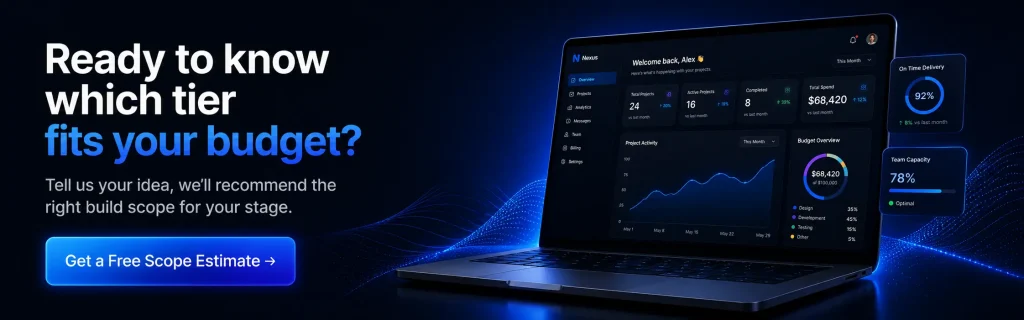
The team model you choose affects not just cost but speed, quality, and communication overhead. Here is a direct comparison of all four options founders typically consider.
|
Approach |
Cash Cost (MVP) | Time to MVP |
Best For |
| Solo Technical Founder | $0 | 3–6+ months | Technical co-founders only |
| Freelancers | $8,000 – $25,000 | 3–9 months | Simple builds with PM bandwidth |
| US/UK Agency | $60,000 – $150,000 | 4–6 months | Regulated industries, high compliance |
| India Agency (Senior) | $15,000 – $40,000 | 6–10 weeks | Best value: speed + quality + cost |
1. Solo Technical Founder:
Zero cash cost for development, but the highest opportunity cost. Viable only if you are an experienced full-stack developer.
Time to MVP: 3–6+ months due to context-switching between product, development, and business. Not a scalable model beyond the early prototype stage.
2. Freelancers:
Lower hourly rates ($25–$100/hr depending on region and skill) but project management falls entirely on you. Coordination overhead across frontend, backend, DevOps, and UI/UX freelancers can easily negate the hourly rate savings. Time to MVP: highly variable (3–9 months).
3. US/UK Agency:
Highest cost ($150–$250/hr senior rates), but typically strong processes and senior accountability. Best for regulated industries where local legal jurisdiction matters. Time to MVP: 4–6 months.
4. India Outsourcing- Senior Agency:
The best risk-adjusted option for most startups and growth-stage companies. Rates of $25–$75/hr for senior developers not junior resources with full project management, dedicated delivery teams, and proven SaaS delivery processes.
Hire dedicated developers in India through an established agency to get agency-quality output without agency-level pricing.
SaaS Development Cost India: Why It’s the Smartest Choice in 2026
Software development outsourcing India has matured into a $200B+ industry precisely because the value-to-cost ratio is unmatched globally and SaaS is where that advantage is most pronounced.
SaaS development cost India is 60–75% lower than equivalent US or UK rates not because of lower quality, but because of labour market dynamics and a 20+ year outsourcing ecosystem that has produced battle-tested engineering talent at scale.
India has approximately 5–6 million software developers, strong English proficiency across technical roles, and a timezone that provides 4–5 hours of overlap with both European morning shifts and US afternoon shifts.
India Developer Hourly Rates (USD)
| Level | India Rate ($/hr) | US Rate ($/hr) | Saving |
| Junior Developer | $15 – $30 | $100 – $150 | 75–85% |
| Mid-Level Developer | $25 – $50 | $130 – $180 | 70–80% |
| Senior Developer | $40 – $80 | $175 – $250 | 65–75% |
India Project Costs in INR (for Indian Market Founders)
| SaaS Tier | Cost in INR |
| Basic / MVP SaaS | ₹8 – ₹12 Lakhs |
| Mid-Scale SaaS | ₹25 – ₹60 Lakhs |
| Enterprise SaaS | ₹1 Crore+ |
Software development outsourcing through an established Indian firm is not the same as hiring the cheapest freelancer on a marketplace.
The top-tier Indian agencies deliver the same architectural rigour as mid-tier US firms at 30 to 40% of the cost.
The gap between best-value and cheapest is real choose a firm with verifiable client reviews, a dedicated delivery model, and SaaS-specific case studies.
SaaS Development Costs by Region in 2026
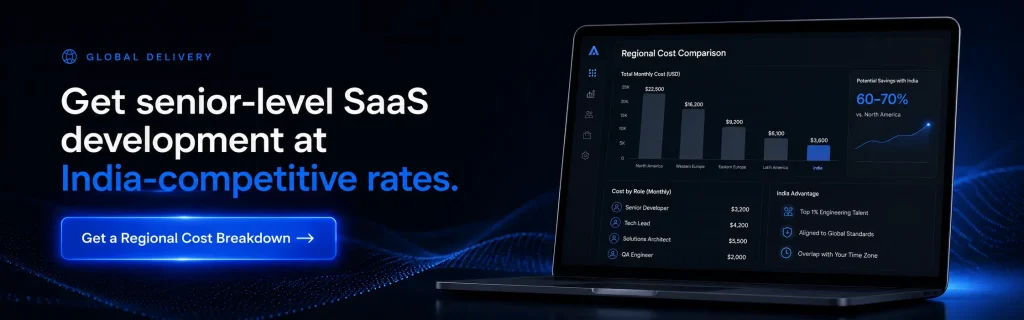
SaaS development costs 2026 vary by 4–5x depending on where your team is located the same MVP that costs $150,000 with a US agency can be built for $25,000–$40,000 with a senior Indian development firm.
Region affects both hourly rates and quality perception and the gap between “cheapest” and “best value” is not the same thing.
| Region | Junior ($/hr) | Mid-Level ($/hr) | Senior ($/hr) | Typical MVP Cost | Best For |
| USA / Canada | $100 – $150 | $150 – $200 | $175 – $250 | $80,000 – $200,000 | High-compliance, regulated industries |
| Western Europe (UK, Germany) | $80 – $120 | $120 – $175 | $150 – $220 | $70,000 – $180,000 | EU-based products needing GDPR expertise |
| Eastern Europe (Poland, Ukraine, Romania) | $20 – $35 | $35 – $60 | $55 – $100 | $30,000 – $80,000 | Strong tech talent, EU timezone overlap |
| Latin America (Brazil, Mexico, Colombia) | $25 – $40 | $40 – $70 | $60 – $110 | $25,000 – $70,000 | US nearshore, low timezone gap |
| India (Senior Agency — e.g. AleaIT) | $25 – $45 | $45 – $70 | $65 – $80 | $15,000 – $50,000 | Best value for quality, 21+ yr ecosystem |
| Southeast Asia (Philippines, Vietnam) | $15 – $25 | $25 – $45 | $40 – $70 | $10,000 – $35,000 | Budget builds, quality varies widely |
The top 10% of Indian agencies deliver the same output as mid-tier US firms at 30-40% of the cost the bottom 10% can cost more in rework than they save. Verify Clutch ratings, client references, and SaaS-specific delivery history before signing any contract.
The hidden cost of timezone gap is real: a US founder working with a Southeast Asia team with zero schedule overlap loses 2 to 4 hours of productive communication daily. Factor this into your total project cost not just the hourly rate.
For most startups and SMEs, an established India-based agency with senior developers and a proven SaaS delivery track record offers the best risk-adjusted value in 2026.
AI SaaS Development Cost: How 2026 Changes Everything
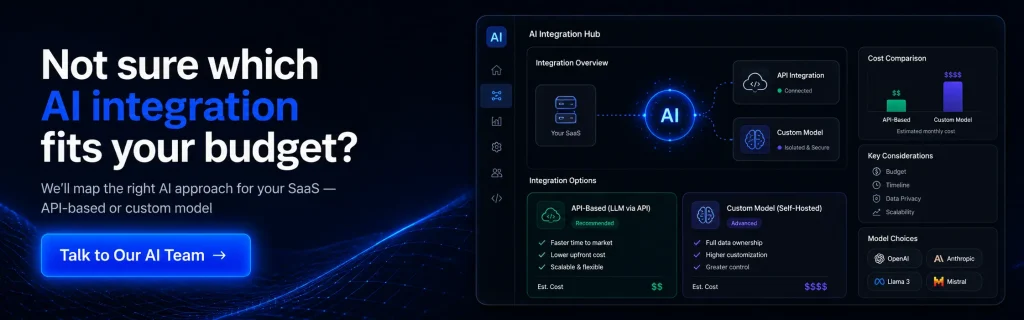
AI SaaS development cost 2026 splits into two fundamentally different categories: API-based AI integration and custom ML model development. Confusing the two is one of the most common scoping mistakes founders make.
1. API-based AI (OpenAI, Anthropic Claude, Google Gemini):
This is the fastest path to AI features and the right choice for 90% of SaaS products. Upfront development cost to integrate an LLM API is low ($5,000–$20,000 depending on complexity).
Ongoing cost comes from API usage fees: typically $500–$5,000/month at early scale, rising with usage volume. This covers features like AI-powered search, document summarisation, chatbots, content generation, and recommendation text.
2. Custom ML model training:
Only relevant when your product needs a proprietary model trained on your own data fraud detection, medical image analysis, demand forecasting.
This adds $50,000–$150,000 upfront for data preparation, model training, validation, and deployment infrastructure. GPU inference costs for serving custom models run $2,000–$20,000/month depending on model size and request volume.
3. AI development acceleration:
AI coding tools Cursor, Claude Code, GitHub Copilot now reduce SaaS build time by 40–60% for experienced development teams. This means an MVP that would have taken 12 weeks in 2023 can ship in 7–8 weeks in 2026 with AI-augmented development.
AleaIT’s engineering team uses AI-accelerated workflows as standard, passing the time savings to clients. As an AI development company, we integrate GenAI from MVP stage rather than retrofitting it post-launch.
Gartner projects that 80% of enterprises will deploy GenAI-enabled applications by end of 2026 meaning AI integration is rapidly shifting from differentiator to baseline expectation.
SaaS Cost by Industry: FinTech, HealthTech, and EdTech
Industry context significantly affects SaaS product development cost. Compliance requirements, integration complexity, and regulatory audit costs add 20–50% on top of baseline development cost in regulated verticals.
| Industry | Additional Cost % | Key Compliance | Typical Range (MVP) |
| FinTech | +20–40% | PCI-DSS, AML/KYC | $20,000 – $55,000 |
| HealthTech | +30–50% | HIPAA, GDPR, HL7 FHIR | $22,000 – $60,000 |
| EdTech | +5–15% | COPPA (if applicable) | $16,000 – $46,000 |
| General B2B SaaS | Baseline | GDPR (EU users) | $15,000 – $40,000 |
1. FinTech SaaS
his industry adds 20 to 40% to baseline cost. PCI-DSS compliance for card data handling, payment gateway integration (Stripe, Braintree, Adyen), fraud detection layers, and AML/KYC workflows all require specialised development and legal review.
When estimating FinTech app development cost, it’s important to scope full PCI-DSS readiness from day one—retrofitting compliance later is always more expensive.
2. HealthTech SaaS
It adds 30 to 50% to baseline cost. HIPAA compliance (US) or NHS Digital standards (UK) require encrypted data storage and transmission, detailed audit trails, Business Associate Agreements with all third-party vendors, and user access logging.
EHR integrations (HL7 FHIR) add further specialisation cost. HealthTech software development demands developers who understand clinical workflows, not just code.
3. EdTech SaaS
This industry typically carries lower compliance overhead, making it the most accessible vertical for bootstrapped founders.
Primary cost drivers are video streaming infrastructure (AWS MediaConvert, Mux), LMS feature complexity (assignments, progress tracking, certificates), and gamification mechanics. COPPA compliance is required if serving users under 13 in the US.
Hidden and Ongoing Costs After Launch: What Nobody Tells You
The build cost is a one-time investment. Ongoing costs are permanent and compound. Before you launch, budget for the following monthly operational expenses they are the true measure of your SaaS runway.
|
Cost Category |
Monthly Range |
| Cloud infrastructure (AWS/GCP/Azure) | $50 – $500+ |
| Third-party APIs and integrations | $100 – $1,000 |
| Monitoring and alerting (Datadog, Sentry) | $30 – $300 |
| Security and compliance audits (annual) | $500 – $5,000/yr |
| Customer support tooling (Intercom, Zendesk) | $50 – $500 |
| Marketing, SEO, and content | $500 – $5,000 |
| Total monthly ops (early stage) | $1,230 – $12,300 |
Two rules to internalise before launch:
Annual maintenance = 15–25% of initial build cost. A $50,000 SaaS product will require $7,500–$12,500/year in ongoing maintenance, security patches, dependency updates, and minor feature work. Budget this from Day 1.
You need to reach $1,000–$7,500 MRR just to cover operating costs before paying a single team member. Cloud infrastructure cost escalates non-linearly as user volume grows plan for it.
GDPR compliance cost and SOC 2 certification cost audits, when required, typically add $15,000–$50,000 in first-year compliance spend.
SaaS Development Timeline: From Idea to Launch
How long does it take to build a SaaS product? The honest answer: it depends on scope, team size, and whether AI-accelerated tooling is used. Here are realistic timelines.
| Tier | Standard Timeline | AI-Accelerated Timeline | Key Milestone |
| MVP SaaS | 6–12 weeks | 4–8 weeks | First paying user |
| Mid-Scale SaaS | 3–6 months | 2–4 months | Market launch |
| Enterprise SaaS | 6–12 months | 5–9 months | Enterprise contracts |
AI coding tools reduce build time by 30 to 40% for experienced teams. The caveat: AI acceleration works best when the architecture and product decisions are locked before development starts. A vague brief with a Cursor subscription does not equal a faster product it equals faster chaos.
How to Reduce SaaS Development Costs Without Cutting Corners
Cost reduction and quality are not opposites they are alignment problems. The following strategies reduce spend without compromising the integrity of your build.
Start with an MVP, not a full product. Ship the smallest thing that validates your core assumption. Every feature added before validation is a gamble, not an investment.
Use AI coding tools to accelerate development. Claude Code, Cursor, and GitHub Copilot are standard in any cost-competitive development workflow in 2026. Insist your agency uses them.
Partner with a senior India-based agency rather than the cheapest freelancer. The output gap between the two is large; the price gap is often smaller than it appears once rework is factored in.
Do a structured discovery phase before writing code. A one-week discovery sprint defining your feature set, data model, and architecture costs $2,000–$5,000 and routinely saves $15,000 to 40,000 in scope changes during development.
Use battle-tested SaaS boilerplate for auth, billing, and multi-tenancy. Building these from scratch in 2026 is unnecessary. Tools like Clerk, Stripe, and established starter kits handle the plumbing so your team can focus on your actual product differentiation.
Working with a senior development partner who provides a fixed-scope estimate upfront is the most reliable way to keep your custom SaaS development cost predictable from discovery through launch.
How AleaIT Solutions Helps You Build a SaaS Product
AleaIT Solutions has built 500+ software products across 21 years including SaaS platforms for startups and enterprises across the UK, Singapore, and the US. Here is how the process actually works.
Our SaaS Development Process: From Idea to Launch
Step 1: Discovery and Scoping:
We begin with a structured discovery sprint to define your core feature set, architecture, and cost estimate before writing a single line of code.
This eliminates scope creep, the number one reason SaaS projects exceed budget. You receive a detailed specification document, architecture diagram, and itemised cost breakdown at the end of the discovery phase.
Step 2: Architecture and Tech Stack Selection:
Our senior architects recommend the right stack for your SaaS type multi-tenant, cloud-native, AI-integrated, or compliance-ready.
We never over-engineer an MVP. If you need a simple, fast-to-market product, we build simple and fast. If you need enterprise-grade scalability from day one, we architect for it.
Step 3: Agile Build (MVP First):
We ship a working MVP in 6 to10 weeks. Real users, real feedback, real iteration before you invest in full-scale development. Every sprint produces releasable software. You see progress weekly, not at the end of a three-month engagement.
Step 4 AI Integration (Where It Adds Value):
For SaaS products that need intelligence recommendation engines, workflow automation, NLP document processing, or generative features our AI team integrates LLM APIs or builds custom ML pipelines based on your budget and use case.
We do not add AI for the sake of a pitch deck; we add it where it directly improves user outcomes or product defensibility.
Step 5: Launch, Scale, and Maintain:
Post-launch, we handle cloud infrastructure, ongoing feature development, performance monitoring, and security on a retainer model that fits your growth stage. As you scale from 100 to 10,000 users, we ensure your architecture scales with you.
Why Founders and Enterprises Choose AleaIT
- 21 years of software delivery experience (founded 2004)
- 4.9/5 rating on Clutch verified by 50+ client reviews
- Offices in Jaipur (India), UK, and Singapore timezone coverage across US, Europe, and Asia
- Senior-level team at India-competitive rates ($25–$75/hr) not junior outsourcing
- Delivered custom SaaS development services for FinTech, HealthTech, EdTech, ERP, and logistics verticals
- AI-first development practice GenAI integration available from MVP stage
Conclusion
The right SaaS development cost depends on your stage, team model, and ambition. An MVP built with a senior India-based team can launch for $15,000–$40,000.
For founders and enterprises choosing software development outsourcing India, the math is clear: senior-level output at 30 to 40% of Western agency rates, delivered by teams with 20+ years of ecosystem maturity.
A compliance-ready enterprise platform for FinTech or HealthTech can reach $500,000+. In between lies a wide range of viable, fundable, and profitable SaaS businesses built by founders who scoped clearly, chose their team wisely, and shipped fast.
AleaIT Solutions has delivered 500+ software products over 21 years, with a 4.9/5 Clutch rating. Whether you are validating an MVP idea or scaling an enterprise SaaS platform, our team gives you senior expertise at India-competitive rates with full transparency on cost and timeline from Day 1.
Frequently Asked Questions
Building a SaaS product in 2026 costs between $15,000 and $500,000+. An MVP with core features costs $15,000–$40,000, a mid-scale competitive product runs $40,000–$150,000, and a full enterprise platform with compliance and multi-tenancy costs $150,000–$500,000+. Region, team type, and AI integration significantly affect the final number.
The cost to build a SaaS MVP is typically $15,000–$40,000 and takes 6–12 weeks. This covers user authentication, one core workflow, Stripe billing, a basic dashboard, and a landing page. With an India-based senior development team and AI-accelerated tooling, the same scope can be delivered in 4–8 weeks.
Many founders ask how much does it cost to build a SaaS product on a tight budget the answer is $15,000–$25,000 when you combine India-based senior agency outsourcing with AI-accelerated development tools. A well-scoped MVP with a team like AleaIT using Cursor, Claude Code, and proven SaaS boilerplate for auth and billing can ship in 6–8 weeks without sacrificing code quality or scalability.
A SaaS MVP takes 6–12 weeks, a mid-scale product takes 3–6 months, and an enterprise platform takes 6–12 months. With AI-accelerated development, these timelines compress by 30–40%. The biggest timeline variable is scope clarity a well-defined discovery phase before development is the single greatest accelerant.
Five factors drive SaaS development cost: (1) feature scope and complexity, (2) team type and location, (3) technology stack choices, (4) multi-tenant architecture requirements, and (5) compliance needs such as HIPAA, GDPR, or SOC 2. AI integration is the emerging sixth factor, adding $500–$150,000+ depending on the approach.
Yes, significantly. Senior Indian developers cost $40–$80/hr versus $175–$250/hr in the US. The same MVP that costs $80,000–$150,000 with a US agency typically costs $15,000–$40,000 with a top-tier Indian firm. The key is choosing a senior agency with verified reviews, not the cheapest marketplace freelancer.
Latest Updates