Key Takeaways
- AI is already automating real parts of US tax work document extraction, error detection, tax research, and predictive planning not just answering questions, but doing the work.
- The US tax management software market is growing fast through the early 2030s, driven largely by AI adoption, not just digitization.
- AI can’t replace a CPA’s judgment yet — it’s best at structured, high-volume tasks, and still carries real risks around hallucination, data security, and edge cases.
- Building AI tax software means combining document AI (OCR/LLM extraction), a tax-logic rules engine, and compliance-grade data security not just plugging in a chatbot.
- Cost to build varies a lot by scope: a single extraction module and a full agentic tax-research platform are completely different builds.
- Businesses with specific workflows or a product to bring to market increasingly need custom-built AI tax tools rather than off-the-shelf software.
Tax season in the US used to mean stacks of paper, manual cross-checks, and an accountant squinting at spreadsheets until midnight. In 2026, it increasingly means software that reads a W-2 in seconds, flags a missing form before it turns into an audit risk, and answers a tax-code question the way a senior associate would instantly, in plain English.
That shift is what this article is about: how AI in US taxation is actually changing day-to-day workflows, not the hype-cycle version you’ve probably already read. We’ll cover where AI tax software 2026 is delivering real results, where it still falls short, and what a build actually involves if you’re weighing the decision.
The market forces driving the shift, five use cases already in production, the risks worth taking seriously before you trust an AI tool with sensitive financial data, and a practical breakdown of what it takes to build AI tax software from the ground up.
Why US Taxation Is Ripe for an AI Overhaul Right Now
US tax law is one of the messiest data problems in business. Between federal, state, and local rules each changing on its own schedule, each generating mountains of unstructured documents it’s exactly the kind of problem pattern-recognition software is built for.
The market is already moving on this. The global tax management software market is on track to grow from roughly $27 billion in 2026 to more than $44 billion by 2030 a compound annual growth rate above 13% with demand for AI-enabled tax analytics cited as one of the primary drivers. That’s not a niche trend. It’s a category being rebuilt from the inside.
Traditional, rule-based tax software has hit a ceiling. It’s excellent at calculating a known scenario but falls apart the moment it hits something nobody explicitly programmed for: a scanned receipt with handwriting on it, a client’s plain-language question, an edge case that doesn’t map cleanly to a single tax-code section.
AI tax software handles exactly that kind of ambiguity reading unstructured documents, interpreting intent, adapting to scenarios no developer anticipated in advance. That’s the real story behind AI transforming US tax right now: it’s not replacing the rules engine underneath every tax platform, it’s filling the gap that rules engine was never built to cover.
For anyone building or buying in this space, that gap is the opportunity. The firms and products gaining ground over the next few years won’t be the ones with the flashiest AI marketing they’ll be the ones that figured out, concretely, which part of the workflow AI should own and which part still needs a person.
Where AI Is Already Changing Tax Workflows – Real Use Cases
1. Document & Data Extraction
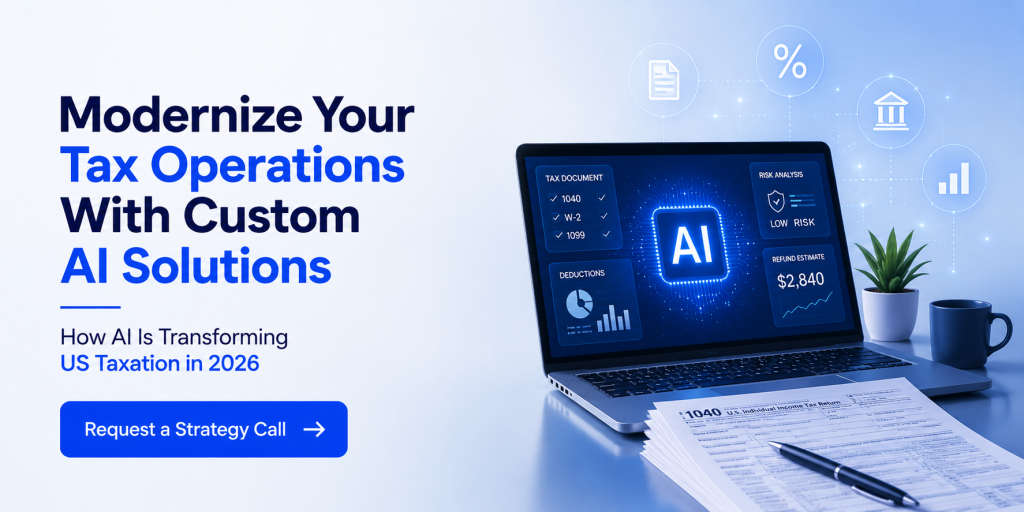
AI now reads W-2s, 1099s, receipts, and prior-year returns, then auto-populates the data instead of someone typing it in by hand. It’s one of the most mature, lower-risk AI applications in tax today, combining OCR with LLM-based extraction to handle messy, real-world documents — not just clean digital forms. It’s the same kind of document-AI pipeline AleaIT has built for clients processing high volumes of structured and unstructured records.
2. Tax Research & Interpretation
This is where agentic AI in tax gets genuinely useful. Instead of a static keyword search, an agentic AI tax research tool can clarify what you’re actually asking, pull the relevant code sections and precedent, and reason through how they apply to your specific scenario in minutes, not hours.
Firms exploring this kind of capability are typically looking at agentic AI development services built specifically for multi-step reasoning tasks like this, not a simple chatbot wrapper.
3. Error Detection & Return Review
Before a return ever gets filed, AI models can flag inconsistencies a missing form, a deduction pattern that doesn’t match prior years, a combination of factors that tends to correlate with audit risk. This is pattern-matching at a scale no single reviewer can replicate across every return that crosses their desk.
4. Predictive Tax Planning
Instead of calculating liability after a decision has already been made, AI can model “what-if” scenarios ahead of time how a transaction, an entity structure, or a filing choice changes the outcome before it happens. That shifts tax from a reactive, after-the-fact calculation into an actual planning tool.
5. Conversational Tax Assistants
Chat-style tools for both consumers and tax professionals are replacing the experience of digging through forms and instruction booklets. Ask a plain-language question, get a plain-language answer, while the underlying research and document lookup happens behind the scenes.
Document extraction and conversational tools, in particular, lean heavily on natural language processing, which is why most teams building in this space end up evaluating generative AI development services early in the planning process.
What’s Holding AI Back in Tax – Risks, Limits & Compliance Realities
AI tax compliance automation isn’t a solved problem, and any article that tells you otherwise is selling something. Being honest about the limits here is what separates a useful guide from vendor marketing copy.
The biggest risk is hallucination an AI tax research tool stating an incorrect answer with total confidence, with nothing in the interface signaling uncertainty. In a regulated field like tax, a confidently wrong citation is worse than no answer at all, because it’s harder to catch before it causes real damage.
Data security is the second major concern. Tax software handles some of the most sensitive financial data a business holds Social Security numbers, full income history, banking details. Any AI tax compliance layer must be designed around that sensitivity from day one, not bolted on after launch as an afterthought.
There’s also a real gap between what AI handles well and what it doesn’t yet. Structured scenarios standard W-2 income, common deductions are largely solved problems at this point. Ambiguous, unstructured scenarios a multi-state business with unusual transactions, a question that depends on facts not present in the document still need a qualified human in the loop.
What It Takes to Build AI Tax Software
If you’ve read this far and you’re thinking “we should build something like this” here’s what that actually involves, without the sales pitch.
1. Core Components of an AI Tax Platform
Every serious AI tax platform needs roughly the same core stack: document ingestion and OCR to handle incoming paperwork, an LLM or machine learning layer to interpret and reason over that data, a rules engine to encode the actual tax-code logic, secure storage built for sensitive financial information, and integration with whatever systems the business already runs on.
That last piece is harder than it sounds most existing tax software in the market is old, and a lot of it simply doesn’t have public APIs, which makes integration one of the most underestimated parts of any plan to build an AI tax filing app.
Teams building the interpretation layer often bring in machine learning development services early, specifically to get the modeling and data pipeline architecture right before writing application code on top of it.
2. Compliance & Security Requirements
This is where a lot of otherwise-solid AI products fail in tax specifically. IRS compliance AI tools need clear audit trails, SOC 2-aligned data handling, and critically explainability: the ability to show why the system flagged a return, recommended a deduction, or surfaced a particular code section.
In a regulated context, “the model said so” isn’t an acceptable answer to give a client or an auditor. Tax compliance AI requirements should be a design constraint from the first sprint, not a feature bolted on right before launch retrofitting audit trails and explainability into a system that wasn’t built for them is consistently more expensive than designing for them up front.
Build vs. Buy and What Realistic Cost Looks Like
Off-the-shelf AI tax tools are genuinely good for general use cases straightforward document extraction, basic research assistance, simple chat support. But the moment a business has a specific workflow, proprietary data, or a product it’s bringing to market, off-the-shelf stops being enough, and custom AI tax software development becomes the more realistic path forward.
AI tax software development cost varies considerably by scope: a single document-extraction module is a very different build from a full agentic research platform with compliance tooling baked into every layer. The honest answer to “how much does this cost” is almost always “what exactly are you building” anyone quoting a number before scoping the work is guessing.
Why This Needs the Right Development Partner
Tax is a regulated, high-stakes domain, and that changes what “the right partner” looks like. It’s not just about general AI experience it’s about teams that have worked inside fintech or other regulated industries, understand explainability and audit requirements firsthand, and have actually shipped agentic systems before, not just chatbot demos.
AleaIT’s work spans custom AI agent development and AI-powered platforms across regulated, high-stakes spaces including AI agents in healthcare, a sector with its own version of the compliance and explainability bar that tax software has to clear.
The Bottom Line
AI in US taxation isn’t about replacing tax expertise it’s about giving tax-focused businesses a way to move faster, serve more clients, and catch what manual review misses, without sacrificing accuracy.
The firms and products winning right now aren’t the ones that bolted AI onto an existing tool; they’re the ones that invested in custom AI tax software development built around what AI actually does well, while staying honest about what still needs a human.
If you’re a CPA firm, fintech founder, or product team thinking about where AI fits into your tax workflow, the next step isn’t a generic AI vendor it’s a conversation about your specific use case, your data, and your compliance requirements. Talk to our AI development team about what’s actually feasible to build, and what it would take to get there.
Frequently Asked Questions
AI is changing tax preparation by automating document extraction, flagging errors before filing, and answering research questions in plain language instead of requiring manual lookup. Tools built on OCR and large language models now read W-2s, 1099s, and receipts directly, cutting manual data entry and catching inconsistencies a person might miss under deadline pressure.
No, AI augments tax professionals rather than replacing them. It handles structured, repetitive work like document extraction and error flagging well, but ambiguous scenarios, judgment calls, and client-specific nuance still require a human preparer. The realistic model in 2026 is AI handling volume so preparers can focus on complex cases and advisory work.
The main risks are hallucination (AI stating an incorrect answer confidently), data security given how sensitive tax information is, and weaker performance on ambiguous or unstructured scenarios compared to straightforward ones. Reputable AI tax compliance tools address these with explainability features, audit trails, and clear human-review checkpoints rather than full automation.
Accuracy and IRS compliance depend entirely on how a specific platform is built, not on whether it uses AI. The systems that hold up are the ones with explainability showing why something was flagged clear audit trails, and secure data handling built in from day one, not added after the fact.
AI tax software development costs typically range from $30,000–$75,000 for a basic MVP, $75,000–$250,000 for a feature-rich platform, and $250,000–$1M+ for an enterprise-grade solution with advanced AI, compliance automation, and complex integrations.
Traditional tax software is rule-based it calculates known scenarios using pre-programmed logic and breaks down outside those rules. AI tax prep tools are adaptive and interpretive they can read unstructured documents, handle ambiguous scenarios, and answer plain-language questions instead of requiring users to navigate rigid forms and fields.