
Key Takeaways
- What it is: courier management software development means building a platform that runs booking, dispatch, tracking, proof of delivery and billing for a courier business.
- Core modules: shipment booking, dispatch and routing, hub and manifest handling, driver app, tracking, proof of delivery, COD and billing, client portals and analytics.
- Cost: from about $15K for a single-workflow custom tool to $150K–$390K for a full platform, plus 15 to 25% a year. Ready-made SaaS starts around $49 a month, and one-time scripts cost about $99–$2,199.
- Build or buy: buy SaaS for standard dispatch; build custom when workflows, billing, branches or branding outgrow products.
- Hidden costs: mapping APIs, messaging, and adding proof of delivery late.
- AI: dispatch, ETA prediction and exception handling work best after enough order volume.
- Next step: map your workflows and volumes first, then choose to buy, extend or build. AleaIT builds custom courier platforms.
Planning to Build Custom Courier Management Software?
Build a scalable platform for shipment tracking, dispatch, delivery and billing.
What Is Courier Management Software, and How Is It Different from a Delivery App or a TMS?
Courier management software is the platform a courier company uses to take bookings, assign and route deliveries, track parcels, confirm delivery and bill customers. It differs from a delivery app, which serves customers, and from a TMS, which plans long-haul freight.
The three products overlap in vocabulary but not in purpose. Each one has different users, a different core job and a different scale of operation.
| Courier management software | Delivery app | TMS (transport management system) | |
| Main users | Dispatchers, branch staff, riders and business clients | Consumers and local merchants | Shippers, freight carriers and planners |
| Core job | Booking, dispatch, tracking, ePOD, COD and billing | Ordering, paying for and following one delivery | Load planning, carrier selection and freight settlement |
| Typical scale | City, regional and national parcel networks | Local, single-merchant or marketplace orders | Long-haul, pallet and truckload moves |
Four terms recur throughout this guide:
- AWB: the unique consignment number on a parcel label that ties every scan to one shipment.
- Hub: a sorting facility where parcels from many pickups are consolidated and routed onward.
- Last mile: the final leg from the local hub or branch to the recipient’s door.
- ePOD: electronic proof of delivery, captured on the driver’s phone as a signature, photo or code.
Buyers also search for courier management system development, which means the same thing: building the booking-to-billing platform rather than configuring someone else’s product.
Because courier management software is organized around parcels, hubs and run sheets, its data model (AWBs, manifests, rate cards) differs from a TMS’s loads and lanes. That difference is the first thing to settle when you scope courier management software development.
Why Do Courier Companies Need Custom Software?
Courier companies need custom software when they run multi-branch or franchise networks, need custom billing or branding, or need integrations that off-the-shelf products do not support. Until then, a ready-made product is usually cheaper and faster.
Most small couriers should start with a product, and the build-or-buy section below says so plainly. Custom courier management software earns its cost only when specific conditions apply.
How Fast Is the Courier Software Market Growing?
Parcel volumes and e-commerce keep pushing couriers to digitize, but published market-size figures differ widely by publisher, region and definition. Any growth number in this guide must therefore carry a named publisher, a date and a scope.
What Triggers a Move to Custom Courier Management Software?
Three triggers usually justify custom courier management software: a network of branches or franchises that products cannot model, billing rules too specific for configurable plans, and integrations with ERP, marketplace or carrier systems that vendors do not support.
- Multi-branch or franchise networks. Each branch needs its own rate cards, permissions, cash settlement and reporting, which most standard plans do not model.
- Custom billing or branding. Contract pricing, slab rates, fuel surcharges and white-labeled tracking pages often exceed what configurable products allow.
- Unsupported integrations. Your ERP, a marketplace or a regional carrier may have no connector in the product you are evaluating.
If none of these apply, last-mile delivery software from a vendor is usually the faster, cheaper route. If one or more apply, compare options in the build-or-buy section.
Core Features and Modules of Courier Management Software
Core modules are shipment booking, dispatch and route planning, hub and manifest handling, delivery run sheets, tracking, proof of delivery, COD and billing, client portals and analytics, connected to e-commerce, payment and carrier APIs.
Courier management software typically covers eight capabilities:
- Booking and bulk booking: single, CSV and API order intake.
- AWB and label generation: unique consignment numbers and printable labels.
- Dispatch and route planning: assigning parcels to riders and sequencing stops.
- Hub, bagging and manifest: consolidating and reconciling parcels between facilities.
- Tracking with ePOD: live status plus a signature, photo or code at handover.
- COD and NDR handling: cash collection, reconciliation and failed-attempt reasons.
- Billing and client accounts: rate cards, invoices and credit terms.
- Analytics and MIS reports: on-time rates, rider productivity and branch performance.
1. Booking, AWB and Label Generation
Booking captures pickups from walk-ins, calls, bulk uploads and e-commerce stores, then issues an AWB and printable label for every parcel so each later scan ties back to one shipment. It also sets service level and charges.
Failure mode: mistyped or duplicate addresses create undeliverable parcels.
Build note: validate addresses at entry and support CSV and API intake from the first release.
2. Courier Dispatch Software: Run Sheets and Rider Assignment
Courier dispatch software groups parcels into routes, assigns each route to a rider or vehicle and produces a delivery run sheet (DRS) that lists stops in order.
Failure mode: when a rider drops out mid-shift, parcels sit unassigned until someone notices.
Build note: let dispatchers reassign by drag and drop while the system resequences stops and refreshes ETAs.
3. Hub, Bagging and Manifest Flow
Hub handling records each parcel as it is scanned into a bag, lists the bag’s contents on a manifest and reconciles that manifest when the bag reaches the next facility. DRS, manifest and bagging records together form the audit trail between pickup and delivery.
Failure mode: a bag arrives short and nobody can say where the parcel left the chain.
Build note: scan at every handoff and flag manifest mismatches automatically.
4. Courier Tracking Software and Proof of Delivery (ePOD)
Courier tracking software records every status change, from picked up to out for delivery to delivered, and shows customers a live tracking page. Proof of delivery (ePOD) confirms handover with a signature, photo or one-time code.
Failure mode: riders closing deliveries without evidence invites disputes.
Build note: design ePOD into the first release, because retrofitting it later touches the driver app, status model and billing.
5. COD and NDR Management
COD handling records cash collected at the door and reconciles it by rider and branch, while NDR handling logs each failed delivery attempt with a reason code so the parcel can be rescheduled or returned.
Failure mode: cash that never reconciles erodes trust between branches and head office.
Build note: agree reason codes and COD and NDR management rules with operations before building screens.
6. Multi-Branch and Franchise Management
Multi-branch management lets head office and each branch or franchise run on one platform, with separate rate cards, user permissions, cash settlement and reports.
Failure mode: a shared data model with no branch boundaries leaks one franchise’s customers or rates to another. Build note: model the branch hierarchy and permissions at the data layer from day one.
7. Billing, Client Portals and Analytics
Billing applies each client’s rate card, surcharges and credit terms to delivered shipments, client portals let business customers book, track and download invoices, and MIS reports show performance by branch and rider.
Failure mode: billing rules hard-coded for one customer break when the next contract differs.
Build note: store rates as configurable data, not code.
Need the Right Features for Your Courier Business?
Identify essential modules for dispatch, routing, tracking and delivery management.
Architecture and Integrations: Dispatch Engine, Tracking, Maps, Payments and Carrier APIs
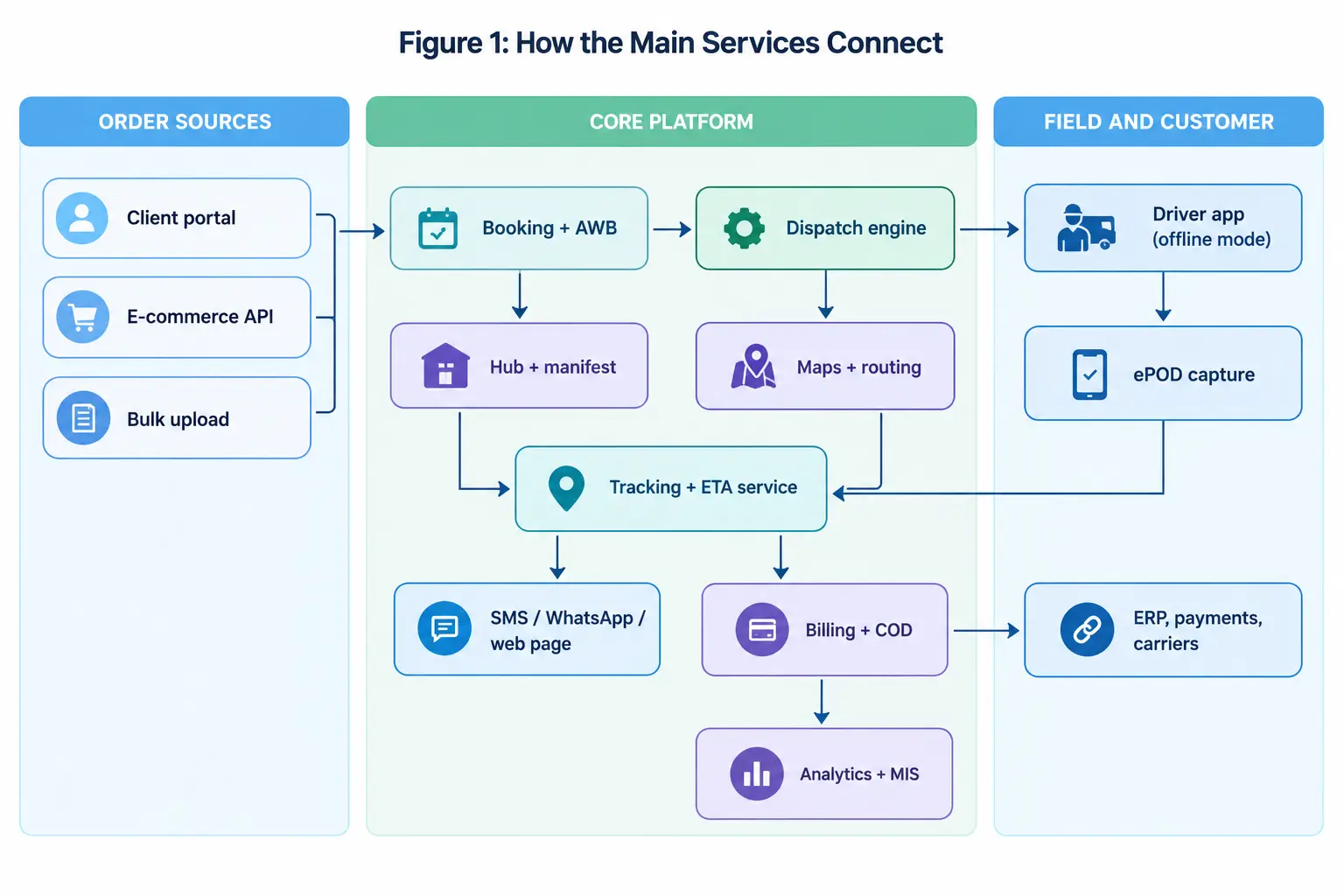
A courier platform receives orders from clients and e-commerce stores, groups them into routes, assigns drivers, tracks each parcel through status updates and confirms delivery with a signature, photo or code.
Figure 1: Reference architecture for a courier platform, from order intake to billing.
Dispatch and Routing Logic
Dispatch logic assigns each parcel to a rider using zones, vehicle capacity, time windows and live location, then sequences the stops. Start with rules and zones, and add optimization only when volumes justify the added complexity.
Route optimization for couriers is a many-stop sequencing problem under time windows, which mapping providers expose through routing and optimization APIs.
Courier dispatch software should keep dispatchers in control: the engine proposes a plan and a person approves or changes it.
Route optimization for couriers pays off most when stops are dense and delivery windows are tight. Last-mile delivery software also depends on accurate geocoding, so address cleaning belongs in this layer.
Tracking and ETA
Tracking converts scan events and driver location pings into customer-facing status and an estimated arrival time. Reliable ETAs depend on clean status events first and prediction second, so build the event model before any machine learning.
Every event should carry a timestamp, a location, an actor and a reason code. Those events then feed customer notifications, merchant webhooks, dispute resolution and billing.
Integrations: E-commerce, Maps, Messaging, Payments, ERP and Carriers
A courier platform typically integrates with e-commerce stores, mapping services, messaging channels, payment gateways, ERP systems and carrier networks. Each integration adds recurring cost and a failure point, so list them all before estimating.
| Integration | Purpose | Watch-out |
| E-commerce APIs (stores and marketplaces) | Pull orders, push tracking updates | Rate limits and changing API versions |
| Maps and routing | Geocoding, routes and ETAs | Per-request fees scale with volume |
| SMS and WhatsApp | Customer notifications and OTPs | Per-message fees and template approvals |
| Payments | COD settlement, prepayment, invoice collection | Reconciliation and card-data scope |
| ERP and accounting | Invoices, ledgers, client master data | Field mapping and sync conflicts; see our ERP integration work |
| Carrier APIs | Hand off or rate third-party carriers | Different status codes for each carrier |
Some operators also connect courier aggregator software to compare or book third-party carriers; treat that as one more carrier-API integration rather than a separate product.
Scaling and Offline Driver Mode
Scaling means the platform keeps accepting bookings, scans and location updates on peak days, while offline driver mode lets riders keep scanning and capturing ePOD without signal and sync later. Last-mile delivery software that needs constant connectivity fails in basements and rural routes.
Use queued event ingestion so a spike in scans does not block bookings, define how the driver app resolves conflicts when it syncs, and load-test with peak-day volumes before launch.
How Much Does Courier Management Software Development Cost in 2026?
Courier management software typically costs about $15,000 to $50,000 for a single-workflow custom MVP, $50,000 to $150,000 for a multi-role platform and $150,000 to $390,000 for a full enterprise system, with 15 to 25 percent a year for maintenance.
All figures in this section are published benchmarks, 2026. Treat them as planning ranges, not quotes. Courier management software development cost rises fastest with branches, integrations and billing rules, not with screen count.
Custom Courier Software Development Cost by Features and Modules
Published 2026 benchmarks put a single-workflow MVP at about $15,000 to $50,000 and a full enterprise system at $150,000 to $390,000, with timelines of roughly 3 to 4 months for an MVP and 6 to 14 months for a full platform.
| Tier | Typical cost | Typical timeline | Typical scope |
| Single-workflow MVP | $15,000–$50,000 | About 3–4 months | One workflow, such as booking, dispatch and a driver app for one branch |
| Multi-role platform | $50,000–$150,000 | Within the 6–14 month full-platform range | Admin, branch, rider and client roles, tracking, ePOD and billing |
| Full enterprise system | $150,000–$390,000 | 6–14 months | Multi-branch operations, hubs and manifests, COD, integrations and analytics |
| Yearly maintenance | 15–25% of build cost per year | Ongoing | Fixes, upgrades, monitoring and support |
These ranges describe courier software development cost in general, not a quote from any vendor, AleaIT included.
Factors That Affect Courier Software Development Cost
Quotes for courier software differ because a driver app alone and a full platform are different products, because team rates vary by region, and because integrations, compliance and billing rules change the scope. Compare quotes line by line, not by total.
Ask every vendor the same questions: which user roles are included, which modules, which integrations, who pays third-party API fees, how long post-launch support lasts, and who owns the source code.
Courier Management Software Cost by Module
Published sources vary too much on module-level prices to quote a single figure, so the table below ranks what drives each module’s cost instead. Billing, driver-app and dispatch modules often carry the most business rules.
| Module | What drives cost | Relative cost pressure |
| Booking and AWB | Intake channels, label formats, address validation | Lower |
| Dispatch and routing | Rules versus optimization, reassignment tools | Medium to higher |
| Driver app and offline mode | Offline sync, ePOD methods, device range | Higher |
| Hub, bagging and manifest | Scan points, reconciliation rules | Medium |
| Tracking and notifications | Channels, languages, merchant webhooks | Medium |
| COD and billing | Rate cards, surcharges, cash reconciliation, credit terms | Higher |
| Client portal and analytics | Roles, report variety, exports | Medium |
Ongoing Courier Software Costs: Hosting, Mapping and Messaging
Running costs after launch include mapping API fees, SMS and WhatsApp messaging, cloud hosting and maintenance, which published benchmarks put at 15 to 25 percent of build cost per year. Mapping and messaging fees scale with parcel volume, so model them early.
Each provider publishes its own price list, so check the current pricing pages when you build your estimate. A routing call per route, a geocode per address and a message per status update add up quickly at courier volumes.
Proof of Delivery (ePOD): Costs of Adding It After Launch
Adding proof of delivery after launch costs more than building it first, because signature, photo and code capture touch the driver app, status model, tracking page, dispute workflow and file storage. Plan ePOD in the first release, even if only one method ships.
The fix is cheap at design time: reserve the status events, storage and screens now, and switch on additional capture methods later.
How to Calculate the ROI of Courier Management Software
Payback in months equals build cost divided by monthly net gain, where net gain is labor hours saved, errors avoided and revenue recovered, minus running costs. Use your own measured figures, not industry averages.
- Monthly net gain = (hours saved × loaded hourly cost) + (errors avoided × average cost per error) + revenue recovered − monthly running costs
- Payback (months) = total build cost ÷ monthly net gain
Measure your current baseline for a few weeks before the project starts, so the comparison afterward is honest.
Get a Custom Courier Software Development Estimate
Get a realistic cost and timeline based on your business requirements.
Build vs Buy vs Hybrid: SaaS, Ready-Made Script or Custom Courier Software?
Buy SaaS courier software when you have standard workflows and a small team, since plans start at about $49 a month.
Choose a ready-made script for a fast, low-cost launch, and custom or hybrid when you need multi-branch operations, custom billing, white-labeling or integrations that products can’t support.
The build vs buy courier software decision comes down to how far your workflows sit from a standard dispatch process.
Buying wins more often than most agencies admit: if your team is small, your delivery flow is standard and you can live with a vendor’s billing and branding, a subscription gets you live sooner and costs less upfront than any custom project. Fees scale with usage, though, so check each vendor’s current pricing page on the day you decide.
| Route | Typical cost | Best for | Limits |
| SaaS | From $49/month; task-based plans from about $619/month | Small teams, standard dispatch | Fees scale, limited customization |
| Ready-made script | One-time $99–$2,199 | Quick launch, tight budget | Code you don’t control, limited depth |
| Hybrid (extend a product) | Case by case | Missing one or two modules | Integration limits |
| Custom build | $15K–$390K+ | Multi-branch networks, unique billing, own platform | Highest upfront cost |
- Buy when your delivery flow is standard, your team is small, and a vendor’s billing, branding and reports already match how you work.
- Choose a ready-made script when you need a quick launch on a tight budget and can accept code you do not control.
- Extend a product (hybrid) when only one or two modules are missing, such as a custom invoice format or an ERP sync.
- Build custom courier management software when multi-branch networks, unique billing or your own branded platform are core to the business.
Here is a quick build vs buy courier software test: answer yes or no to five questions.
- Do you run several branches or franchises?
- Do you need billing rules products cannot model?
- Do you need white-labeled tracking or client portals?
- Do you rely on integrations no vendor supports?
- Do you want to own the platform as an asset?
Two or more yes answers suggest pricing a hybrid or custom build alongside SaaS; fewer suggests starting with SaaS.
This is our rule of thumb, not a published benchmark. Whatever you choose, run the build vs buy courier software comparison on total cost over several years, including SaaS fees that scale with usage.
How Is AI Changing Courier Management Software?
AI in courier software improves route planning, predicts delivery times, flags at-risk deliveries and handles routine customer queries, though simple rules often beat machine learning until order volumes are high enough.
AI in courier management is useful where data and volume support it, and the five use cases below are the most practical starting points.
AI dispatch, meaning machine-assisted assignment and sequencing, is the best known, but the others often matter just as much. Each use case pairs a model with a human check, because dispatch decisions affect real customers and real money.
| Use case | Input | Output | Human check |
| Dispatch and route optimization for couriers | Order locations, time windows, rider capacity, live traffic | Proposed assignments and stop sequence | Dispatcher approves or edits the plan |
| ETA prediction | Historical scan events, route, time of day | Predicted arrival window | Operations reviews error by zone |
| At-risk delivery flagging | Delayed scans, failed attempts, address quality | Exception queue with a suggested action | Agent confirms before contacting the customer |
| Customer query handling | Tracking events, policy text, customer message | Draft reply or status summary | Agent reviews unusual cases |
| Address cleaning | Free-text addresses | Structured, geocoded address | Dispatcher confirms low-confidence matches |
Teams that want agents to handle exceptions and queries can start a conversation with an AI agent development company.
Drafted replies and tracking summaries draw on generative AI development services. Whichever route you take, AI in courier management should keep a person in the loop for decisions that affect customers or money.
When Not to Build Machine Learning Yet
Do not build machine learning until you have enough clean order and scan history to train and test it. Rules, zones and time windows are cheaper, easier to debug and often good enough at low volume.
AI in courier management depends on clean, consistent history: accurate scans, reason codes and addresses. Without them, a model guesses with confidence.
Start by logging events well, then add prediction where rules stop working. This guide makes no savings claims for AI in courier management, because published figures vary by operation and none is cited here.
Ready to Automate Your Courier Operations with AI?
Explore AI-powered dispatch, ETA prediction and delivery exception handling.
How to Develop Courier Management Software Step by Step
Develop courier management software in seven steps: workflow mapping, UX design, architecture, MVP build, integrations, load testing, and phased rollout with support. Each step ends with a named deliverable, so you can judge progress without reading code.
- Workflow mapping. Deliverable: workflow maps, roles, volumes and billing rules signed off by operations. Duration: short.
- UX design. Deliverable: clickable prototypes for dispatcher, rider, branch and client roles. Duration: short to medium.
- Architecture. Deliverable: architecture diagram, data model, integration list and security plan. Duration: short.
- MVP build. Deliverable: a working booking-to-delivery slice in a test environment, including ePOD. Duration: the longest step.
- Integrations. Deliverable: e-commerce, maps, messaging, payment and ERP connectors tested against sandbox data. Duration: medium.
- Load testing. Deliverable: a peak-day test report and the fixes it triggers. Duration: short.
- Phased rollout with support. Deliverable: a pilot branch live, trained staff, monitoring and a support plan. Duration: medium, then ongoing.
Published 2026 benchmarks put an MVP at roughly 3 to 4 months overall and a full platform at 6 to 14 months, so ask any vendor for step-level durations in the estimate.
This sequence applies to courier software development of any size, and larger projects repeat steps 4 and 5 by module.
In courier management system development, keep each release small enough to pilot in one branch, because courier software development benefits from early feedback from dispatchers and riders.
That is how to build courier management software in stages rather than in one risky launch. Courier management system development works best as a series of tested releases, each adding a module.
Courier software development stacks vary by team, so treat the table below as examples rather than a recommendation.
Best Technologies for Building Courier Management Software
| Layer | Common options | Note |
| Backend | Node.js, Python or Java | Pick what your team can maintain |
| Database | PostgreSQL with a cache such as Redis | Relational data suits shipments and billing |
| Driver app | Flutter, React Native or native Android | Offline storage and background location matter most |
| Web admin and portals | React or a similar framework | Role-based screens for dispatchers, branches and clients |
| Maps and routing | Google Maps Platform, Mapbox or OpenStreetMap-based services | Compare per-request pricing |
| Messaging | SMS gateways and the WhatsApp Business Platform | Template approvals take time |
| Hosting | AWS, Azure or Google Cloud | Autoscaling for peak days |
Security, Compliance and Regional Requirements
Courier software must protect customer and payment data and support regional rules, such as data-protection laws and local shipping documentation. Requirements differ by country and by what you collect, so confirm them with your compliance team before design is locked.
| Region | Data protection | Payments | Shipping and local items |
| US | State privacy laws, such as California’s CCPA and CPRA | PCI DSS if you store, process or transmit card data | Customs and carrier documents for cross-border parcels |
| UK and EU | UK GDPR and EU GDPR: lawful basis, retention limits, data-subject rights | PCI DSS | Customs documents for cross-border parcels |
| India | Digital Personal Data Protection Act, 2023 | PCI DSS and payment-gateway rules | E-way bills where applicable; COD handling and reconciliation |
Across regions, plan for encryption in transit and at rest, role-based access, audit logs for status changes and cash events, and retention rules. Names, phone numbers, addresses, signatures and ePOD photos are all personal data. This section is general information, not legal advice; consult your compliance team.
Common Mistakes in Courier Software Projects
The most common mistakes are building machine learning too early, adding proof of delivery after launch, ignoring mapping costs, and underestimating billing complexity. Each one is cheaper to avoid at design time than to fix after launch.
- Building machine learning too early. Consequence: months spent on models that simple rules would have matched, trained on thin data. Fix: launch with zones and rules, log clean events, then add prediction.
- Adding proof of delivery (ePOD) after launch. Consequence: rework across the driver app, tracking page, disputes and billing. Fix: design ePOD into the first release.
- Ignoring mapping and messaging costs. Consequence: running costs jump as parcel volume grows. Fix: model per-request and per-message fees in the estimate.
- Underestimating billing complexity. Consequence: hard-coded rates, invoice disputes and manual corrections. Fix: configurable rate cards, tested with real contracts.
- Skipping offline mode and load testing. Consequence: the driver app fails in dead zones and the system stalls on peak days. Fix: an offline-first driver app and a peak-day test.
- Not validating terms with operations. Consequence: modules built around words staff do not use. Fix: a glossary covering DRS, manifest and bagging, and NDR, signed off before design.
How to Choose a Courier Software Development Company
Choose a partner with real-time dispatch and tracking experience, strong integration skills, load-testing practice, clear estimates and post-launch support. Ask for evidence of each, such as a demo, a reference or a sample estimate, rather than a sales deck.
A courier software development company should be able to show working dispatch and tracking, not only screens. Use these eight questions:
- Have you built real-time dispatch and tracking systems, and can you demo one?
- Which integrations (e-commerce, maps, messaging, payments, ERP, carriers) have you delivered?
- How do you handle offline driver apps and sync conflicts?
- What does your load-testing practice look like, and at what volumes have you tested?
- Do your estimates break out modules, roles and integrations, with assumptions listed?
- Who owns the source code, and what does handover look like?
- What post-launch support and maintenance do you offer, and on what terms?
- Will you tell me to buy SaaS if that is the better fit?
If your roadmap includes AI features, you may also want to hire dedicated AI engineers alongside the core delivery team.
AleaIT Courier Management Software Development: How We Build Courier and Logistics Software
AleaIT builds custom logistics platforms, including fleet management, route optimization and tracking, scoped around your workflows, volumes and integrations.
As a courier software development company, we start with workflow mapping, and we will say so if a SaaS product fits you better.
Our approach follows the seven steps above, with estimates broken out by module, role and integration so you can compare them line by line.
Our published logistics and fleet management case study shows how we approach this kind of work; read it as published, since every operation’s requirements and results differ. To see how we work with clients, read why AleaIT.
If you are weighing a custom courier platform, share your workflows and volumes and we will tell you whether to buy, extend or build.
Where to Start Your Courier Software Project
Start by mapping your order sources, volumes, delivery types and billing rules, then decide whether to buy, extend or build before requesting an estimate. That sequence keeps courier management software development grounded in your real operation.
If SaaS covers your workflows, buy it and revisit custom later. If branches, billing or integrations outgrow products, a courier software development company can scope a platform from your workflow maps, with module-level estimates and a phased rollout.

Frequently Asked Questions
The platform a courier business uses for bookings, dispatch, tracking, proof of delivery and billing. It connects customers, branches, hubs and riders in one system, so parcels, cash and invoices can be traced from pickup to payment.
Ready-made SaaS starts around $49 a month, one-time scripts cost about $99–$2,199, and custom builds range from about $15K to $390K or more (published benchmarks, 2026). Courier software development cost then adds 15 to 25 percent a year for maintenance.
Roughly 3 to 4 months for an MVP and 6 to 14 months for a full platform, according to published 2026 benchmarks. Timelines stretch with integrations, branches and billing rules, so ask any vendor for a milestone plan.
Buy for standard workflows and small teams. Build when multi-branch operations, billing logic, white-labeling or integrations outgrow products. A hybrid approach, extending a product, suits teams missing only one or two modules.
Delivery run sheets (DRS) assign parcels to riders, manifests list parcels moving between hubs, and NDRs record failed delivery attempts and their reasons. Confirm the exact wording with your operations team, since terms vary by company.
No. A delivery app serves customers and drivers for individual orders, while this platform runs the whole courier operation across every branch: booking, dispatch, hubs, tracking, ePOD, COD and billing.
Yes, for routing, ETA prediction and exception handling, ideally after you have enough order volume and clean scan history. Until then, zones and rules are cheaper and easier to maintain than machine learning.
Look for dispatch and tracking experience, integration skills, load testing and post-launch support. Ask for demos and references, and prefer a partner who will tell you when buying SaaS is the better choice.


