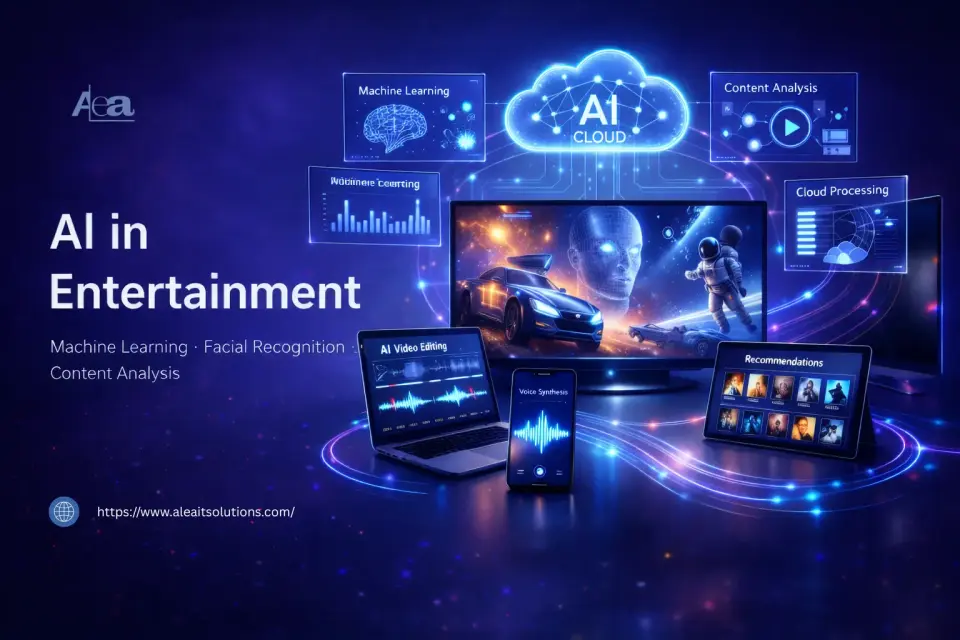
Artificial Intelligence is rapidly reshaping the entertainment ecosystem by enabling smarter content creation, personalized recommendations, immersive gaming experiences, and data-driven audience engagement across media, streaming, and interactive platforms.
AI adoption is accelerating due to its proven impact on scale and efficiency studies indicate that over 70% of streaming platforms rely on AI-based recommendation engines, which can drive 20–30% higher user engagement, while the global AI in media and entertainment market is projected to grow at a CAGR of over 20%, reaching $160+ billion by the early 2030s, as companies invest in automation, personalization, and competitive differentiation.
Below is a more elaborative, well-structured version with a clear introduction followed by detailed explanations of each factor, while maintaining a professional, blog-ready tone.
How AI Is Transforming the Entertainment Industry
Artificial Intelligence is fundamentally reshaping the entertainment industry by introducing intelligent automation, advanced analytics, and personalized experiences across the entire value chain.
From content ideation and production to distribution, marketing, and audience engagement, AI-driven technologies are enabling entertainment companies to move beyond traditional, manual workflows toward scalable, data-driven systems.
This transformation not only improves operational efficiency but also creates new opportunities for creativity, monetization, and competitive differentiation in an increasingly digital and on-demand entertainment landscape.
Key Impact Areas of AI in Entertainment
1. AI-Driven Content Creation
AI-driven content creation leverages machine learning and generative models to assist in writing scripts, composing music, editing videos, and generating digital assets. These tools accelerate creative workflows, reduce production timelines, and allow creators to experiment with new formats and styles while maintaining consistency and quality at scale.
2. Intelligent Recommendation Systems
Recommendation engines use AI algorithms to analyze user behavior, viewing history, preferences, and engagement patterns. By delivering personalized content suggestions, these systems significantly enhance user experience, increase watch time, and improve customer retention across streaming platforms and digital media services.
3. Predictive Audience Analytics
Predictive analytics applies AI to large datasets to forecast audience demand, content performance, and market trends. Entertainment companies use these insights to make informed decisions about content investments, release strategies, and monetization models, reducing risk and maximizing return on investment.
4. AI-Enhanced Visual Effects
AI-enhanced visual effects utilize computer vision and deep learning to automate complex post-production tasks such as scene enhancement, CGI rendering, motion tracking, and image restoration. This reduces manual effort, lowers production costs, and enables high-quality visual storytelling within shorter timeframes.
5. Automated Quality Control
AI-powered quality control systems automatically detect errors in audio, video, subtitles, and metadata. By ensuring compliance with quality standards and platform requirements, AI minimizes human intervention, reduces rework, and ensures a consistent viewing experience across devices and regions.
6. AI-Powered Marketing Optimization
AI enables smarter marketing by analyzing audience data to predict campaign performance, optimize ad placements, and personalize promotional content. This allows entertainment brands to reach the right audience with tailored messaging, improving conversion rates and marketing efficiency.
7. Immersive & Interactive Experiences
In gaming and interactive media, AI drives adaptive storytelling, intelligent non-player characters (NPCs), and real-time personalization. These capabilities create dynamic and immersive experiences that respond to user behavior, increasing engagement and replay value.
8. Smart Production Pipelines
AI streamlines production workflows by optimizing scheduling, resource allocation, budgeting, and collaboration across teams. Smart production pipelines improve operational visibility, reduce delays, and help studios manage complex projects more efficiently.
9. AI-Based Content Security
AI-based security solutions monitor digital content for piracy, copyright infringement, and unauthorized distribution. Using pattern recognition and real-time analysis, these systems help protect intellectual property and revenue streams in an increasingly digital ecosystem.
10. Virtual Influencers & Digital Avatars
Virtual influencers and AI-generated avatars are transforming brand engagement and entertainment marketing. These digital entities can interact with audiences across platforms, deliver consistent brand messaging, and operate continuously without the constraints of human availability.
11. AI-Enabled Event Management
AI supports live and virtual events by analyzing audience behavior, enabling automated moderation, and providing real-time engagement insights. Event organizers use AI to personalize experiences, improve crowd management, and enhance overall event effectiveness.
12. Automated Subtitling & Localization
Natural language processing enables automated subtitling, dubbing, and translation, making content accessible to global audiences. AI-driven localization significantly reduces time and cost while ensuring cultural relevance and linguistic accuracy.
Key Applications and Use Cases of AI in Entertainment
1. AI-Powered Content Creation
AI-powered content creation is transforming how entertainment assets are developed by automating scriptwriting, music composition, and video generation. Advanced ai tools for content creation enable creators to generate story drafts, background scores, trailers, and visual assets more efficiently while preserving creative control.
Additionally, AI-generated characters and virtual influencers are increasingly used in films, games, and marketing campaigns, offering scalable digital personas that engage audiences across platforms.
2. Smart Recommendation Systems
Smart recommendation systems rely on ai content creation insights and behavioral data to personalize content discovery across streaming and digital platforms. By analyzing user preferences, watch history, and interaction patterns, AI-driven engines suggest relevant movies, shows, or games, significantly improving viewer retention, session duration, and overall engagement.
3. Predictive Analytics and Audience Insights
Predictive analytics uses content creation ai models to forecast viewer preferences, content demand, and market trends before production or release. Entertainment companies leverage these insights to design data-driven content strategies, optimize release timing, and reduce financial risk by aligning creative investments with audience expectations.
4. AI in Gaming and Interactive Experiences
In gaming and interactive media, ai generated content enables intelligent non-player characters (NPCs), adaptive storylines, and real-time personalization. AI-driven systems adjust gameplay difficulty, narratives, and environments based on player behavior, creating immersive and responsive experiences that enhance engagement and replay value.
5. Visual Effects, Animation, and Post-Production
AI is redefining post-production through automated editing, scene enhancement, and advanced CGI workflows powered by ai tools for content creation. These technologies accelerate rendering, improve visual accuracy, and reduce manual effort in animation and VFX, allowing studios to achieve cinematic quality at lower cost and shorter timelines.
6. Marketing, Advertising, and Audience Engagement
AI-driven marketing leverages ai content creation to generate personalized promotional assets, optimize ad placements, and tailor messaging for specific audience segments. Sentiment analysis tools further interpret audience feedback across social platforms, helping brands refine campaigns and strengthen audience engagement.
7. Production Management and Operational Automation
Production teams increasingly rely on content creation ai to automate scheduling, resource planning, and workflow optimization. AI also enables automated quality control by detecting audio, video, and metadata inconsistencies, improving operational efficiency while ensuring consistent production standards.
8. Security, Piracy Prevention, and Rights Management
AI-based security systems use ai generated content recognition and pattern analysis to detect piracy, copyright infringement, and fraudulent distribution. These solutions help entertainment companies protect intellectual property, monitor digital channels, and safeguard revenue streams in real time.
9. Localization and Accessibility
Localization workflows are accelerated through ai tools for content creation, enabling automated subtitle generation, dubbing, and multilingual translation. AI-driven localization ensures global content scalability while maintaining linguistic accuracy and cultural relevance for diverse audiences.
10.AI in Events, Concerts, and Live Entertainment
AI enhances live entertainment experiences through ai content creation and analytics that support crowd behavior analysis, experience personalization, and smart event planning. From virtual concerts to large-scale live events, AI enables organizers to optimize logistics, engagement, and real-time decision-making.
Benefits of AI Integration in Entertainment
1. Enhanced Creativity and Innovation
AI empowers creators to explore new storytelling formats, visual styles, and interactive experiences by augmenting human creativity with intelligent automation. Using ai tools for content creation, writers, designers, and producers can rapidly prototype ideas, experiment with narratives, and push creative boundaries without being constrained by time-intensive manual processes.
2. Improved Production Efficiency and Speed
AI significantly accelerates production workflows by automating repetitive and resource-heavy tasks such as editing, rendering, and asset management. Through ai content creation, entertainment companies can reduce production timelines, streamline collaboration, and deliver high-quality content to market faster while maintaining creative consistency.
3. Superior Personalization and User Experience
AI enables entertainment platforms to tailor experiences at an individual level by analyzing user behavior, preferences, and engagement patterns. With content creation ai, platforms can dynamically personalize content recommendations, interfaces, and interactive elements, resulting in more relevant and engaging user experiences.
4. Advanced Analytics and Strategic Insights
AI-driven analytics provide deep insights into audience behavior, content performance, and market trends. By leveraging ai generated content data signals, organizations can make informed strategic decisions around content planning, release strategies, and monetization, reducing uncertainty and improving long-term outcomes.
5. Cost Optimization and Budget Control
AI helps entertainment businesses optimize budgets by reducing manual labor, minimizing rework, and improving resource allocation. The use of ai tools for content creation lowers operational costs across production and post-production while enabling scalable output without proportionally increasing expenses.
6. Higher Audience Engagement and Retention
AI enhances audience engagement by delivering timely, relevant, and immersive experiences across platforms. Through ai content creation, entertainment brands can craft personalized marketing messages, interactive content, and adaptive experiences that strengthen emotional connections and improve audience retention.
7. Consistent Quality Control and Output
AI ensures consistent quality across large volumes of content by automating quality checks and compliance validation. With content creation ai, errors in audio, video, subtitles, and formatting can be detected early, ensuring reliable output standards and a seamless viewing experience across devices and regions.
Future Trends of AI in Entertainment
1. AI-Generated and AI-Assisted Content at Scale
The future of entertainment will be defined by AI-generated and AI-assisted content produced at unprecedented scale. As AI models mature, studios and platforms will increasingly rely on intelligent systems to support scripting, animation, music composition, and post-production.
This evolution will accelerate demand for entertainment app development services., enabling businesses to deliver AI-powered content experiences efficiently across mobile and digital platforms.
2. Virtual Reality (VR) and Augmented Reality (AR) Integration
AI will play a pivotal role in enhancing VR and AR by enabling real-time scene generation, intelligent object behavior, and adaptive user interactions.
Through Custom Mobile App Development Services, entertainment companies will integrate AI-driven VR and AR features into applications, creating immersive experiences for gaming, virtual concerts, interactive media, and digital storytelling.
3. Interactive and Adaptive Storytelling
Interactive storytelling will evolve as AI enables narratives that dynamically adapt to user decisions, preferences, and engagement patterns. AI-driven story engines will support multiple plotlines, responsive characters, and personalized story arcs, transforming passive content consumption into active, immersive participation.
4. Hyper-Personalized Entertainment Experiences
Hyper-personalization will become a core differentiator as AI continuously analyzes user behavior to tailor content recommendations, interfaces, and engagement strategies. From adaptive gameplay and personalized streaming feeds to targeted promotions, AI will enable entertainment platforms to deliver deeply customized experiences that enhance user satisfaction and long-term loyalty.
How Custom AI Solutions Drive Entertainment Excellence
As the entertainment industry becomes increasingly data-driven and experience-centric, off-the-shelf AI tools are often insufficient to meet complex creative and operational demands.
Custom AI solutions enable entertainment organizations to align technology with unique business objectives, content strategies, and audience expectations. By designing AI systems tailored to specific workflows and scale requirements, companies can unlock higher efficiency, innovation, and sustainable competitive advantage.
Role of Tailored AI Platforms and Enterprise AI Adoption
Tailored AI platforms empower entertainment enterprises to integrate intelligence across the entire value chain—from content creation and production to distribution, marketing, and audience engagement.
Custom AI models are trained on proprietary data, ensuring higher accuracy, relevance, and contextual understanding compared to generic solutions. At the enterprise level, AI adoption enables centralized analytics, workflow automation, and seamless interoperability across departments, supporting consistent decision-making and scalable operations while preserving creative flexibility.

Conclusion
Artificial Intelligence is transforming the entertainment industry, revolutionizing how content is created, produced, and consumed. For media and entertainment development companies, AI enhances creativity, speeds up workflows, and improves personalized experiences through data-driven insights.
As AI continues to evolve, entertainment platforms will become more responsive to audience preferences, driving innovation and business value. Companies that invest in scalable, ethical AI will be at the forefront of delivering immersive, impactful experiences in the future of entertainment.
Frequently Asked Questions (FAQs)
-
What is the role of AI in the entertainment industry?
AI plays a critical role in the entertainment industry by enhancing content creation, automating production workflows, enabling personalized recommendations, and providing data-driven audience insights. It helps entertainment companies improve efficiency, creativity, and user engagement across digital platforms.
-
How is AI used in content creation and production?
AI is used in content creation for scriptwriting assistance, music composition, video editing, animation, and visual effects. It also supports automated quality control and post-production optimization, allowing creators to produce high-quality content faster and at scale.
-
Can AI replace human creativity in entertainment?
AI does not replace human creativity but augments it. While AI automates repetitive tasks and provides creative support, human insight, emotion, and storytelling remain essential to producing meaningful and original entertainment experiences.
-
How does AI improve personalization for viewers and users?
AI analyzes user behavior, preferences, and engagement patterns to deliver personalized content recommendations, adaptive interfaces, and tailored experiences. This results in higher user satisfaction, increased engagement, and improved audience retention.
-
What are the ethical concerns of using AI in entertainment?
Key ethical concerns include data privacy, intellectual property ownership, algorithmic bias, and workforce impact. Responsible AI adoption requires transparency, ethical governance, and compliance with data protection and copyright regulations.