Key Takeaways
- AI-powered automation goes beyond rule-based automation by using AI to understand unstructured information, identify patterns, and support judgment-based tasks.
- Knowledge work is increasingly being automated across legal, finance, healthcare, marketing, HR, and education.
- AI and RPA can work together—RPA handles predictable, repetitive processes while AI handles tasks requiring context and interpretation.
- AI automation can improve efficiency, accuracy, decision-making, and cost management, but the actual ROI depends on how well it is implemented.
- Data privacy, security, bias, and workforce disruption remain major challenges businesses need to address.
- Successful AI adoption requires more than technology—businesses also need employee upskilling, governance, compliance, and carefully selected use cases.
- The future of knowledge work is likely to involve greater collaboration between people and AI, rather than automation of every task.
Artificial Intelligence (AI) powered automation is no longer a future concept it’s already running large parts of the modern business. In 2026, the global AI automation market has passed $169 billion, growing at over 31% a year, and 88% of organizations now use AI automation in at least one business function, up from just 55% three years ago.
For knowledge workers the people whose job is to think, decide, and advise rather than assemble or ship that shift is personal. AI is moving into contract review, financial reporting, diagnosis support, and recruiting work that used to require years of training to do well.
This guide breaks down what AI-powered automation actually is, how it’s playing out industry by industry, and what the real trade-offs are not just the upside.
What is AI-Powered Automation in Knowledge Work?
AI-powered automation refers to the use of machine learning, natural language processing (NLP), and related AI technologies to carry out tasks that traditionally required a trained person’s judgment not just their hands.
That’s the key difference from older automation tools. AI-powered systems don’t just execute fixed steps, they can read unstructured information (a contract, a medical scan, a customer email), weigh context, and produce a judgment call or a draft output.
Think AI is making a difference in your work? Take our quick poll
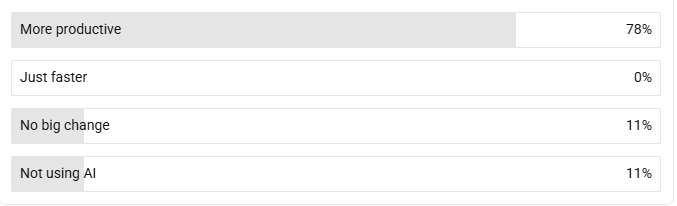
Is AI making you more productive or just faster?
78% said AI is making them more productive, while 11% felt there was no big change. Another 11% said they are not currently using AI, and 0% selected “Just faster.”
These results suggest that for most respondents, AI is going beyond simply speeding up tasks it is helping them improve productivity and accomplish more. At the same time, the responses show that AI adoption and its impact can vary across individuals.
AI-Powered Automation vs. RPA
It’s worth separating this from Robotic Process Automation (RPA), a term people often use interchangeably with AI automation incorrectly.
- RPA follows fixed, rule-based steps: click here, copy this field, paste it there. It’s fast and reliable, but it breaks the moment a process changes.
- AI-powered automation adapts. It can handle variation a contract clause worded differently, an email phrased unusually because it’s reasoning over content, not just executing a script.
Many enterprise platforms now combine both: RPA for the repetitive mechanics, AI for the judgment calls in between.
Key Benefits of AI-Powered Automation
- Increased efficiency – AI handles data entry, scheduling, and document triage, freeing employees for higher-value work.
- Enhanced accuracy – Automated data processing and compliance checks reduce the human-error rate in repetitive judgment tasks.
- Cost savings – Deloitte estimates AI automation delivers 25–50% cost reductions in back-office functions where it’s fully deployed.
- Faster decisions – AI can process large datasets in real time, surfacing insights a human team would take days to compile.
- Better ROI than expected – 84% of organizations investing in AI automation report positive ROI (Deloitte).
Industry Applications of AI-Powered Automation
1. Legal Services
AI equipment can review contracts, perform legal research and reduce the charge for lawyers, generate legal documents. Predictive analytics can also aid in the strategy of the case.
Examples: Legal firms used AI-operated platforms to automate the document review, to save hours of manual work.
2. Marketing and Advertising
AI automates the campaign management, material construction and division of audiences. This can analyze customer data to personalize marketing messages and predict trends.
Example: AI-driven marketing platforms personalize email campaigns based on user behavior and preferences.
3. Finance and Accounting
AI can automate financial reporting, detection of fraud and preparation of tax. It also helps in risk management by analyzing market trends and financial data.
Examples: Banks use AI to detect fraud transactions in real time, enhancing security and customer trusts.
4. Healthcare
The AI-operated automation supports diagnosis, medical imaging analysis and patient record management. This appointment can also streamline administrative functions like scheduling and billing.
Example: AI equipment analyzes medical images to detect early signs of diseases, supporting doctors in diagnosis.
5. Human Resources (HR)
AI automates the recruitment processes, employee onboarding and performance reviews. It also analyzes employee data to predict the turnover and optimize the workforce plan.
Example: AI-operated recruitment platform screen resumes and schedule interviews, rented periodically.
6. Education
The AI creates personal learning experience by analysing the student’s performance and adopting the material accordingly. It also automatically auto matches administrative functions such as grading and scheduling.
Examples: AI-Vacked Learned Learning Platform Tailing Course Material for individual students’ learning style and progress.
Challenges of AI-Powered Automation
While the benefits are important, businesses should solve many challenges:
- Data privacy and security – Feeding AI systems sensitive contracts, financial records, or patient data raises the stakes on security infrastructure significantly.
- Ethical and bias concerns – AI decisions need to be explainable and auditable, particularly in hiring, lending, and healthcare, where a biased output has real consequences for real people.
- Workforce impact – This is the honest part most vendor content skips. Roughly 30% of current work hours are technically automatable today with existing technology (McKinsey), and estimates suggest tens of millions of roles will shift or disappear by 2030 alongside a larger number of new roles created. Both things are happening simultaneously, and pretending otherwise doesn’t serve anyone making a real workforce decision.
Preparing for an AI-Driven Future
Businesses can prepare for AI-powered automation by:
- Invest deliberately, not broadly – match specific AI tools to specific workflow bottlenecks rather than automating for its own sake.
- Upskill your team – the highest-ROI automation programs pair the tool rollout with training on how to work alongside it.
- Build compliance in from the start – data privacy and AI governance requirements are tightening across most regulated industries; retrofitting compliance later is far more expensive.
Conclusion
AI-operated automation is changing knowledge work in industries, driving efficiency, accuracy and innovation. As AI continues to develop, automation -embrace businesses will gain a competitive lead, which will unlock new opportunities for development and success.
Aleait Solutions are here to help your business use AI-operated automation power. Contact us today to detect analog solutions that can run efficiency and innovation in your organization.
Frequently Asked Questions
AI-powered automation uses artificial intelligence technologies such as machine learning and natural language processing to automate tasks that traditionally require human judgment, interpretation, or decision-making.
RPA follows predefined, rule-based instructions to perform repetitive tasks. AI-powered automation can interpret unstructured data, understand context, identify patterns, and adapt its output based on the information it processes. Businesses can also combine RPA and AI within the same workflow.
The main benefits include increased efficiency, improved accuracy, faster decision-making, reduced operational costs, better data processing, and the ability to free employees from repetitive tasks so they can focus on higher-value work.
AI-powered automation is being used across industries including legal services, marketing and advertising, finance and accounting, healthcare, human resources, and education. Applications range from contract analysis and fraud detection to recruitment, medical imaging, personalization, and automated administrative tasks.
AI-powered automation can automate specific tasks performed by knowledge workers, but it does not necessarily replace entire roles. In many cases, AI acts as an assistant that handles information-heavy or repetitive work while people remain responsible for judgment, oversight, strategy, and complex decisions.
Major challenges include data privacy and security, algorithmic bias, regulatory compliance, integration with existing systems, workforce disruption, and the need to train employees to work effectively with AI tools.
Businesses should start by identifying specific workflow bottlenecks, selecting AI solutions that address those problems, training employees, establishing governance and security controls, and measuring the results against clear business objectives.
Yes. Small businesses can use AI automation for tasks such as customer support, document processing, marketing workflows, scheduling, data analysis, and administrative operations. Starting with a focused, high-impact workflow can help demonstrate ROI before expanding automation.
Employees remain important for tasks involving strategic thinking, creativity, relationship management, accountability, and complex decision-making. They also provide oversight and context that AI systems may not reliably handle on their own.
AI-powered automation is expected to become increasingly integrated into knowledge-work processes. Rather than simply eliminating tasks, it is likely to reshape how professionals research, analyze information, make decisions, and collaborate with technology.