Key Takeaways
- Agentic AI is moving beyond code assistance toward autonomous development, testing, debugging, and operational workflows.
- Low-code and no-code development are becoming practical options for internal tools, MVPs, and rapid business application development.
- Edge computing is gaining importance for applications that require low latency, real-time processing, and localized decision-making.
- Cloud-native architecture helps businesses build software that is scalable, flexible, and easier to deploy and maintain.
- Security-by-design through DevSecOps and zero-trust principles is becoming essential for protecting applications throughout the development lifecycle.
- Blockchain is expanding beyond cryptocurrency into areas such as digital identity, smart contracts, supply chains, and secure data exchange.
- Quantum computing remains an emerging technology, but businesses in fields such as finance, healthcare, and cryptography should monitor its development.
- Sustainable software development focuses on improving code and infrastructure efficiency while reducing energy consumption and environmental impact.
- DevOps and CI/CD continue to help development teams release software faster while improving reliability, testing, and collaboration.
- Businesses should prioritize trends based on actual business needs rather than adopting every emerging technology simply because it is gaining attention.
There is nothing to wait for the future, this is something made by you. In 2026, the world of software development is evolving at a breakneck pace, and the innovation-shaped innovation of the industry is pushing businesses to think, operate and grow in a new and exciting manner. If you are not favorable, you are falling back.
This year is ready to be transformed for software development, which introduces ground-breaking methods to create, deploy and maintain applications. This picture: AI writing code, blockchain safe transactions, and quantum computing problems solving problems that once seemed impossible. These are not future fantasies they are trending techniques of 2026 that are re-shaping the landscape.
The numbers back this up. AI is no longer a novelty in the developer’s toolkit it’s the baseline. Roughly 84–90% of developers now use AI coding tools in their day-to-day work, up sharply from the mid-70s just two years ago, and about 51% use them daily. Yet trust hasn’t kept pace with adoption: only around 29–33% of developers say they actually trust AI-generated output, which is why manual review remains standard practice even as AI assists with a growing share of code.
Beyond AI, the edge computing market alone is projected to grow from roughly $21–23 billion in 2025 to well over $28 billion in 2026, on its way toward the hundreds of billions by the early 2030s, while the DevSecOps market is climbing past the $8.5–10.8 billion mark in 2026. The message is consistent across every category: software isn’t just being written faster it’s being built, secured, and scaled in fundamentally new ways.
It is about mastery in progress in 2026. The way we develop software, the way we develop software, with AI-powered coding, edge computing, and speed, efficiency and safety, is set for revolution. To be ahead, it is important to understand how to effectively apply these trends in your business.
Let’s dive into the most important software development trends of 2026. Whether you want to take advantage of AI, integrate blockchain, or adopt durable practices, there are enough opportunities to lead the path.
What Are the Top Software Development Trends in 2026?
The biggest software development trends in 2026 are: agentic AI, low-code/no-code platforms, edge computing, cloud-native architecture, security-by-design (DevSecOps and zero trust), blockchain beyond crypto, early-stage quantum computing, sustainable (“green”) software engineering, 5G-powered AR/VR and real-time apps, and mature DevOps practices built around CI/CD. Together, these trends are pushing teams toward software that’s faster to build, more autonomous to run, and more secure and efficient by default.
Below, each trend is broken down with what’s actually changing, why it matters for your team, and one practical way to act on it.
Agentic AI: From Assistant to Autonomous Operator
AI coding tools have graduated from suggesting the next line of code to planning, executing, and even testing multi-step tasks with minimal supervision. This is the shift from generative AI (which produces content when asked) to agentic AI (which can pursue a goal across several steps, call tools, and course-correct along the way).
For engineering teams, this means:
- AI agents drafting entire features from a spec, not just snippets
- Automated triage and even resolution of routine bugs
- AI handling repetitive operational work admin tasks, ticket routing, first-pass QA freeing developers for harder problems
Pro tip: Don’t bolt agentic AI onto your existing workflow as an afterthought. Redesign the workflow around it decide which decisions still need a human sign-off, and which can run autonomously.
Low-Code/No-Code: Now Built for Serious Applications
Low-code and no-code platforms have shed their “toy app” reputation. They’re increasingly used for real, complex, business-critical systems not just prototypes — because they let teams validate ideas and ship MVPs dramatically faster than hand-coding everything.
This doesn’t replace custom development; it complements it. The pattern that’s winning low-code for internal tools and fast iteration, custom code where performance, security, or differentiation really matter.
Pro tip: Use low-code platforms to pressure-test an idea with real users before committing engineering time to a fully custom build.
Edge Computing: Real-Time Data, Real-World Impact
As IoT devices, autonomous systems, and real-time applications multiply, sending every byte to a central cloud and back is too slow. Edge computing processes data close to its source, cutting latency and easing the load on centralized infrastructure.
Industries feeling this most: healthcare (real-time patient monitoring), finance (fraud detection), manufacturing (predictive maintenance), and autonomous vehicles.
Pro tip: If your application is latency-sensitive, design for “process locally, sync centrally” not the other way around.
Cloud-Native Development: The Future of Scalability
Cloud-country development is set to be a new standard in 2026. Companies are moving away from traditional unbroken applications in favor of architecture of microscopic services which are more agile, scalable and easy to manage. Cloud-country tools such as doors, Kubernetes and server-free computing will dominate.
Why is this change important? Because businesses need to be favorable to change the demands of the scale and market quickly. If you are creating applications in 2026, they should be cloud-industry to ensure flexibility, safety and costs.
Pro Tip: If you want rapid sorrow and better scalability, start changing your application into cloud-country architecture.
Security-by-Design (DevSecOps & Zero Trust)
Security has moved from “final QA step” to a concern baked into every stage of development. Two ideas are driving this:
- DevSecOps – security checks integrated directly into CI/CD pipelines, not bolted on after deployment
- Zero-trust architecture – no user, device, or service is trusted by default, even inside the network perimeter
With AI-powered threat detection now mainstream, teams can catch anomalies faster but that also means attackers have better tools too. Security leaders consistently rank it as one of the top operational concerns going into this year.
Pro tip: Treat security as a design constraint from the first architecture diagram, not a checklist item before launch.
Blockchain: Beyond Crypto
Blockchain technology has developed beyond its cryptocurrency origin and is making significant progress in various industries from supply chain management to healthcare. Its ability to offer transparency, safety and de-centralization makes it a warm trend in 2026.
Including blockchain in your applications can help in creating confidence and reliability with your users, making it ideal for systems that require safe, verification transactions or data exchanges.
Pro Tip: Explore blockchain for cases such as smart contracts, digital identification, and your application for future proofs.
Quantum Computing: Future Tech, Today’s Preparation
However, in its early stages, quantum computing is starting to make a splash. In 2026, further-thinking companies will experiment to deal with problems with quantum algorithms that cannot handle traditional computers. Areas such as cryptography, drug discovery and financial modeling stand to be greatly benefited from quantum computing in future.
Although it is not yet ready for everyday use, developers must be informed about quantum progress to maintain a competitive edge in industries requiring cutting-edge innovation.
Pro Tip: Stay updated on quantum development and when this technique becomes mainstream, be prepared for pivot.
Sustainable Software Development: The Green Coding Movement
As businesses become more environmental-conscious, green coding is emerging as a trend aimed at reducing the environmental impact of technology. To reduce energy consumption to adopt energy-efficient servers by adapting the algorithm, stability will play a major role on how software is developed and deployed.
In 2026, companies will try to reduce their carbon footprints while maintaining performance levels. Developers that understand sustainable coding practices will be in high demand as more companies adopt this environmentally friendly approach.
Pro Tip: Focus on efficiency-cum codes, more adaptation-environment-friendly applications and to reduce energy consumption.
The DevOps Boom: Faster, More Reliable Software
Devops is not just a trend this is a movement that is manufactured and deployed software. In 2026, continuous integration, continuous delivery (CI/CD), and automated tests will be the main components of any modern development process.
Business hugging Devops will enjoy the market, better software quality and streamlined cooperation between better software quality and development teams from time to time.
Pro tip: Integrate devops practices to speed up growth, reduce errors and distribute high quality software more efficiently.
Which Tech Skill Is Hardest to Master?
As software development continues to evolve, developers are expected to master more than just writing code. From building scalable architectures and solving complex bugs to managing deployment and infrastructure, each skill brings its own set of challenges.
We’d love to know what developers and technology professionals think. Take this quick poll and share the tech skill you find most challenging to master.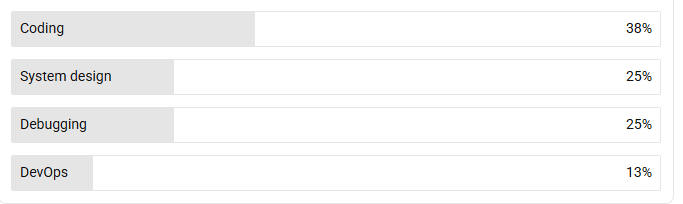
Every tech skill comes with its own challenges. While coding forms the foundation of software development, system design requires a broader understanding of scalability and architecture. Debugging tests problem-solving skills and patience, while DevOps demands expertise across development, deployment, and infrastructure.
There is no single easy path to mastering technology. The skills developers find most challenging often depend on their experience, the complexity of the projects they work on, and the technologies they use every day. That’s why continuous learning and hands-on practice remain essential for staying ahead in the evolving software development landscape.
How to Prioritize These Trends for Your Business
Not every trend deserves equal investment right away. A practical way to prioritize:
- Start with agentic AI and DevOps these deliver the fastest, most measurable productivity gains for most teams.
- Layer in security-by-design early retrofitting security is always more expensive than building it in.
- Adopt cloud-native and edge computing where latency or scale genuinely constrain your product today, not speculatively.
- Treat blockchain and quantum computing as watch-and-prepare items unless your industry has an immediate use case.
- Bake in sustainability metrics as a long-term cost and brand advantage, not a compliance checkbox.
Conclusion: Staying Ahead in 2026
Software development landscape is developing rapidly, and to stay further requires to maintain with state-of-the-art trends such as AI, cloud-country development and cyber security. By embracing these trends, your business can provide innovative, safe and scalable solution.
In Aleait Solutions, we specialize in helping businesses navigate this changing landscape with future proof development strategies.
Want to stay ahead of the curve? Contact Aleait Solutions today and help us convert these trends into powerful, real-world applications that run development and success!
Frequently Asked Questions
The top software development trends in 2026 include agentic AI, low-code/no-code development, edge computing, cloud-native architecture, DevSecOps, zero-trust security, blockchain, quantum computing, sustainable software development, and advanced DevOps practices.
AI is moving beyond code generation and autocomplete. Agentic AI can help developers plan tasks, generate code, run tests, identify bugs, manage workflows, and perform other multi-step development activities with less manual intervention.
No. Low-code and no-code platforms complement traditional development rather than replacing it. They are particularly useful for prototypes, internal applications, workflow automation, and rapidly validating business ideas, while custom development remains important for complex, highly customized, secure, or performance-critical applications.
Edge computing processes data closer to where it is generated instead of sending everything to a centralized cloud. This can reduce latency and improve real-time performance for applications such as IoT, healthcare monitoring, autonomous systems, manufacturing, and real-time analytics.
Cloud-native software development involves designing applications specifically for cloud environments using approaches such as microservices, containers, Kubernetes, serverless computing, and automated deployment. It helps businesses improve scalability, flexibility, and deployment efficiency.