AI Robo-Spider Powers Smart City Surveillance and...
Built an AI-powered hexapod robot that patrols a smart-city model, detects accidents and trapped persons,...
View Case Study

The target environment is an old-age-home / assisted-care facility where nurses and caregivers handle medication rounds, resident check-ins, service requests, and room inspections by hand. The solution was built by Alea and demonstrated in a controlled 13 ft × 20 ft care-home setup with two resident rooms, a nurse station/lobby, a compact medical store, and a charging/dispatch station.
Manual medication delivery, verification, and resident monitoring in assisted-care settings is time-consuming and error-prone. A wrong resident or wrong medicine has real consequences, and every round pulls caregivers away from residents who need them.
The team evolved the Waveshare UGV Rover (Raspberry Pi / ESP32) from a mobile robotic platform into an intelligent resident-care assistant that follows one workflow: Identify → Navigate → Verify → Assist → Record → Alert → Report. The rover is connected to a caregiver web dashboard through a backend API, so every task, alert, and piece of evidence is visible and auditable.
Medication Rounds
Medicine and Resident Identity
Caregiver Alerts
Timestamped Event History
We designed a connected care workflow so nurses can delegate routine rounds to the rover, while every medication event stays verified, recorded, and reviewable in one place.
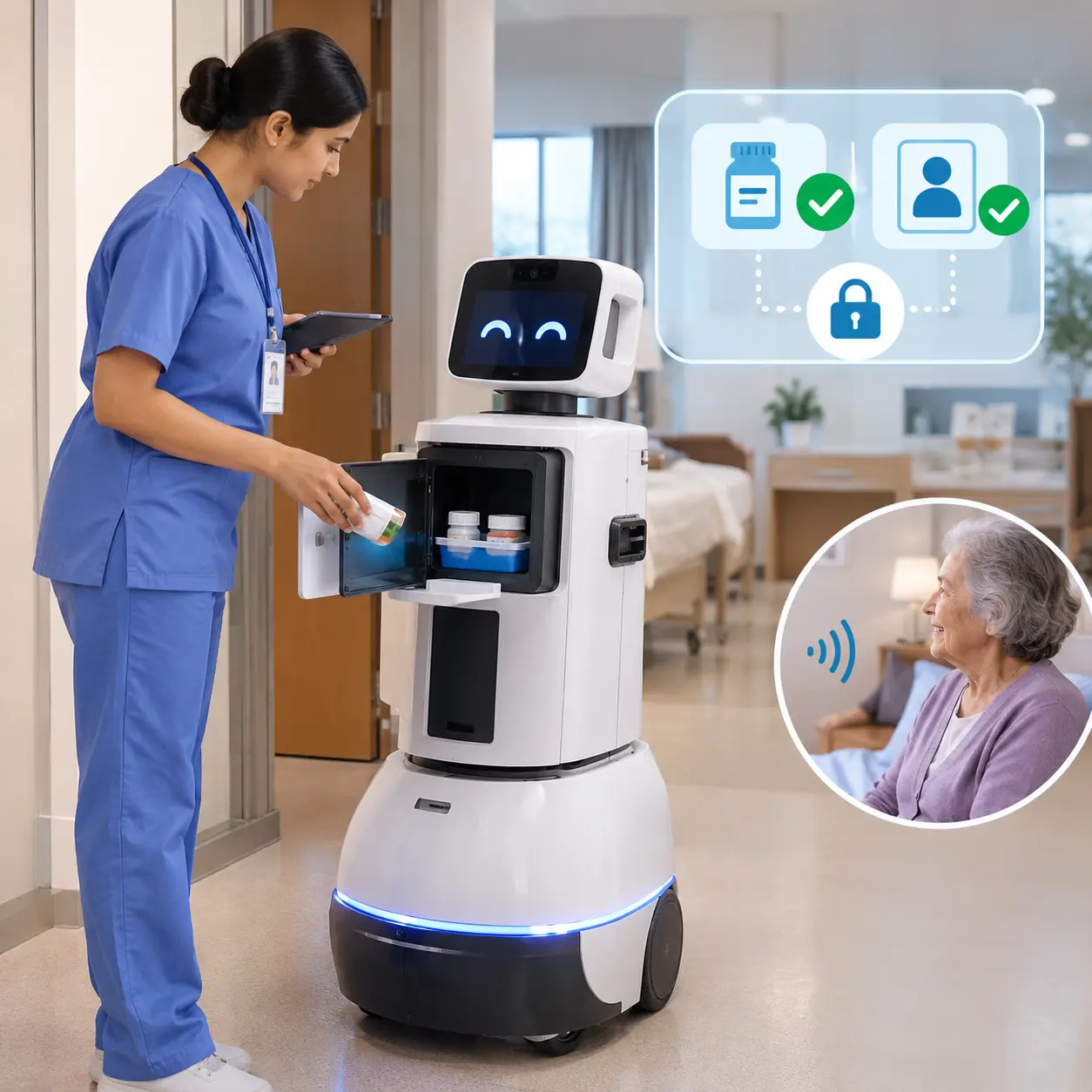
Caregivers create or confirm a medication task, the assigned nurse acknowledges it, and the rover collects and verifies the medication against the task. The secured compartment unlocks only after both medication and resident identity are verified.
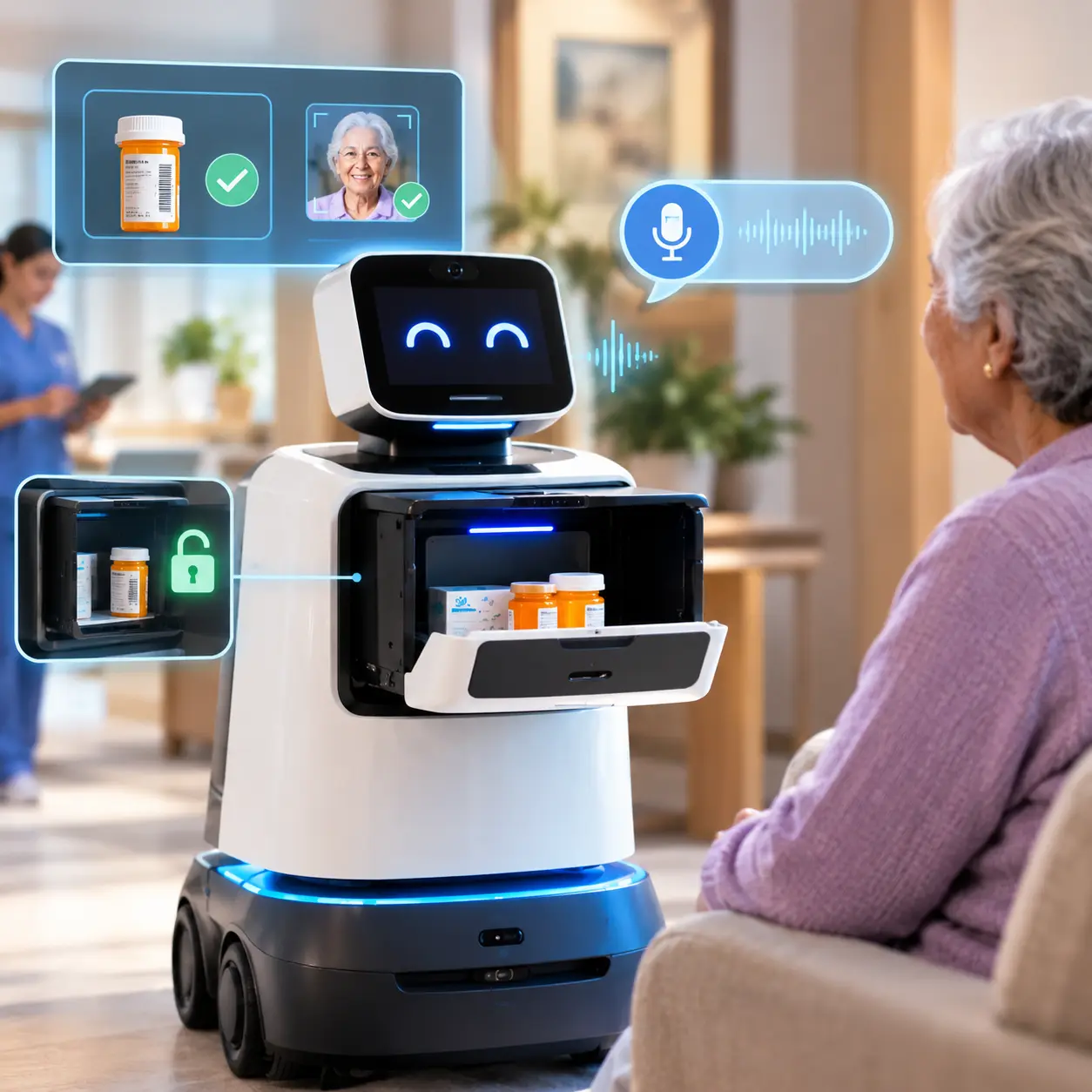
Residents talk to the rover naturally. It answers reminders, basic medication information, and help or service requests using a Whisper → GPT-4o-mini → TTS voice pipeline, with an offline espeak-ng fallback.
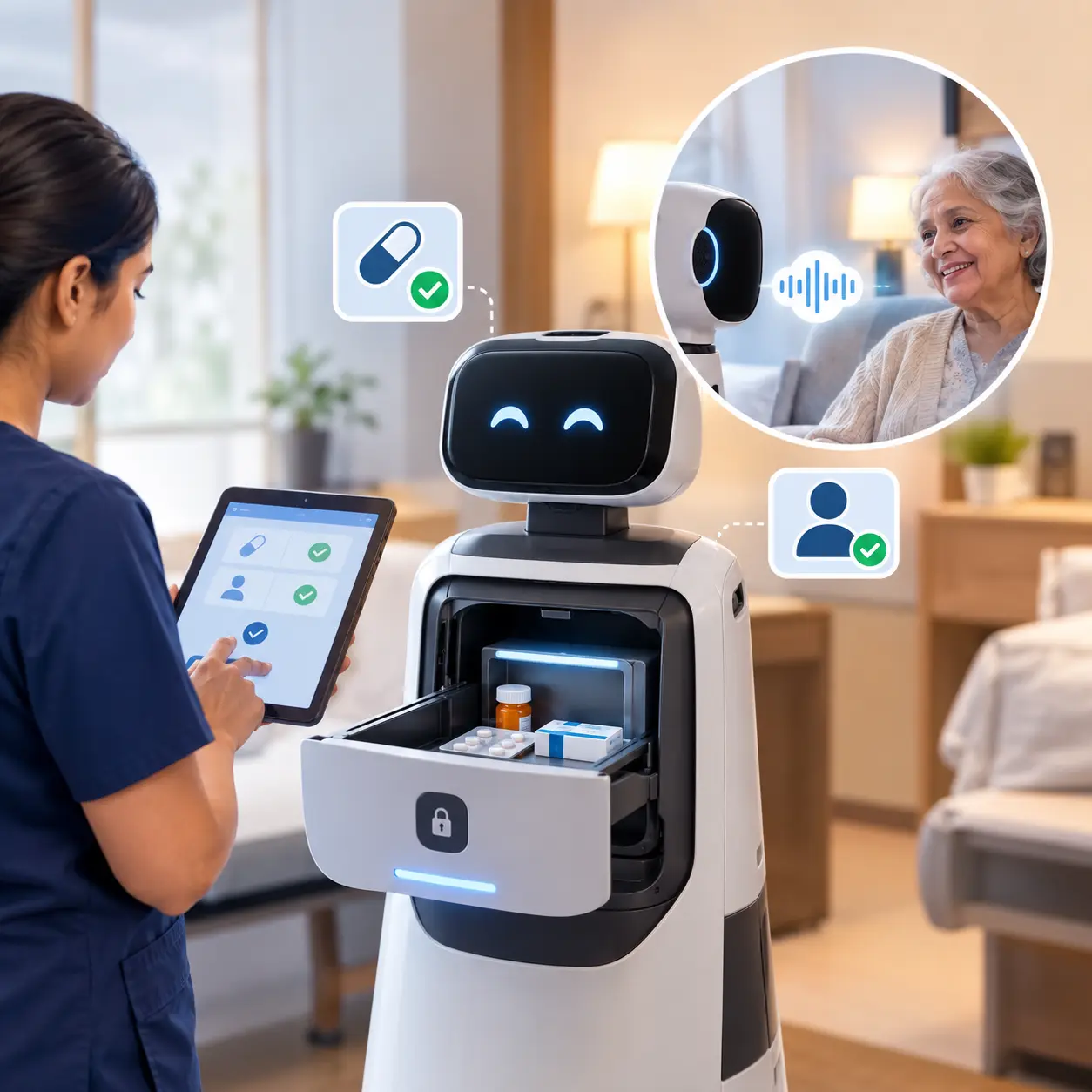
A resident can call for help by voice. The rover raises an alert and notifies the caregiver, and captures photo or short-video evidence for configured events.
The rover travels between the nurse station, medical store, resident rooms, and charging station using Dijkstra shortest-path routing over a waypoint mesh, and supports predefined patrol and room-inspection routes.
Encoder and 6-DOF IMU sensor fusion (Runge-Kutta dead reckoning) tracks the rover’s position against defined room zones. A Three.js 3D digital twin shows it moving through the facility in real time.
A web dashboard shows rover status, battery, location, camera feed, active tasks, alerts, and activity history. It also manages service requests, facility tickets, and daily reports.
Medication is a safety-critical workflow running on a small robot in a tight space. The system had to be deterministic, fail safely, and work without expensive navigation hardware.
Manual verification is error-prone, and a rover that unlocks on a bad match, or on a lost connection, would be worse than no rover.
The medication compartment defaults to locked and fails closed on any verification or communication failure. A patient or medication mismatch keeps it locked, displays a warning, notifies the caregiver, and records an audit event.
The demo rover had no LiDAR or depth localization, yet it had to reach specific rooms reliably inside a 13 ft × 20 ft space.
Built Dijkstra-based waypoint navigation with encoder + IMU sensor fusion for dead-reckoned localization. A zone tracker matches the live (x, y) position against 2D room bounding boxes, so the rover always knows which room it is in.
Robot hardware, AI processing, and caregiver workflows change at different speeds and must not be tangled together.
Adopted a layered architecture: ESP32/Arduino Mega for low-level motor control over serial UART, Raspberry Pi as the integration gateway, a rover-agent that normalizes telemetry and commands, and a Flask + Socket.IO backend feeding the dashboard through REST and real-time updates.
Residents, staff, and visitors share the space with the rover. A software-only stop could be too slow.
Built a dedicated safety guardian: an ultrasonic trigger below 30 cm causes an instant stop reflex within 10 ms, and a 3-second hardware watchdog on the MCU link halts the rover if communication drops. The obstacle event is recorded.
Residents should not need a screen or app to get help from the rover.
Built a microphone-to-speaker voice loop using Whisper-1 for speech-to-text, GPT-4o-mini with dynamic tool calling for reasoning, and OpenAI TTS-1 for speech. Spoken requests such as “Take medicine to Room 101” trigger real navigation.
Caregivers will only delegate medication tasks if they can see what happened and prove it afterwards.
Every important action and state transition is timestamped and recorded. Role-based access, authenticated rover connections, access-controlled evidence storage, and explicit camera-unavailable handling mean the system never falsely claims evidence was captured or a task was completed.
The AI rover transformed routine care operations into a connected, verified, and auditable workflow—helping caregivers automate medication rounds, respond to resident needs, and monitor every task in real time.
Delivered a real-time dashboard covering rover status, live camera, battery, location, tasks, alerts, service requests, and activity history.
Enabled voice-driven navigation across 7 tracked zones, with medication and resident verification, fail-closed delivery, emergency requests, and complete audit logging.
Delivered a production-ready technical foundation covering 28 functional and 10 non-functional requirements, including the API reference, data model, event history, and evidence workflows.
Alea engineered the end-to-end AI robotics solution, integrating autonomous navigation, voice-based AI, safety controls, medication verification, backend intelligence, and real-time caregiver monitoring into one connected care platform.
Built the rover-agent, serial UART link, waypoint navigation, and encoder/IMU localization on the Waveshare UGV platform.
Built the Whisper → GPT-4o-mini → TTS conversational pipeline with tool calling for navigation commands.
Built the Flask + Socket.IO backend, medication task state machine, fail-closed compartment logic, and the audit/event trail.
Built the real-time operations dashboard and the Three.js 3D digital twin.
Hire dedicated developers & shape your business journey with our top-rated website & mobile app development services.