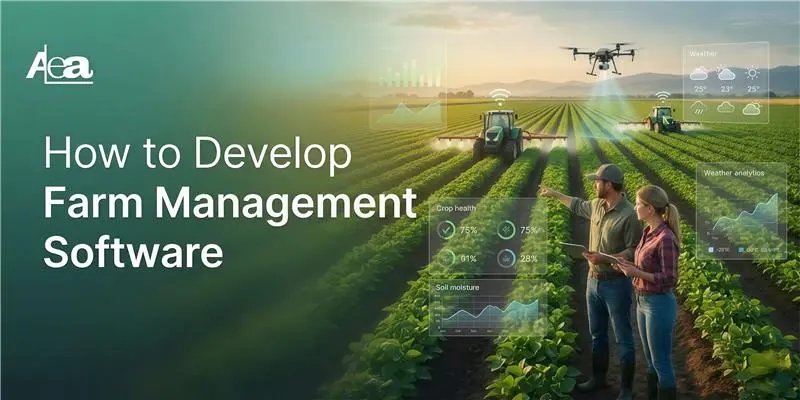
In the rapidly digitizing landscape of 2025, the global Farm Management Software (FMS) market is no longer a niche “future” concept—it is a $4.3 billion powerhouse projected to more than double to $10.6 billion by 2032.
For agribusinesses and AgTech startups, the question is no longer why to build, but how to develop a platform that balances cutting-edge AI with the rugged, practical reality of the field.
Farm management software helps agricultural businesses comply with regulations imposed by authorities such as the USDA, FDA, EPA, FSIS, NPDES, and GHGRP. These regulations govern food safety, environmental impact, livestock tracking, pesticide usage, emissions reporting, and water management.
By automating compliance workflows such as digital record-keeping, traceability logs, chemical usage reports, and audit-ready documentation farms can reduce compliance-related manual work by 30–40%. Centralized reporting also minimizes errors and lowers the risk of penalties, non-compliance notices, or operational delays during inspections.
This guide explores the roadmap to developing high-growth farm management software that meets the demands of modern, data-driven agriculture.
What Is Farm Management Software?
Farm management software is a specialized agriculture software designed to help farmers and agribusinesses efficiently manage, monitor, and optimize daily farming operations.
As a core part of modern agriculture technology, it centralizes key activities such as crop planning, field management, labor scheduling, inventory control, equipment maintenance, and financial tracking within a single digital platform.
In today’s data-driven farming landscape, farm management software plays a critical role in improving productivity, reducing operational costs, and managing risks caused by climate variability and labor shortages.
By leveraging advanced agriculture technology like IoT, analytics, and automation, this agriculture software enables smarter decision-making, regulatory compliance, and sustainable farm management practices.
Market Overview & Industry Trends
The global farm management software market is experiencing robust growth as agriculture embraces digital transformation and agriculture technology solutions across operations.
In 2024, the global market value for farm management software was estimated at around USD 2.7–3.2 billion, and it is projected to grow to over USD 10 billion by the early 2030s, expanding at a strong compound annual growth rate (CAGR) of approximately 11–18% depending on the forecast period.
This growth is driven by the increasing adoption of agriculture software that integrates advanced technologies such as IoT, AI, cloud computing, and real-time analytics to optimize farm planning, resource management, crop performance, labor tracking, and financial operations.
Software development trends show a clear shift toward cloud-based solutions and mobile platforms, with more than 60% of farm software deployments delivered via the cloud, improving accessibility and scalability for farms of all sizes.
In parallel, the broader agriculture software market including precision farming, data analytics, and automation tools is also expanding rapidly.
Types of Farm Management Software
Farm management software is available in multiple forms, each designed to address specific agricultural operations. Modern agriculture software solutions often combine several of these types into a single, integrated platform to improve efficiency and decision-making.
1. Crop & Field Management Software
This type of farm management software helps plan crops, monitor field activities, track soil health, manage irrigation, and analyze yield performance. It supports data-driven crop planning and improves overall farm productivity.
2. Labor Management Software
Labor management tools enable farmers to schedule tasks, track workforce availability, monitor productivity, and manage payroll efficiently. This is especially important for large farms facing labor shortages and rising operational costs.
3. Inventory & Equipment Management Software
This software tracks seeds, fertilizers, pesticides, machinery, and equipment usage. It helps reduce waste, avoid downtime through timely maintenance, and optimize resource utilization across farm operations.
4. Livestock Management Software
Designed for animal farming, this solution manages livestock health records, breeding cycles, feed planning, and performance tracking, ensuring better herd management and compliance with agricultural standards.
5. Farm Accounting & Reporting Software
Also known as agricultural accounting software, this type focuses on expense tracking, budgeting, revenue management, tax reporting, and financial analysis, providing clear visibility into farm profitability.
6. Precision & IoT-Based Farming Software
Powered by advanced agriculture technology, this software uses IoT sensors, GPS, drones, and analytics to enable precision farming. It supports real-time monitoring, predictive insights, and smarter decision-making for sustainable agriculture.
Together, these types form the foundation of scalable and intelligent farm management software, often developed through specialized agriculture software development by a custom software development firms.
Key Features of Farm Management Software
Farm management software powered by modern agriculture technology offers a suite of features that significantly improve efficiency, planning, and profitability across agricultural operations. Many farms implementing these tools report measurable gains in productivity and resource utilization.
1. Crop Planning & Yield Tracking
Advanced crop planning enables farmers to schedule sowing, irrigation, fertilization, and harvesting with precision. Using real‑time data and predictive models, some platforms can improve yield forecasts by up to 20–30%, helping optimize input use and reduce waste.
2. Land, Labor & Inventory Management
Integrated modules for land, labor, and inventory ensure seamless tracking of field activities, workforce allocation, and stock levels of seeds, fertilizers, and other inputs. Farms that use such management features can see inventory waste reduced by around 25% and labor efficiencies improved by 15–25%.
3. Equipment Maintenance
Automated maintenance scheduling and condition tracking help prevent breakdowns and extend machinery life. Predictive alerts based on usage data can cut unexpected downtime by 10–15%, ensuring higher uptime of essential equipment.
4. Financial Tracking & Reporting
Often integrated with agricultural accounting software, these tools provide budgeting, expense tracking, profit analysis, and customizable reports. Real‑time financial insights can improve decision‑making efficiency by 15–25% and streamline audit preparation.
5. Analytics & Dashboards
Interactive dashboards consolidate key performance indicators such as input usage, crop health, yield trends, and financial summaries into visual insights. Farms using visual analytics report up to a 30% improvement in decision‑making efficiency, enabling faster responses to field and market dynamics.
These core features central to farm management software and broader agriculture software development are instrumental for digital transformation in agriculture. Partnering with a custom software development company can help tailor these functionalities to specific farm requirements and scale with business growth.
Benefits of Farm Management Software
Implementing farm management software and other agriculture software solutions brings measurable advantages to modern farming operations, helping agribusinesses leverage agriculture technology for better outcomes.
1. Improved Productivity & Planning
By centralizing crop planning, labor scheduling, and inventory management, farms can increase operational efficiency. Studies show that farms using integrated farm management systems can improve productivity by 20–30%, optimizing the use of land, resources, and manpower.
2. Cost and Labor Optimization
3. Better Risk Management
Farm management software enables monitoring of weather patterns, crop health, pest outbreaks, and financial trends. This predictive capability helps mitigate risks, reducing potential losses by 15–20%.
4. Data-Driven Decisions
Integrated dashboards and analytics provide actionable insights for crop performance, financial planning, and resource allocation. Decision-making speed and accuracy can improve by 30%, allowing farms to respond quickly to changing conditions and market demands.
5. Compliance & Security
As agriculture becomes increasingly digital, compliance and security have become mission-critical components of modern farm management software. Advanced agriculture software not only improves productivity but also ensures farms operate within regulatory frameworks while safeguarding sensitive data generated through agriculture technology.
Technologies Used in Farm Management Software
Modern farm management software is built on advanced agriculture technology that enables smarter, faster, and more efficient farm operations. These technologies help transform traditional farming into a data-driven and scalable system.
1. IoT & Sensors
IoT-enabled sensors play a critical role in real-time farm monitoring. Sensors track soil moisture, temperature, humidity, crop health, equipment usage, and livestock conditions. Farms using IoT-based agriculture software can reduce water usage by 20–30% and improve crop yields by 15–25% through precision irrigation and timely interventions.
2. AI & Predictive Analytics
Artificial Intelligence and predictive analytics help analyze large volumes of agricultural data to forecast crop yields, detect pest outbreaks, optimize fertilizer use, and predict equipment failures. AI-driven farm management software can improve decision accuracy by 30–40%, enabling proactive risk management and higher operational efficiency.
3. Cloud & Mobile Applications
Cloud-based platforms provide scalability, real-time data access, and seamless collaboration across devices. Mobile farm management apps allow farmers to monitor operations, update records, and receive alerts from anywhere.
Cloud adoption in agriculture software has increased by over 60%, enabling cost-effective deployment, secure data storage, and easier system updates.
Read Also: How to Build Property Management Software
How to Develop Farm Management Software
Developing robust and scalable farm management software requires a well-defined, end-to-end development strategy that aligns agricultural workflows with modern agriculture technology. Below is a detailed breakdown of the development process.
1. Requirement Analysis & Planning
This phase focuses on understanding farm size, crop types, livestock operations, compliance requirements, and business objectives.
Stakeholders define core modules such as crop and field management, labor tracking, inventory control, equipment maintenance, and agricultural accounting software integration.
Technical planning includes selecting the right technology stack, defining system architecture, and identifying third-party integrations (IoT devices, sensors, ERP tools). A strong planning phase can reduce development risks and cost overruns by 25–30%.
2. UI/UX Design & Development
User experience is critical for adoption, especially for farmers and field workers. UI/UX design focuses on simple workflows, intuitive dashboards, mobile responsiveness, and multilingual support if required. Well-designed interfaces can improve user engagement by 35–40%.
During development, the system is built using cloud-native architecture, secure APIs, and modular components. Features such as real-time data sync, analytics dashboards, alerts, and automation are implemented to support efficient farm operations.
3. Testing, Deployment & Support
Comprehensive testing ensures software reliability, security, and compliance with agricultural regulations.
This includes functional testing, performance testing, security testing, and integration testing with IoT devices and external systems. Proper QA processes can reduce post-launch defects by 40–50%.
Deployment is typically cloud-based for scalability and remote access, followed by continuous monitoring, regular updates, and long-term technical support.
Ongoing maintenance ensures the farm management software remains secure, compliant, and adaptable to evolving agricultural needs.
Cost of Farm Management Software Development
The cost of developing farm management software depends on multiple technical, functional, and business factors. Whether you choose an MVP or a full-scale enterprise solution significantly impacts the overall investment.
Cost Breakdown by Project Complexity
|
Complexity Tier |
Estimated Cost Range |
|
Basic (MVP) |
$30,000 – $60,000 |
| Mid-Tier (Integrated) |
$60,000 – $150,000 |
| Enterprise (AI-Driven) |
$150,000 – $300,000+ |
Key Features and Their “Price Tags”
The most expensive components are often the “high-tech” modules that provide the highest ROI for B2B clients.
-
-
Offline-First Functionality ($10k – $25k): Essential for remote fields without 5G. This requires complex data synchronization logic once the device returns to a Wi-Fi zone.
-
Precision AI & Machine Learning ($25k – $50k+): Building custom algorithms for pest prediction, yield forecasting, or automated irrigation schedules.
-
IoT & Hardware Integration ($15k – $30k): Developing a “middleware” to connect with various tractor brands (John Deere, Case IH) and third-party soil sensors.
-
GIS & Satellite Mapping ($10k – $20k): Real-time biomass monitoring using NDVI data and field boundary mapping
-
Development Rates by Region (Hourly)
The geographic location of your development team is the biggest variable in your total budget.
|
Region |
Average Hourly Rate (2025) |
|
North America (USA/Canada) |
$120 – $200+ |
|
Western Europe (UK/Germany) |
$100 – $150 |
|
Eastern Europe (Poland/Ukraine) |
$50 – $90 |
| Latin America (Brazil/Mexico) |
$45 – $80 |
| Asia (India/Vietnam) |
$25 – $60 |
Total Cost of Ownership (TCO)
Beyond the initial development, remember to budget for annual recurring costs:
-
Maintenance & Updates: Usually 15–20% of the original development cost per year.
-
Cloud Infrastructure (AWS/Azure): $2,000 – $10,000+ per year depending on data volume.
-
API Fees: Satellite data or weather APIs can cost between $100 and $1,000+ per month.
Conclusion
Building scalable and future-ready farm management software is no longer optional it is essential for modern, data-driven agriculture.
With the adoption of advanced agriculture technology such as IoT, AI, cloud platforms, and analytics, farms can significantly improve productivity, optimize costs, ensure regulatory compliance, and make informed decisions in real time.
A well-designed agriculture software solution should be flexible, secure, and scalable to adapt to changing farming practices, market demands, and regulatory requirements.
By investing in the right agriculture software development approach and partnering with an experienced custom software development company, agribusinesses can develop intelligent farm management systems that support sustainable growth, operational efficiency, and long-term success in the evolving agricultural landscape.
Frequently Asked Questions (FAQs)
-
What is farm management software?
Farm management software is a digital agriculture software solution that helps farmers and agribusinesses manage crop planning, labor, inventory, equipment, livestock, and finances from a single platform. It improves efficiency, productivity, and decision-making through data-driven insights.
-
Why is farm management software important in modern agriculture?
Modern agriculture faces challenges such as rising costs, labor shortages, climate risks, and regulatory compliance. Farm management software uses advanced agriculture technology like IoT, AI, and analytics to optimize operations, reduce risks, and support sustainable farming practices.
-
What types of farms can use farm management software?
Farm management software can be used by small farms, large agribusinesses, livestock farms, dairy farms, precision farms, and commercial agricultural enterprises. Solutions can be customized based on farm size and operations.
- How much does it cost to develop farm management software?
The cost typically ranges from USD 25,000 to USD 120,000+, depending on features, technology stack, integrations, and customization. MVP solutions are more affordable, while enterprise systems cost more.
- What is the difference between MVP and full-scale farm management software?
An MVP includes essential features for quick market validation, while a full-scale solution offers advanced analytics, IoT integration, automation, mobile apps, and scalability for large agricultural operations.
- How long does it take to develop farm management software?
Development timelines vary by scope. An MVP may take 3–4 months, while a full-scale farm management platform may require 6–9 months or more.
- Why choose a custom software development company for farm management software?
A specialized custom software development company ensures tailored solutions, regulatory compliance, scalability, and seamless integration—delivering agriculture software that fits your unique operational needs and long-term goals.