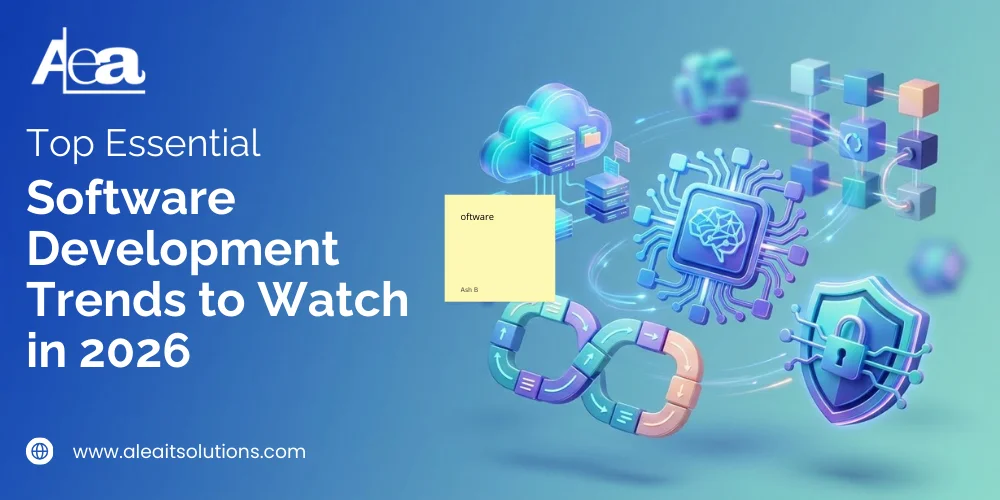
The world of software development is evolving at an unprecedented pace, with new technologies and methodologies transforming the industry. By 2026, the global software development market is expected to reach a value of $1 trillion as businesses across every sector continue to invest in digital transformation. With such rapid growth, understanding the top software development trends will be essential for staying competitive.
From AI-powered development tools and cloud-native solutions to the rise of low-code/no-code platforms, 2026 will bring innovations that will redefine how software is built, deployed, and maintained.
In this post, we’ll dive into the key software development trends to watch for in the coming years and explore how they’re set to reshape the market.
Why Software Development Trends Matter in 2026
Staying updated with software development trends highly used in 2026 is essential for businesses operating in a rapidly evolving digital landscape.
The latest trends in software development directly influence how applications are built, secured, and scaled.
Organizations that understand current software industry trends can make smarter technology investments and avoid long-term technical debt.
Following software development industry trends helps companies improve efficiency, accelerate innovation, and stay competitive. From AI-driven automation to cloud-native architectures, these advancements enable faster time-to-market and better user experiences.
Businesses that adapt early gain a strategic advantage, while those that delay risk falling behind in performance, security, and scalability.
The Growing Importance of Automation in Modern Development
Automation plays a central role in modern development practices. Among the latest trends in software development, automation streamlines testing, deployment, monitoring, and infrastructure management.
This is especially important for delivering software services in demand, such as scalable SaaS and enterprise applications.
Automated CI/CD pipelines reduce human error and ensure consistent releases. By eliminating repetitive tasks, development teams can focus on innovation and quality improvement. Automation also supports faster iterations and improved system stability.
As applications grow more complex, automation becomes essential for maintaining speed, reliability, and cost efficiency.
The Role of Emerging Technologies in Software Innovation
Emerging technologies are shaping modern software industry trends by enabling smarter and more efficient systems. Technologies such as WebAssembly, blockchain, edge computing, and digital twins improve performance, security, and real-time processing.
These innovations allow businesses to test, optimize, and scale applications with greater confidence. Industries like healthcare, fintech, and manufacturing benefit from faster insights and reduced operational risk.
Adopting emerging technologies helps organizations stay innovative and competitive in a fast-changing digital environment.
1. 1. AI-Powered Development Tools: A Game Changer for Developers
Artificial Intelligence is not just a buzzword anymore—it’s revolutionizing the software development process. AI-powered tools and platforms will continue to grow in importance in 2026, offering developers smart code suggestions, error detection, and automated debugging. These innovations are streamlining the development cycle, improving productivity, and reducing manual coding efforts.
For example, GitHub Copilot, powered by OpenAI’s language model, has already shown how AI can assist developers by suggesting code in real-time.
In the future, we expect even more advanced AI assistants that will not only recommend code but help in planning and architecture, making software development more intuitive and efficient.
Why It Matters:
-
Increased Developer Productivity: AI can help developers code faster by offering suggestions and detecting errors before they cause problems.
-
Improved Code Quality: AI-driven tools can spot potential bugs and vulnerabilities, ensuring more secure and reliable software.
-
Smarter Automation: AI can learn from previous projects, enhancing the development process over time.
2. AI Pair Programming & Copilot Tools
AI pair programming is becoming standard practice in 2026. Developers collaborate with AI copilots that assist in writing, reviewing, and optimizing code in real time.
AI copilots support:
- Context-aware code suggestions
- Faster debugging and error fixes
- Learning new frameworks and languages
- Consistent coding standards
These tools act as intelligent teammates rather than simple assistants.
Why it matters: Improves developer efficiency and reduces development time without compromising quality
3. Low-Code/No-Code Development: Empowering Non-Developers
In 2026, low-code/no-code platforms are expected to become a mainstream choice for businesses looking to develop applications without heavy reliance on professional developers.
These platforms enable non-technical users, such as product managers or business analysts, to create software solutions through intuitive drag-and-drop interfaces.
Companies are increasingly using low-code/no-code tools to quickly prototype, iterate, and launch applications, reducing the time-to-market and empowering business stakeholders to take part in the development process.
Why It Matters:
-
Increased Accessibility: Business teams can now develop solutions without needing advanced coding knowledge.
-
Faster Time-to-Market: Applications can be built and deployed faster, allowing companies to respond more quickly to changing market demands.
-
Cost-Effectiveness: By reducing the need for dedicated developers, organizations can save on development costs.
4. Cloud-Native Development and the Rise of Microservices
Cloud-native development is set to continue its dominance as businesses demand scalable, flexible, and resilient software solutions. The use of microservices architecture will further cement its place in 2026 as more companies opt for modular software that can be developed, deployed, and scaled independently.
Cloud providers like AWS, Azure, and Google Cloud are at the forefront of this shift, offering advanced tools for developers to build cloud-native applications with minimal friction. With the growing adoption of containerization technologies like Docker and Kubernetes, organizations will be able to rapidly develop, test, and deploy their software in dynamic environments.
Why It Matters:
-
Faster Deployment: Cloud-native applications can be developed and updated more quickly, with less downtime.
-
Scalability: Microservices allow for better scalability, as each service can be independently scaled to meet demand.
-
Flexibility: Businesses can move between different cloud providers or infrastructure without disrupting the entire application.
5. DevOps Automation: Streamlining Development and Operations
The DevOps movement will continue to gain traction in 2026, as companies seek to break down the barriers between development and operations teams.
The integration of CI/CD (Continuous Integration/Continuous Deployment) pipelines, automated testing, and infrastructure as code will allow development teams to deploy software with greater efficiency and fewer errors.
DevOps tools such as Jenkins, GitLab, and CircleCI are already transforming the development lifecycle, but in 2026, we’ll see even deeper automation, with AI and machine learning being used to predict and prevent issues before they occur.
Why It Matters:
-
Faster Releases: Automation of testing and deployment speeds up the release cycle, allowing for more frequent software updates.
-
Improved Collaboration: DevOps fosters collaboration between development and operations teams, leading to more stable and scalable applications.
-
Reduced Errors: Automated testing and CI/CD pipelines minimize the risk of human error in deployment.
Read More: How to Develop an AI-Powered HRM Software
6. Progressive Web Apps (PWAs)
Progressive Web Apps continue to gain popularity as a cost-effective alternative to native mobile apps. PWAs offer:
- Offline access
- Faster load times
- App-like user experience
- Reduced development effort
In 2026, businesses increasingly choose PWAs to deliver seamless cross-device experiences.
Why it matters: PWAs improve performance and accessibility without the cost of multiple platforms.
7. Cross-Platform App Development
Cross-platform frameworks such as Flutter, React Native, and .NET MAUI are becoming more powerful and stable. These frameworks allow app developers to create applications for multiple platforms using a single codebase.
Advantages include:
- Faster development
- Consistent UI/UX
- Easier maintenance
This approach is especially popular among startups and enterprises aiming for faster product launches.
Why it matters: Cross-platform development saves time and resources.
8. Cybersecurity and Privacy: A Growing Focus
As cyber threats become more sophisticated, the need for strong cybersecurity measures in software development is more critical than ever.
In 2026, we expect to see the integration of security-first development practices, commonly known as DevSecOps, where security is baked into the software development lifecycle from day one.
Additionally, with increasing privacy concerns, compliance with regulations like the GDPR, CCPA, and emerging data protection laws will be a top priority for developers, who will need to ensure their applications are built with privacy in mind from the ground up.
Why It Matters:
-
Proactive Security: By integrating security into the development process, organizations can catch vulnerabilities early and avoid costly breaches.
-
Data Protection: Software will need to comply with an ever-evolving regulatory landscape to protect user data and privacy.
-
Trust and Reputation: Businesses that prioritize security will gain customer trust and avoid costly data breaches.
9. Zero-Trust Security Architecture
Zero-trust architecture assumes no system or user is trusted by default. Every access request must be verified.
Zero-trust models include:
- Continuous authentication
- Strict access controls
- Network segmentation
This approach limits the impact of security breaches.
Why it matters: Enhances protection against modern cyber threats.
Read Also: Software Development Cost in 2026
10. Edge Computing for Real-Time Applications
Edge computing processes data closer to the source rather than relying solely on centralized cloud servers. In 2026, edge computing supports applications requiring real-time responses, such as:
- IoT solutions
- Healthcare monitoring
- Smart devices
- Fintech and gaming platforms
It also improves data privacy and reduces latency.
Why it matters: Faster processing and improved performance for time-sensitive applications.
11. On-Device AI
On-device AI allows machine learning models to run directly on user devices rather than the cloud.
Benefits include:
- Faster processing
- Improved data privacy
- Offline AI capabilities
This trend is growing in mobile and IoT applications.
Why it matters: Enhances performance while protecting user data.
12.Web Assembly (WASM) Adoption
WebAssembly is emerging as a powerful runtime for high-performance applications. It allows code to run at near-native speed across browsers and platforms.
In 2026, WASM is widely used for:
- Performance-intensive web apps
- Cross-platform execution
- Secure sandboxed environments
It bridges the gap between web and native applications.
Why it matters: Delivers faster, more secure applications across platforms.
13. Modern Programming Languages and Frameworks
The focus in 2026 is on languages that offer safety, scalability, and performance. Rust, Kotlin, Go, and TypeScript continue to gain popularity.
Trends include:
- Memory-safe programming
- Functional programming principles
- Improved concurrency handling
Developers are choosing tools that reduce bugs and enhance long-term maintainability.
Why it matters: Cleaner, safer, and more reliable codebases.
14. . Blockchain and Decentralized Applications
Blockchain technology is no longer just associated with cryptocurrency. By 2026, we’ll see a massive expansion of blockchain-based applications in various industries such as finance, supply chain, and healthcare.
Decentralized apps (DApps) will gain more mainstream adoption as businesses explore ways to leverage blockchain for secure, transparent, and tamper-proof data management.
With the rise of Web3 technologies, developers will be able to build applications that offer decentralized control, putting power back into the hands of users rather than centralized authorities.
Why It Matters:
-
Enhanced Security and Transparency: Blockchain offers a tamper-proof, transparent ledger for transactions, improving trust in business processes.
-
Reduced Intermediaries: By leveraging blockchain, businesses can reduce or eliminate the need for middlemen in various transactions.
-
Innovative Business Models: Web3 and decentralized applications will enable new business models, particularly in finance, gaming, and supply chain industries.
Related Insight: Top Challenges in Software Development and How to Overcome
15. AI-Driven Testing and Continuous Delivery
Quality assurance is being transformed through AI-powered testing tools. These tools automatically generate test cases, detect anomalies, and predict failures before deployment.
CI/CD pipelines in 2026 are:
- Fully automated
- AI-optimized
- Faster and more reliable
This ensures continuous delivery without compromising quality.
Why it matters: Faster releases with higher software reliability.
16. Remote-First Development Teams
Remote development is now a permanent model. Organizations are adopting:
- Cloud-based development environments
- Secure collaboration tools
- Asynchronous workflows
This enables access to global talent while maintaining productivity and flexibility.
Why it matters: Scalable teams and improved work-life balance.
API-First Development
API-first development prioritizes building APIs before frontend interfaces.
This approach enables:
- Seamless integrations
- Scalable architectures
- Faster parallel development
APIs become the backbone of digital ecosystems.
Why it matters: Improves flexibility and system interoperability.
18. Event-Driven & Microservices 2.0
Modern microservices rely on event-driven architectures for real-time communication.
This architecture enables:
- Better scalability
- Loose coupling between services
- Real-time data processing
Applications become more responsive and resilient.
Why it matters: Improves system performance and reliability.
19. AI-Driven Testing & Quality Assurance
AI is transforming software testing by automating quality assurance processes.
AI-powered testing includes:
- Automated test case generation
- Predictive bug detection
- Intelligent regression testing
This ensures faster and more reliable releases.
Why it matters: Enhances software quality while reducing testing time.
20. Advanced CI/CD Pipelines
CI/CD pipelines are becoming smarter with automation and AI integration.
Modern pipelines offer:
- Faster deployments
- Automated rollbacks
- Continuous monitoring
Release cycles become shorter and safer.
Why it matters: Enables rapid and stable software delivery.
21. Rust & Memory-Safe Programming
Rust and other memory-safe languages are gaining popularity for system-level development.
They offer:
- Strong security guarantees
- High performance
- Reduced runtime errors
These languages are ideal for critical systems.
Why it matters: Minimizes security vulnerabilities and crashes.
22. Functional Programming Adoption
Functional programming principles are increasingly adopted in modern development.
Key advantages include:
- Predictable code behavior
- Better scalability
- Improved maintainability
Many mainstream languages support functional concepts.
Why it matters: Results in cleaner and more reliable codebases.
23. Multi-Cloud & Hybrid Cloud Strategies
Businesses are adopting multi-cloud and hybrid cloud models to increase flexibility.
These strategies offer:
- Vendor independence
- Improved disaster recovery
- Better workload distribution
Organizations gain more control over infrastructure.
Why it matters: Enhances resilience and operational flexibility.
24. SaaS-Based Development Platforms
Development tools are increasingly delivered as SaaS solutions.
These platforms enable:
- Real-time collaboration
- Cloud-based IDEs
- Faster onboarding
They support distributed development teams.
Why it matters: Simplifies development and team collaboration.
25. Green & Sustainable Software Development
Sustainability is becoming a priority in software engineering.
Green development focuses on:
- Energy-efficient code
- Optimized cloud usage
- Reduced carbon footprint
Environment-friendly software is gaining importance.
Why it matters: Supports sustainability goals and cost efficiency.

Final Thoughts
The software development trends of 2026 highlight a clear shift toward AI-driven innovation, automation, enhanced security, and highly scalable architectures, all of which are reshaping how modern software is built and delivered.
Businesses that proactively embrace these trends will be better equipped to innovate, respond to market changes, and maintain a strong competitive advantage in an increasingly digital and connected world.
To stay ahead, organizations should adopt AI-powered development tools to accelerate delivery, invest in secure and cloud-native architectures for long-term scalability, continuously upskill their teams to work with modern frameworks and technologies, and place a strong emphasis on performance, privacy, and user experience.
As customer expectations and technological capabilities continue to evolve, the future of software development is becoming smarter, faster, and more secure making 2026 a pivotal year for adaptation, transformation, and sustainable growth.
How Businesses Can Prepare for Software Development in 2026
Preparing for 2026 requires alignment with evolving trends in software development. Businesses should invest in AI tools, cloud platforms, and secure architectures while continuously upskilling teams.
Assessing existing systems for scalability and performance is crucial. Collaborating with experienced software development companies can accelerate adoption and reduce implementation risks. A clear roadmap, agile mindset, and innovation-driven culture help organizations stay competitive and future-ready.
Challenges Businesses May Face While Adopting New Trends
Adopting modern development practices often comes with challenges such as skill gaps, legacy system integration, and rising security concerns. These challenges are common across offshore software development company, where coordination and quality control can be complex.
Budget constraints and resistance to change may also slow adoption. Overcoming these obstacles requires strategic planning, training, and strong partnerships to ensure smooth and sustainable transformation.
Benefits of Adopting Modern Software Development Practices
Modern development practices deliver faster releases, better scalability, and improved security. These advantages align with software services in demand, including cloud-based platforms and AI-driven applications.
Automation reduces costs, cloud-native systems improve flexibility, and security-first approaches enhance trust. Together, these benefits enable businesses to innovate faster and maintain a competitive edge in the digital economy.
Industry-Wise Impact of Software Development Trends
Software development trends are transforming industries at different levels. Healthcare benefits from secure AI solutions, fintech gains real-time processing, and eCommerce leverages personalization and scalability.
Manufacturing and logistics adopt IoT and digital twins to optimize operations. These changes reflect broader software development industry growth trends, where technology drives efficiency and customer satisfaction across sectors.
The Future of Software Development Beyond 2026
Beyond 2026, software development will focus on intelligent automation, privacy-first design, and sustainable computing. AI-driven systems and scalable architectures will continue shaping digital strategies.
Organizations investing early in custom software development services will be better positioned to adapt to evolving technologies and market demands. Continuous innovation will define long-term success.
Selecting the right partner is critical for successful digital transformation. An experienced software development firm understands modern architectures, security standards, and business needs.
The right partner delivers tailored custom software development solutions that reduce risk and accelerate growth. Strategic collaboration ensures scalable, secure, and future-ready software outcomes.
Frequently Asked Questions (FAQs)
1. What are the top software development trends in 2026?
The top software development trends in 2026 include AI-powered development, low-code and no-code platforms, cloud-native and serverless architectures, DevSecOps, Progressive Web Apps (PWAs), cross-platform development, edge computing, WebAssembly, blockchain adoption, and AI-driven testing and deployment.
2. How is AI changing software development in 2026?
AI is transforming software development by automating coding, testing, debugging, and code reviews. AI-powered tools help developers build applications faster, reduce errors, and improve overall software quality while allowing teams to focus on architecture and innovation.
3. Why is cloud-native development important in 2026?
Cloud-native development enables scalability, flexibility, and cost efficiency. In 2026, businesses rely on microservices, containers, and serverless computing to build resilient applications that can scale automatically based on user demand.
4. Are low-code and no-code platforms suitable for enterprise applications?
Yes, modern low-code and no-code platforms in 2026 support enterprise-grade applications with advanced security, scalability, and integration capabilities. They help businesses speed up development and reduce reliance on traditional coding.
5. Whatroledo Progressive Web Apps (PWAs) play in modern development?
PWAs provide fast, reliable, and app-like experiences across devices. In 2026, they are widely used due to offline functionality, faster load times, and lower development costs compared to native applications.
6. What programming languages are trending in 2026?
Languages like Rust, Go, Kotlin, and TypeScript are trending in 2026 due to their performance, security, and scalability. Developers prefer languages that support modern architectures and reduce runtime errors.
7. . How is AI improving software testing and deployment?
AI-driven testing tools automatically generate test cases, detect anomalies, and predict failures. In 2026, AI-powered CI/CD pipelines enable faster and more reliable software releases.