Key Takeaways
- Agentic AI is moving from experimentation to execution, helping businesses automate workflows, make decisions, and take action with limited human intervention.
- AI-native software development is reshaping engineering, with AI agents supporting coding, testing, maintenance, and multi-agent development workflows.
- Blockchain is evolving beyond cryptocurrency, becoming a potential trust and verification layer for transactions, data sharing, and AI-agent interactions.
- 5G, edge computing, and IoT are converging to enable real-time applications across smart infrastructure, autonomous systems, logistics, and healthcare.
- Spatial computing is expanding AR/VR into business environments, supporting immersive training, virtual experiences, and real-world applications.
- Sustainable technology is becoming measurable, with energy efficiency, data-center performance, and sustainability metrics increasingly influencing technology decisions.
- Cybersecurity is combining AI-powered detection, Zero Trust, and post-quantum preparation to address increasingly complex digital threats.
- Composable architecture is gaining importance, allowing businesses to build modular systems that can adapt faster to changing requirements.
- The key shift for 2026 is execution at scale, with businesses moving from isolated technology experiments toward measurable, integrated, and governed implementation.
By 2026, global spending on digital transformation will cross $3.4 trillion, and Gartner projects agentic AI spending alone will hit $201.9 billion this year a 141% jump over 2025.
The gap between companies that treat these shifts as headlines and those that build them into their roadmap is widening fast.
Here are the eight digital trends actually shaping how businesses compete in 2026 and what they mean for your industry.
Agentic AI: From Responding to Acting
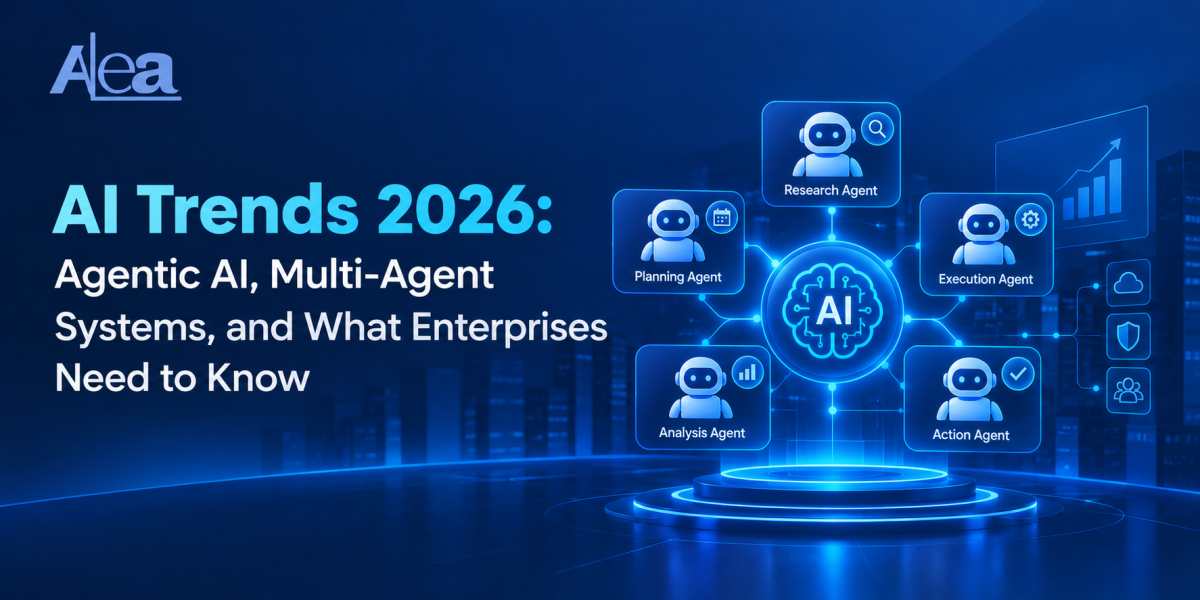
Generative AI gave businesses tools that could answer questions and draft content. Agentic AI goes several steps further these are systems designed to take autonomous action across internal and customer-facing workflows, automating routine tasks, surfacing insights across systems, initiating transactions, and resolving service issues with limited human intervention.
In 2026, this shift is no longer experimental, it’s showing up in sales, marketing, customer service, supply chain, and cybersecurity workflows across every major industry.
What the Numbers Show
The market reflects how fast this is moving. The AI agent market was valued at $8.03 billion in 2025 and is expected to reach $11.78 billion by 2026, growing at a 46.61% CAGR, with long-term projections putting the market at $251.38 billion by 2034.
Adoption vs. Maturity
Adoption and maturity are two different things. Gartner reports that 75% of enterprises are now experimenting with AI agents, but only 15% have moved to fully autonomous, goal-driven systems most deployments still keep a human in the loop, and that’s a deliberate, sensible choice rather than a limitation.
Where companies have committed, the returns are real: PwC found that 79% of businesses now use AI agents, 66% report measurable productivity gains, and 62% expect ROI above 100%.
Where to Start
For businesses evaluating where to start, the pattern among early movers is consistent: pick one or two high-volume, well-defined workflows support triage, lead qualification, invoice processing rather than attempting an enterprise-wide rollout on day one.
Our AI consultancy services are built around exactly this kind of phased approach, and if you’d rather bring in specialists directly, you can also hire AI agent developers for a focused build.
AI-Native Software Development
How Engineering Teams Are Changing
Alongside agentic AI in the workplace, AI is changing how software itself gets built. Engineering teams are shifting from writing code line-by-line to orchestrating agents that write, test, and maintain it a change that touches roles, review processes, and delivery timelines.
Multi-agent coordination, where specialized agents each own a piece of the development pipeline, is becoming the standard pattern for teams furthest along this curve, and some organizations report meaningfully faster delivery cycles as a result.
What It Means for Businesses Buying Software
For businesses building custom software, this means development partners with mature AI-assisted workflows can often move faster and at lower cost than those still working entirely by hand a factor worth asking about when evaluating a development vendor in 2026.
Blockchain: Beyond Cryptocurrency, Into Trust Infrastructure
Where Blockchain Is Actually Being Used
Blockchain’s role in business has kept maturing well past its crypto-trading origins. In 2026, companies are using blockchain for secure transactions, tamper-proof data sharing, and decentralized applications, with healthcare, finance, and supply chain management leading adoption because of the transparency and fraud resistance it offers.
The New Angle: Trust Layer for AI Agents
As agentic AI systems increasingly transact and exchange data autonomously, blockchain is emerging as a trust and verification layer underneath those interactions giving businesses an auditable record of what an AI agent did and when, which matters as regulators start asking exactly that question.
5G, Edge Computing, and IoT Convergence
Infrastructure of 5G, Not Novelty
5G has moved from rollout to infrastructure. Networks remain a critical part of digital infrastructure, delivering high-speed connectivity, lower latency, and support for large numbers of connected devices, while telecom providers continue improving performance and exploring new enterprise use cases.
Why Convergence Is the Real Story
The more relevant 2026 story isn’t 5G in isolation it’s how it converges with edge computing, IoT devices, and autonomous systems to power smart infrastructure and industrial applications. For businesses, that convergence is what actually unlocks real-time AR-assisted maintenance, autonomous logistics, and remote healthcare monitoring at scale.
Spatial Computing (formerly AR/VR)
From AR/VR to a Single Category
What used to be discussed as separate AR and VR trends has converged into a broader category: spatial computing, where digital data and interfaces are layered directly into a business’s physical environment rather than confined to a screen. Retail is using it for virtual try-before-you-buy experiences; healthcare and manufacturing are using immersive simulation to train staff on high-risk procedures without real-world consequences.
Sustainable Technology – Now Measured, Not Just Pledged
Why AI Compute Changed the Conversation
Sustainability commitments used to be a marketing line item. In 2026, the expectation has shifted toward sustainable tech that’s actually measured, driven partly by the sheer energy demand of AI compute itself, which has put data center efficiency under far more scrutiny than in prior years.
From Pledges to Procurement Criteria
Cloud providers are investing further in renewable-powered infrastructure, and businesses are being asked by regulators, investors, and increasingly by customers to show auditable sustainability metrics rather than general statements of intent.
For companies building or hosting digital products, this is becoming a genuine procurement criterion, not a nice-to-have something we factor into every cloud computing engagement.
Cybersecurity: Zero Trust Meets Post-Quantum Preparation
AI-Powered Detection Is Now the Baseline
Cyber risk keeps scaling with the surface area of connected systems, and 2026’s priority list has AI woven through nearly every layer of it. AI-powered threat detection tools are now standard for identifying and responding to attacks faster than manual monitoring ever could, while zero-trust architecture and multi-factor authentication have become baseline expectations rather than advanced practices.
The New Frontier: Post-Quantum Cryptography
Because powerful future quantum computers could break widely used encryption methods, organizations with long-term data protection needs are increasingly starting migration planning now toward encryption designed to resist both conventional and quantum-based attacks. This matters most for industries handling data that needs to stay confidential for years finance, healthcare, government, and legal services should be having this conversation in 2026, even if full migration is still some way off.
Composable, Modular Architecture
Why Monolithic Systems Are Losing Ground
The last major shift is architectural. Enterprises are moving away from rigid, monolithic systems toward composable architecture modular, interchangeable components that can be reconfigured quickly as business needs change because it directly boosts agility and speed compared to rebuilding a monolith every time requirements shift.
The Market Is Backing This Up
The composable infrastructure market is projected to reach $39.37 billion by 2032, growing at a 24.9% CAGR. For any business planning a platform rebuild or a new product in 2026, architecting for composability from day one is far cheaper than retrofitting it later.
How Alea IT Solutions Can Help
If your business wants to put agentic AI, modern infrastructure, or stronger security into practice, Alea IT Solutions offers end-to-end web, mobile, and AI development services. Our team works hands-on with AI agents, blockchain, and cloud-native architecture to help businesses build for where the market is actually heading not where it was two years ago.
Conclusion: From Experimentation to Execution
The digital trends of 2026 share one theme underneath the technology. The shift from experimenting with new tools to making them work at real, measurable scale. Governed AI instead of ungoverned pilots. GenAI embedded in actual processes instead of sitting in a sandbox. Cybersecurity that closes exposed gaps instead of adding another dashboard. Sustainability that’s audited instead of promised.
Businesses should treat 2026 as the year to act on these shifts. Instead of watching from the sidelines, they can start implementing these technologies. This approach can help them stay competitive and move ahead.
Frequently Asked Questions
Generative AI creates content or responses when prompted text, images, code. Agentic AI goes further: it takes autonomous, multi-step action to complete a goal, such as resolving a customer ticket end-to-end or reallocating supply chain inventory, often with minimal human input at each step.
AI now touches nearly every stage of digital transformation automating operational workflows through AI agents, accelerating software development itself, strengthening cybersecurity threat detection, and personalizing customer experiences at scale.
Blockchain supports secure transactions, tamper-resistant data sharing, and decentralized applications across healthcare, finance, and supply chains, and is increasingly used as a trust layer for verifying autonomous AI agent transactions.
Businesses holding data that must stay confidential for years financial records, health data, government or legal information should begin migration planning now. Quantum computers capable of breaking current encryption aren’t here yet, but the data being stolen today could still be decrypted later, which is why early planning matters.
Rising AI compute demand has put data center energy use under real scrutiny, and regulators, investors, and customers increasingly expect measured, auditable sustainability metrics rather than general commitments.
A layered approach works best: AI-powered threat detection, zero-trust architecture, multi-factor authentication, and for long-term sensitive data an early look at post-quantum encryption readiness.
Start narrow. Pick one high-volume, well-defined workflow for an AI agent pilot, or one system that needs a composable rebuild, rather than attempting a company-wide transformation at once. Measure results, then expand.