The software industry is undergoing a major transformation as traditional SaaS platforms evolve with the rise of artificial intelligence. In the growing debate of SaaS vs AaaS, businesses now expect more than tools they want systems that can think, act, and deliver outcomes.
This shift has led to AI-as-a-Service (AaaS), where AI becomes the core driver of functionality, automating workflows and enabling real-time decision-making.
According to recent market insights, the global AI market is projected to exceed $1.5 trillion by 2030, with enterprise AI adoption growing at over 35% CAGR, highlighting the rapid shift toward AI-driven systems.
As organizations prioritize efficiency, scalability, and speed, AaaS is gaining strong momentum, fundamentally reshaping modern software architectures and how businesses operate.
SaaS vs AaaS: Market Momentum Driving the Next Software Revolution
The ongoing shift in SaaS vs AaaS is clearly reflected in current market trends and enterprise adoption patterns. While the global SaaS market continues its steady growth and is projected to surpass $300 billion by 2030, the AI market is expanding at a significantly faster pace. The global artificial intelligence market is expected to exceed $1.5 trillion by 2030, fueled by rapid innovation and increasing demand for intelligent automation.
In the broader discussion of SaaS vs AaaS, one of the most defining factors is the speed of adoption. AI implementation across businesses is growing at an impressive 35–40% CAGR, as organizations invest heavily in automation, predictive analytics, and real-time decision-making systems. Enterprises are no longer just adopting tools they are integrating AI into core workflows, signaling a strong transition toward AaaS models.
As the SaaS vs AaaS landscape continues to evolve, these market trends highlight a clear direction: while SaaS remains foundational, AaaS is emerging as the future of software. With its ability to deliver faster innovation, greater efficiency, and outcome-driven capabilities, AaaS is set to redefine how businesses leverage technology at scale.
What is AI-as-a-Service (AaaS) and How It’s Transforming SaaS Solutions?
AI-as-a-Service (AaaS) is redefining how modern software solutions are built and delivered. Unlike traditional SaaS platforms that depend heavily on user inputs and manual workflows, AaaS integrates artificial intelligence directly into systems enabling them to analyze data, make decisions, and execute tasks autonomously.
This shift marks a major transition from software that simply supports users to intelligent systems that actively perform business operations. For companies looking to scale efficiently, AaaS is becoming the foundation of next-generation digital solutions.
Core Components of AaaS Solutions in AI-Driven Software Development
AaaS solutions are powered by a combination of advanced AI technologies and automation systems that enable intelligent execution:
- Large Language Models (LLMs): Enable natural language understanding, content generation, and conversational interfaces
- AI Agents: Act as autonomous workers that handle tasks, workflows, and decision-making processes
- Automation Engines: Connect systems and execute end-to-end workflows without manual intervention
- Real-Time Data Processing: Allows systems to respond dynamically based on live data and changing conditions
Together, these components form scalable AI-powered solutions that go far beyond traditional software capabilities.
Key Features of AI-as-a-Service (AaaS) Platforms
Modern AaaS platforms offer capabilities that are transforming how businesses operate:
- Natural language interaction through chat and voice interfaces
- AI-driven content generation and recommendations
- Autonomous workflow execution across multiple tools and platforms
- Continuous learning and optimization based on real-time data
These features allow businesses to automate complex processes, reduce operational costs, and improve efficiency at scale.
SaaS vs AaaS: From Software Tools to AI-Powered Business Solutions
The difference between SaaS and AaaS lies in how work gets done.
- SaaS solutions act as tools users must log in, manage workflows, and manually execute tasks
- AaaS solutions act as intelligent systems AI handles execution, decision-making, and optimization
This evolution introduces the concept of a digital workforce, where AI agents replace repetitive manual effort and deliver outcomes faster and more accurately.
For businesses, this means shifting from managing software to leveraging AI-driven solutions that work independently.
How AaaS is Replacing Traditional SaaS Platforms
The transition from SaaS to AaaS is happening rapidly as businesses demand smarter, faster, and more scalable solutions.
Traditional SaaS platforms are evolving into AI-powered systems where:
- User actions are replaced by intent-driven commands
- Workflows become automated and self-optimizing
- Interfaces shift from dashboards to conversational experiences
AaaS eliminates the need for constant human interaction, allowing businesses to operate more efficiently with fewer resources.
From Manual Workflows to AI-Driven Automation Systems
In SaaS environments, workflows require continuous human input. Every action from data entry to decision-making depends on the user.
With AaaS solutions, this changes completely.
AI systems can:
- Automatically execute workflows
- Make data-driven decisions in real time
- Continuously optimize processes without manual intervention
This transformation enables businesses to focus on outcomes rather than operations, significantly improving productivity and scalability.
Why Businesses Are Moving from SaaS to AaaS Solutions
AaaS is quickly becoming the preferred model for modern software development because it aligns with key business needs:
- Faster execution through AI automation
- Reduced operational costs and manual effort
- Scalable systems that grow with the business
- Improved decision-making using real-time data insights
As AI continues to evolve, AaaS is not just enhancing SaaS it is gradually replacing it as the standard for building intelligent software solutions.
Evolution from SaaS to AaaS: The Shift Toward Intelligent Software Architectures
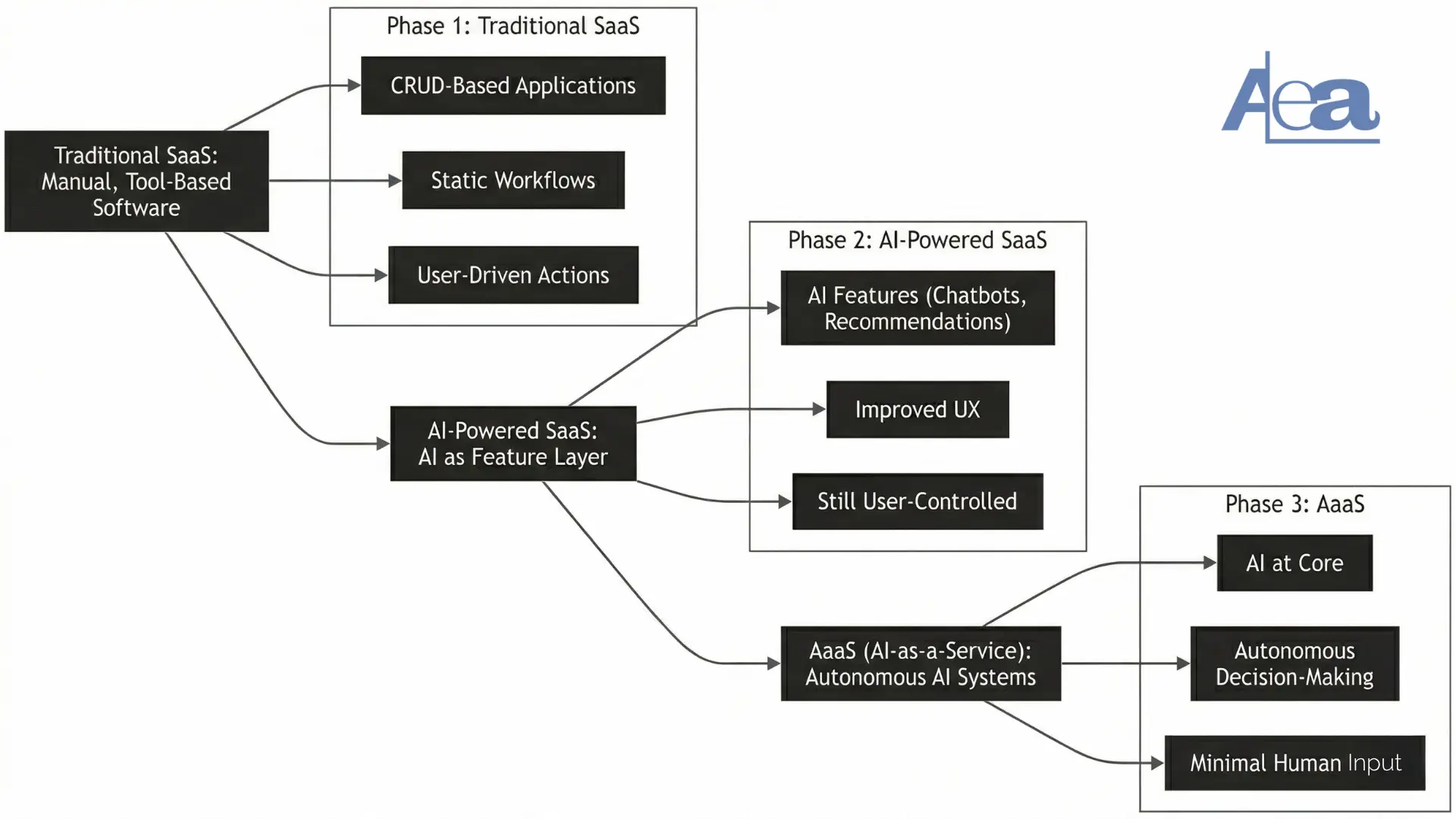
The software architecture landscape is evolving from traditional SaaS models to AI-driven AaaS systems. This transition reflects a shift from user-operated tools to intelligent platforms capable of autonomous decision-making, real-time execution, and adaptive workflows powered by advanced AI technologies and agents.
1st Phase: Traditional SaaS
- CRUD-based applications – Systems focused on creating, reading, updating, and deleting structured data within predefined database-driven workflows.
- Static workflows – Processes follow fixed, rule-based sequences with limited flexibility or ability to adapt dynamically.
- User-driven interactions – Users manually control actions, inputs, and decisions through dashboards or interfaces to complete tasks.
2nd Phase: AI-Powered SaaS
- AI integrated as a feature (e.g., recommendations, chatbots) – Artificial intelligence is added to enhance functionality, supporting tasks like suggestions, automation, and basic conversational interactions.
- Enhanced user experience but still tool-centric – Improves usability and efficiency, but users still rely on interfaces and manually operate the system to complete workflows.
3rd Phase: AaaS
- AI at the core of the system – Artificial intelligence drives core functionality, managing workflows, processing data, and executing tasks as the primary system engine.
- Autonomous decision-making – Systems analyze data, learn patterns, and make informed decisions independently without requiring constant human input or supervision.
- Minimal user intervention – Users provide high-level inputs or goals, while the system handles execution, reducing the need for continuous manual involvement.
How AaaS Is Transforming Modern Software Development Lifecycle
AaaS is fundamentally transforming the software development lifecycle by shifting the focus from traditional coding and interface design to intelligent system orchestration and automation.
This evolution is redefining how modern applications are built, deployed, and maintained, especially within organizations adopting ai aoftware development services.
Key Changes by AaaS:
1. AI-Assisted Coding
Developers are increasingly leveraging AI-powered tools to generate code, automate testing, and identify bugs in real time. This significantly reduces development effort and accelerates delivery timelines.
AI-assisted coding also enables rapid prototyping, allowing teams to build and iterate products faster while maintaining high code quality making it a core component of modern ai software development solutions.
2. Reduced Frontend Complexity
With the rise of conversational interfaces and AI-driven interactions, traditional dashboards are becoming less central. Users can now interact with systems using natural language, reducing the need for complex UI/UX layers. This shift allows development teams to focus more on backend intelligence and less on designing intricate user interfaces.
3. Rise of Prompt-Based Systems
Prompt engineering is emerging as a critical skill in AaaS environments. Instead of hardcoding logic, developers design prompts that guide AI models to produce desired outcomes. This introduces a new paradigm where application behavior is controlled through structured inputs, making systems more flexible and adaptive.
4. New Backend Requirements
AaaS demands a more sophisticated backend architecture to support AI-driven operations, including:
- Model orchestration: Managing multiple AI models and workflows efficiently
- Vector databases: Enabling semantic search and contextual data retrieval
- Real-time data pipelines: Supporting instant processing and decision-making
- Integration layers: Connecting AI systems with existing enterprise tools and APIs
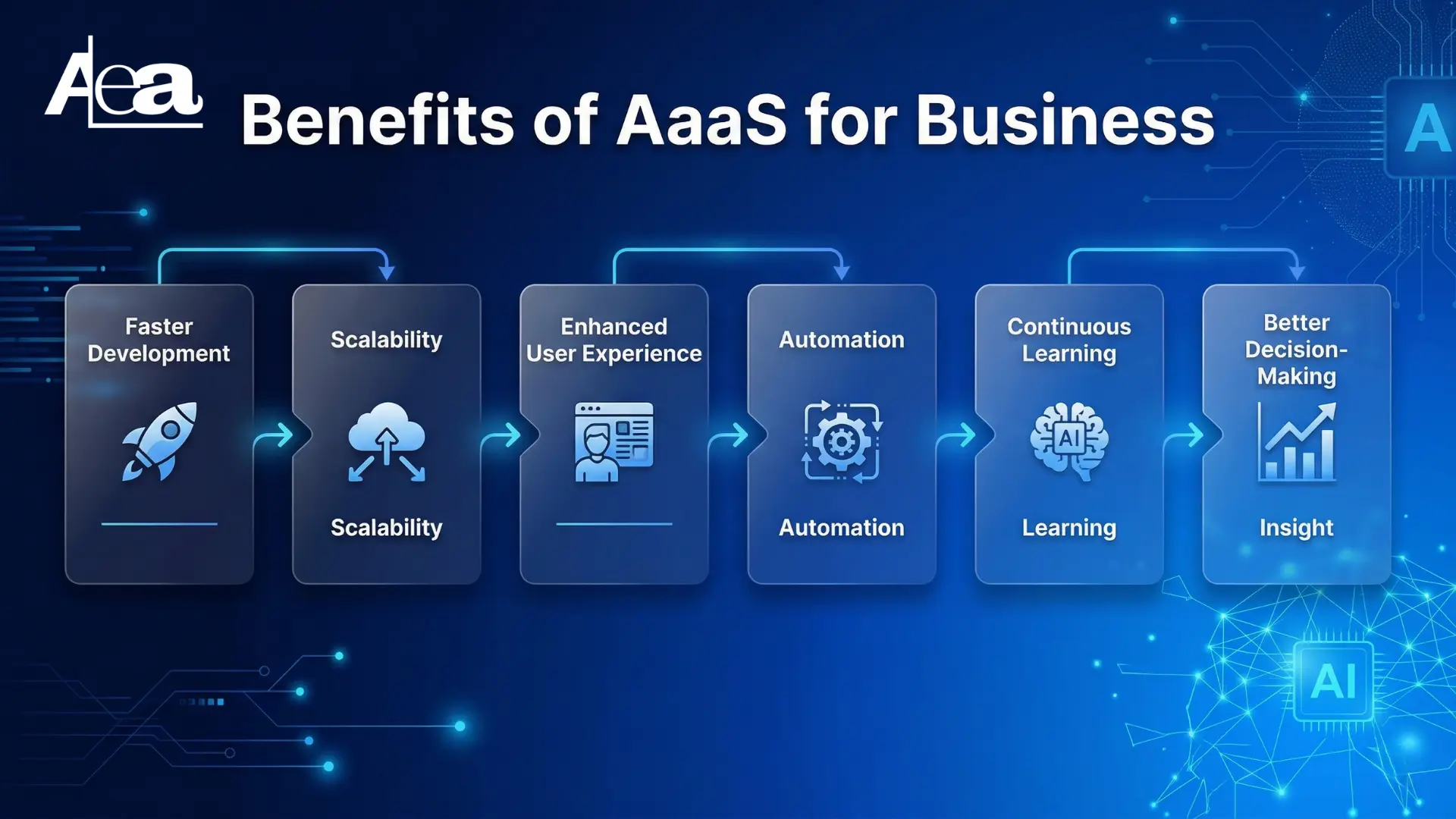
Benefits of AaaS for Business
Adopting AaaS offers several strategic advantages for businesses moving toward ai-driven enterprises:
- Faster Development – Reduces manual coding effort with AI-assisted development, enabling quicker deployment and faster time-to-market.
- Scalability – AI systems can efficiently handle large volumes of data and workloads, making it easier to scale operations without major infrastructure changes.
- Enhanced User Experience – Delivers personalized, intuitive, and conversational interactions, improving engagement and customer satisfaction.
- Automation – Automates repetitive and complex workflows, reducing operational costs and minimizing human errors.
- Continuous Learning – AI models evolve over time by learning from data and user interactions, improving accuracy and performance.
- Better Decision-Making – Real-time data processing and predictive insights help businesses make faster and more informed decisions.
Multi-Agent Systems in AaaS: The Core Architecture Behind AI-Driven Software
Multi-agent systems form the backbone of modern AaaS architectures. Instead of relying on a single AI model, AaaS platforms deploy multiple specialized agents that collaborate to complete tasks efficiently.
Each AI agent is responsible for a specific function within the workflow, enabling systems to operate more efficiently and scale across complex operations. This distributed architecture allows businesses to automate end-to-end processes without creating overly complex monolithic systems.
At the center of a multi-agent system is the orchestration layer, which coordinates how agents communicate, share data, and execute tasks in sequence. This orchestration ensures smooth workflow execution and prevents conflicts between different processes.
Another important component is the memory layer, which stores contextual information and historical data. This allows agents to maintain continuity across interactions and make more accurate decisions over time.
Integration also plays a crucial role in multi-agent systems. Through APIs and external tools, agents can connect with CRMs, databases, analytics platforms, and other enterprise applications. This connectivity enables intelligent automation across entire organizations.
As businesses increasingly adopt AI Software Solutions, multi-agent architectures are becoming essential for building scalable and efficient AI-driven applications.
Enterprise AI Use Cases Driving AaaS Adoption
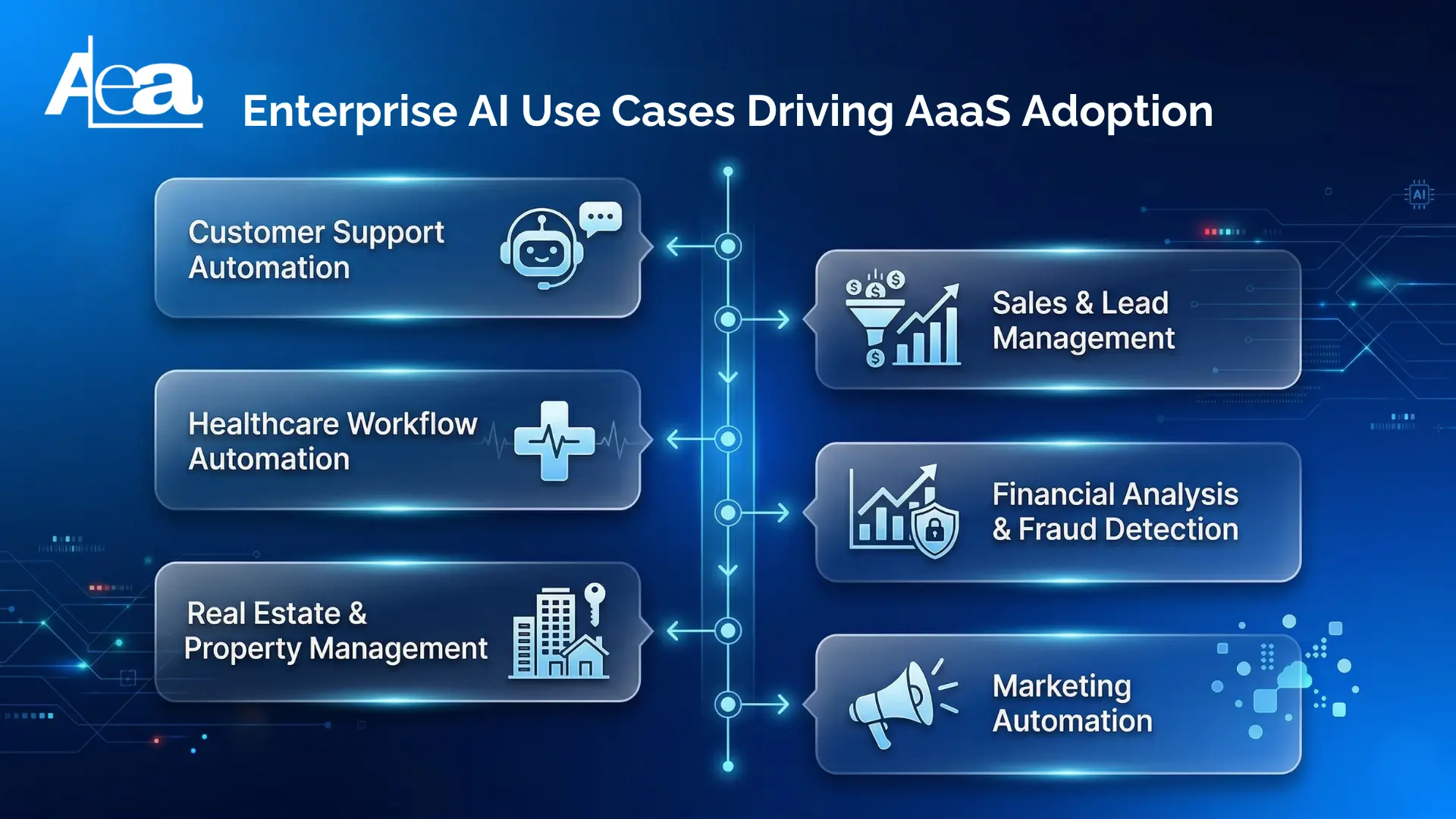
The rapid rise of AaaS is being fueled by real-world enterprise applications across industries. Organizations are leveraging AI to move beyond manual operations and build AI-driven enterprises.
1. Customer Support Automation
AI agents handle queries, resolve issues, and escalate cases when needed reducing response time and operational costs.
2. Sales & Lead Management
AI systems can qualify leads, schedule meetings, and even follow up with prospects autonomously, improving conversion rates.
3. Healthcare Workflow Automation
From patient data analysis to appointment scheduling and diagnostics support, AaaS is transforming healthcare operations.
4. Financial Analysis & Fraud Detection
AI models analyze transaction patterns in real time, detect anomalies, and generate predictive insights for risk management.
5. Real Estate & Property Management
AI agents automate listing management, customer interactions, and market analysis, improving efficiency in real estate operations.
6. Marketing Automation
AI-driven systems generate content, optimize campaigns, and analyze performance without manual intervention.
These use cases highlight how ai development solutions are enabling enterprises to shift from reactive operations to proactive, intelligent systems that drive measurable outcomes.
How SaaS Pricing Works vs AaaS Pricing Models
SaaS platforms typically follow a subscription-based pricing model, where businesses pay a fixed monthly or annual fee to access software. This approach provides predictable costs and allows organizations to scale usage based on the number of users or features required. It simplifies budgeting while ensuring continuous access to updates and support.
In contrast, AaaS introduces more dynamic and flexible pricing structures aligned with actual usage and outcomes. Instead of paying for access, businesses pay for results such as completed tasks, AI-driven actions, or data processed. While this model offers greater efficiency and value, it also requires careful monitoring, as costs can vary depending on workload and system usage.
Future of SaaS and AaaS
The future of software is not about completely replacing SaaS but evolving it into more intelligent, adaptive, and outcome-driven systems. As AI continues to advance, businesses are moving toward hybrid models that combine the reliability of SaaS with the intelligence of AaaS.
Key Trends:
- Hybrid Models (SaaS + AI)- Traditional SaaS platforms are increasingly integrating AI capabilities to enhance functionality. This allows businesses to retain familiar tools while benefiting from automation, predictive insights, and smarter workflows.
- AI-Native Applications- A new generation of applications is being built with AI at the core rather than as an add-on. These systems are designed to learn, adapt, and operate autonomously, offering greater efficiency and flexibility from the start.
- Embedded AI Agents- AI agents are becoming a standard feature within SaaS tools, enabling automation of repetitive tasks, real-time decision-making, and seamless execution of workflows without constant user involvement.
- Industry-Specific AI Solutions- Businesses are adopting tailored ai software solutions designed for specific industries such as healthcare, finance, and real estate. These solutions address unique challenges and deliver more accurate, domain-specific outcomes.
How AleaIT Solutions Builds AI Agent Layers for AaaS-Driven Enterprises
At AleaIT Solutions, we are at the forefront of this shift from traditional SaaS to AI-driven architectures by building intelligent, scalable, and future-ready software systems. By leveraging advanced technologies such as AI agents, automation frameworks, and real-time data processing, we enable businesses to move beyond manual workflows and embrace outcome-driven operations.
An AI Agent Development Company builds intelligent agents that automate workflows, execute tasks autonomously, and integrate with enterprise systems to improve efficiency and streamline business operations.
Our expertise in developing custom AI-powered solutions across industries including healthcare, real estate, and enterprise platforms helps organizations streamline processes, enhance decision-making, and accelerate digital transformation.
With a strong focus on innovation and performance, aleait solutions empowers businesses to adopt AaaS models and stay competitive in an increasingly AI-driven world.
Conclusion
SaaS is not dead it is evolving. The rise of AaaS represents the next phase in the software lifecycle, where intelligence and automation take center stage.
Businesses are moving from using software as tools to leveraging AI as a strategic partner. This shift is redefining software development architectures, enabling faster innovation, improved efficiency, and smarter decision-making.
Organizations that embrace AI-first approaches today will be better positioned to lead in the future of digital transformation.
ai development services enable businesses to build intelligent applications using machine learning, automation, and data analytics to improve decision-making, optimize processes, and drive innovation across industries.
FAQs
Q: What is AaaS (AI as a Service) vs SaaS?
A: SaaS provides cloud-based tools that require user input, while AaaS uses AI to automate tasks and deliver outcomes. In short, SaaS is tool-driven, whereas AaaS is outcome-driven.
Q: What is prompt-driven execution in AaaS?
A: Prompt-driven execution replaces hardcoded logic with dynamic instructions, allowing developers to control system behavior through structured prompts interpreted by AI models.
Q: How does scalability differ in AaaS vs SaaS?
A: SaaS scales by adding infrastructure and users, while AaaS scales through model efficiency, parallel processing, and distributed AI workloads across systems.
Q: How do workflows differ between SaaS and AaaS?
A: SaaS workflows are rule-based and user-triggered, while AaaS workflows are adaptive, AI-driven, and capable of autonomous execution based on data and context.
Q: What role do AI agents play in AaaS?
A: AI agents act as autonomous units that can interpret inputs, interact with systems, and execute multi-step tasks, replacing manual processes typically handled in SaaS environments.
Q: How is data handled differently in AaaS?
A: SaaS primarily uses structured data with predefined schemas, while AaaS processes both structured and unstructured data using embeddings, semantic search, and contextual analysis.