Key Takeaways
- he scale of the problem:WHO data shows that in low- and middle-income countries, 134 million adverse events occur annually in hospitals, causing about 2.6 million deaths. In high-income countries, about 1 in 10 patients is harmed during hospital care. More than half of all patient harm is preventable.
- Where AI helps most:real-time monitoring and alerts, medication-error prevention, clinical decision support for diagnosis, and structuring unstructured clinical notes with NLP.
- What AI does not replace:final diagnostic and treatment decisions stay with the clinician. AI supports judgment; it does not substitute for it.
- Regulatory reality:AI used to diagnose, treat or prevent disease is typically regulated as Software as a Medical Device (SaMD) under the FDA or EU MDR/IVDR, which adds validation requirements most teams underestimate.
- Cost and timeline:a single-purpose tool (for example, a medication-safety checker) typically costs $40,000 to $90,000 and takes 3 to 5 months. A broader clinical decision support platform typically costs $150,000 to $400,000+ and takes 6 to 12 months.
Where to start: pick one high-harm, high-volume risk, such as medication interactions or vital-sign alerting, and prove it on one unit before expanding.
Building or upgrading clinical software and need it to reduce, not add, risk?
Get a free feasibility review of your patient-safety workflow within 12 hours.
AI reduces clinical errors by giving clinicians real-time alerts on abnormal vitals and lab trends, flagging medication risks before a prescription is finalized, and supporting diagnosis with evidence-based recommendations from a clinical decision support system (CDSS).
It works by structuring and monitoring data faster than manual review can, catching the preventable errors that cause most patient harm.
Even more concerning, 1 in 10 patients is affected during treatment, and over 50% of these errors are preventable. These issues ranging from misdiagnosis to medication mistakes highlight how clinical errors continue to impact patient safety and outcomes.
Understanding Medical Errors: The Scope of the Problem in Healthcare
Medical errors are a widespread and persistent issue across global healthcare systems, affecting patient safety, treatment outcomes, and operational efficiency. These errors can occur at any stage of care from diagnosis and treatment to medication and follow-ups.
The real scale, from the World Health Organization:
- In low- and middle-income countries, 134 million adverse events occur in hospitals each year, contributing to about 2.6 million deaths.
- In high-income countries, an estimated 1 in 10 patients is harmed while receiving hospital care.
- More than 50% of this harm is preventable, most often from medication errors, diagnostic errors and surgical or procedural errors.
These figures point to preventable, structural failures, incomplete data, delayed decisions and communication gaps, which is exactly where AI-driven software has measurable impact.
This is where ai-driven software solutions play a critical role by enhancing data accuracy, improving clinical decision-making, and reducing human error.
Diagnostic errors alone contribute to a large percentage of serious health complications, while medication-related mistakes remain one of the most common risks in clinical settings.
The growing complexity of healthcare systems, combined with increasing patient volumes, makes manual processes more vulnerable to failure. Without real-time insights and data-driven support, clinicians often face challenges in making timely and accurate decisions. This is where AI in healthcare is playing a crucial role by enabling faster and more accurate clinical insights.
Related Insights: How AI Is Upgrading Automated Clinical Documentation in Modern Healthcare
Common Causes of Clinical Errors in Healthcare
Before implementing solutions, it’s important to understand why Clinical Errors happen in the first place. Some of the most common causes include:
1. Data Silos and Poor Interoperability
Healthcare systems often operate in isolation, making it difficult to access complete patient histories. This leads to incomplete or incorrect clinical decisions.
2. Manual Processes and Human Fatigue
Manual data entry, handwritten prescriptions, and long working hours increase the chances of oversight and mistakes.
3. Delayed Decision-Making
Without real-time insights, clinicians may rely on outdated or incomplete information, leading to delayed or incorrect diagnoses.
4. Communication Gaps
Miscommunication between departments or care teams can result in duplicated tests, wrong treatments, or missed critical information.
5. Lack of Continuous Monitoring
Patients, especially those with chronic conditions, require ongoing observation. Without proper systems, early warning signs are often missed.
How AI Helps Prevent Clinical Errors
AI technologies are designed to process vast volumes of healthcare data in real time, making them highly effective in preventing Clinical Errors before they occur. Advanced healthcare software solutions act as intelligent assistants for clinicians.
1. Real-Time Monitoring and Alerts
AI-powered platforms continuously analyze patient vitals, lab results, and historical data. With ai for patient monitoring, systems can detect abnormalities instantly such as sudden drops in oxygen levels or irregular heart rates and trigger alerts for immediate intervention.
2. Predictive Analytics for High-Risk Patients
Machine learning models evaluate patient history, genetics, lifestyle, and ongoing treatments to identify individuals at high risk. This is especially valuable for reducing medication errors with machine learning, where AI flags potential drug interactions, allergies, or incorrect dosages before prescriptions are finalized.
3. AI-Assisted Decision Support
Clinical Decision Support Systems (CDSS) leverage algorithms trained on millions of data points to guide physicians. These systems enhance AI for patient safety and diagnostic accuracy by recommending evidence-based treatments and reducing diagnostic variability.
4. Natural Language Processing (NLP) in Clinical Data
AI systems use NLP to extract meaningful insights from unstructured clinical notes, discharge summaries, and reports. This ensures no critical information is overlooked.
5, Continuous Learning and Improvement
Unlike traditional systems, AI models improve over time by learning from new data, outcomes, and feedback making them increasingly accurate and reliable.
What This Looks Like in Practice
To make this concrete rather than abstract, here is how each AI capability maps to a specific, common error it targets.
| AI capability | Specific error it targets | How it intervenes |
| Real-time vital-sign monitoring | Missed deterioration (e.g., sepsis onset, falling oxygen) | Continuous analysis of vitals against each patient’s baseline, with an alert before a critical threshold is crossed |
| Medication interaction checking | Wrong drug, wrong dose, dangerous interaction | Cross-checks a new prescription against the patient’s current medications, allergies and renal/hepatic function in real time |
| Clinical decision support (CDSS) | Diagnostic delay or variability between clinicians | Surfaces the most likely diagnoses and relevant guidelines based on the patient’s presenting data |
| NLP on clinical notes | Lost information in unstructured notes or discharge summaries | Extracts structured facts (allergies, prior conditions, follow-up needs) so nothing depends on someone re-reading free text |
| Imaging triage | Delayed detection on X-rays, CT or MRI | Flags scans with likely abnormalities for priority radiologist review, without replacing the radiologist’s read |
Healthcare Problems AI Can Solve
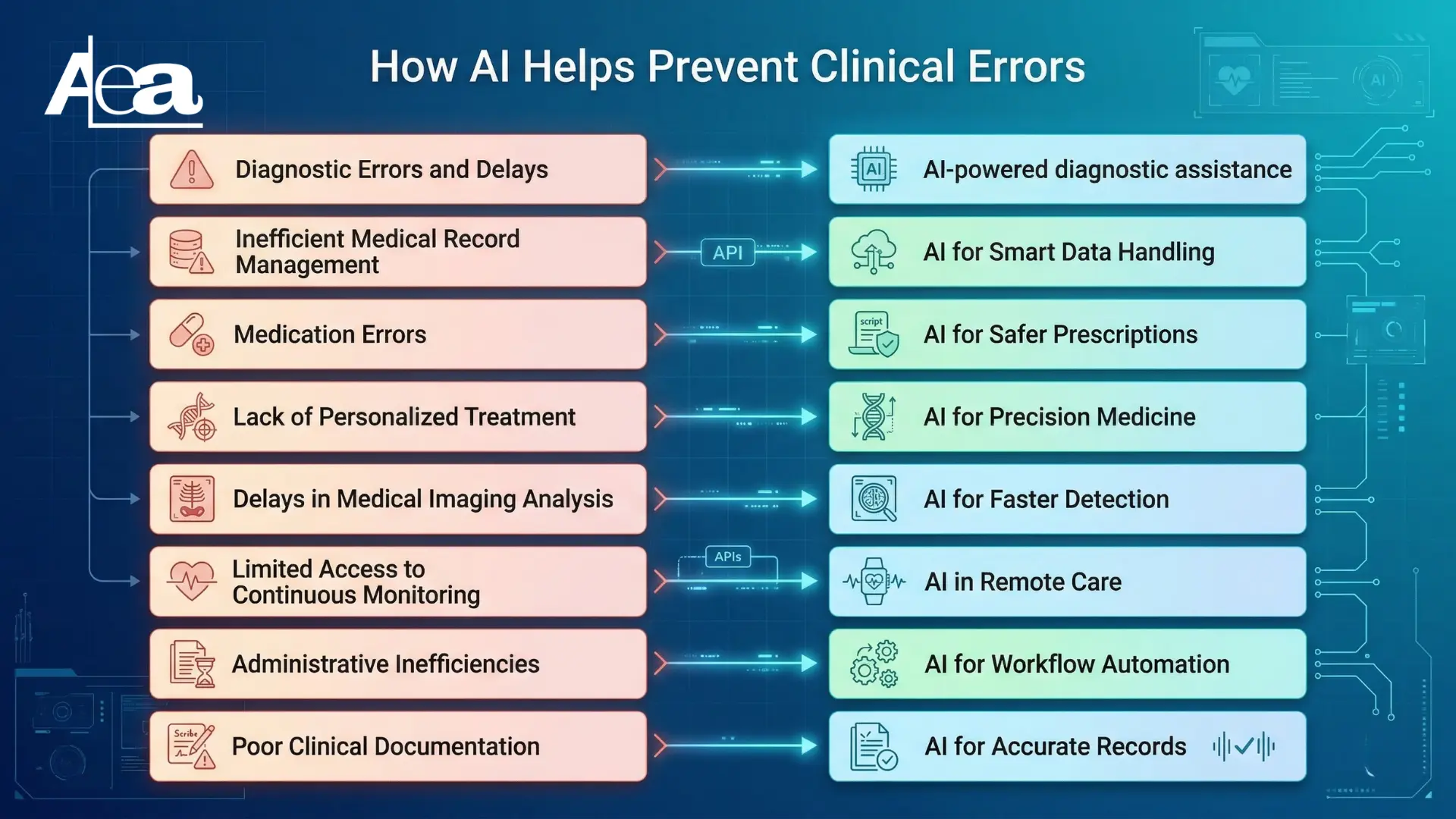
Healthcare systems face multiple operational and clinical challenges that directly contribute to errors and poor patient outcomes. By adopting ai healthcare software solutions, providers can address these issues with precision, automation, and real-time intelligence.
Below are the most critical problems and how AI in healthcare is transforming them, along with the benefits of AI-driven clinical software in improving safety and efficiency.
1. Diagnostic Errors and Delays: AI–Powered Diagnostics
Problem:
Delayed or incorrect diagnoses are among the leading ai powered diagnostics
causes of clinical errors, especially in critical fields like oncology and cardiology.
AI Solution:
AI-powered diagnostics use machine learning and deep learning to analyze medical data and imaging with high accuracy. This strengthens ai for patient safety and diagnostic accuracy by supporting faster and more reliable clinical decisions.
Key Benefits:
- Improved diagnostic precision
- Early disease detection
- Reduced misdiagnosis rates
2. Inefficient Medical Record Management: AI for Smart Data Handling
Problem:
Fragmented and poorly managed health records increase the risk of missing or incorrect patient information, leading to clinical errors.
AI Solution:
Advanced ai software solutions use NLP and analytics to structure, organize, and retrieve patient data efficiently. This enhances healthcare data analytics for error prevention and ensures better clinical decisions.
Key Benefits:
- Accurate and real-time patient data access
- Reduced administrative burden
- Improved data integrity
3. Medication Errors: AI for Safer Prescriptions
Problem:
Medication errors due to incorrect dosage, drug interactions, or manual prescribing are a major cause of patient harm.
AI Solution:
AI systems enable reducing medication errors with machine learning by analyzing prescriptions, detecting risks, and suggesting safer alternatives.
Key Benefits:
- Safer medication management
- Reduced adverse drug events
- Enhanced patient safety
4. Lack of Personalized Treatment: AI for Precision Medicine
Problem:
Generic treatment plans often fail to meet individual patient needs, increasing the risk of ineffective care.
AI Solution:
AI enables personalized care using patient history, genetics, and real-time data, strengthening healthcare ai software for clinical error reduction.
Key Benefits:
- Tailored treatment plans
- Better clinical outcomes
- Reduced treatment-related risks
5. Delays in Medical Imaging Analysis: AI for Faster Detection
Problem:
Manual analysis of X-rays, CT scans, and MRIs can lead to delays and missed abnormalities.
AI Solution:
AI-powered imaging tools analyze scans quickly and accurately, improving medical error prevention tools in radiology.
Key Benefits:
- Faster diagnosis
- Early detection of critical conditions
- Reduced human oversight errors
6. Limited Access to Continuous Monitoring: AI in Remote Care
Problem:
Patients outside hospitals often lack continuous monitoring, increasing the risk of unnoticed complications.
AI Solution:
With remote patient monitoring software, providers can track patient health in real time and intervene early.
Key Benefits:
- Continuous patient tracking
- Reduced hospital readmissions
- Improved chronic disease management
7. Administrative Inefficiencies: AI for Workflow Automation
Problem:
Manual administrative processes increase workload, delays, and chances of human error.
AI Solution:
AI automates repetitive tasks, improving workflow optimization in clinics and reducing operational risks.
Key Benefits:
- Faster operations
- Reduced human errors
- Lower operational costs
8. Poor Clinical Documentation: AI for Accurate Records
Problem:
Inaccurate or incomplete documentation often leads to miscommunication and clinical errors.
AI Solution:
Tools like AI for clinical documentation automate and standardize record-keeping, ensuring accurate and structured data.
Key Benefits:
- Improved documentation accuracy
- Better communication among clinicians
- Reduced legal and compliance risk
Key Features of AI Healthcare Software for Patient Safety
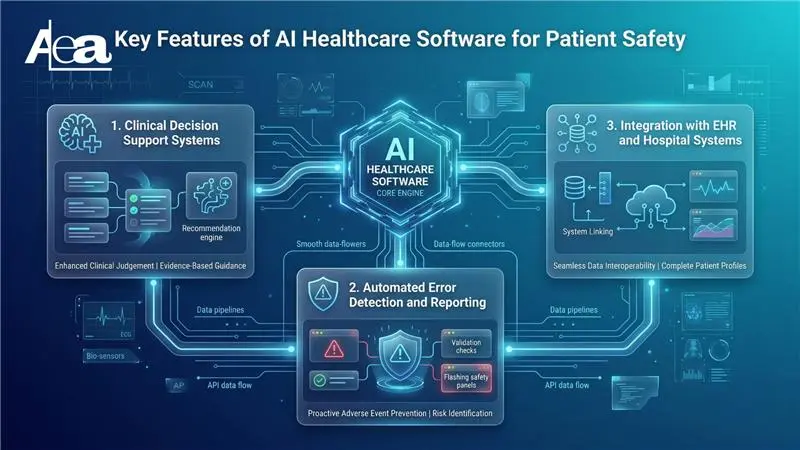
To effectively reduce clinical errors, modern Ai Healthcare software solutions come equipped with intelligent features that enhance accuracy, automation, and decision-making.
1. Clinical Decision Support Systems
CDSS tools analyze patient data in real time and provide evidence-based recommendations. This strengthens AI for patient safety and diagnostic accuracy by supporting clinicians with precise insights.
2. Automated Error Detection and Reporting
AI systems continuously scan patient records, prescriptions, and workflows to identify inconsistencies. These medical error prevention tools reduce reliance on manual checks and ensure faster error detection.
3. Integration with EHR and Hospital Systems
Seamless integration with electronic health records improves data accessibility and coordination across departments. This enhances workflow optimization in clinics and minimizes risks caused by fragmented data.
H2: What AI Does Not Replace in Clinical Error Prevention
AI reduces the preventable share of clinical errors; it does not remove the need for a clinician’s judgment. Being explicit about this builds trust, and it is also the kind of nuance that answer engines increasingly reward over one-sided AI hype.
• Final diagnosis and treatment decisions stay with a licensed clinician, not the software.
• AI recommendations need explainability. A “black box” score a doctor cannot question is a liability, not a safety feature.
• Bad data produces bad alerts. A model trained on incomplete or biased data can miss the patients it should flag, or over-alert on others (alert fatigue).
• Regulatory approval takes time. Tools that influence diagnosis or treatment usually need SaMD validation (Part 6), which is a real project phase, not a formality.
Best Practices for Implementing AI Solutions in Hospitals
Successfully implementing AI-Driven Software Solutions requires a strategic and well-planned approach to maximize impact and minimize risks.
1. Staff Training and Adoption
Healthcare professionals must be trained to effectively use AI tools. Proper onboarding ensures trust, usability, and better outcomes.
2. Regulatory Compliance and Data Security
AI systems must comply with healthcare regulations and maintain strict data privacy standards to avoid legal and operational risks.
3. Continuous Monitoring and Optimization
Regular system evaluation helps improve performance and ensures AI models remain accurate and reliable over time.
4. High-Quality Data Management
Clean, structured, and updated data is essential for effective AI performance and accurate predictions.
Cost and Timeline to Build AI Clinical Error-Reduction Software (2026)
Cost depends mainly on scope (a single tool vs. a platform), data readiness, and whether the software needs SaMD validation. Ranges below are AleaIT project estimates.
| Build tier | Typical cost | Timeline |
| Single-purpose tool (e.g., medication-safety checker, vitals alerting module added to an existing EHR) | $40,000 to $90,000 | 3 to 5 months |
| Broader clinical decision support platform, multiple integrations, SaMD-track validation | $150,000 to $400,000+ | 6 to 12 months, phased |
What drives the cost:
• Data preparation and integration with existing EHR, pharmacy and monitoring systems
• Model validation and clinical testing (heavier if the tool is classified as SaMD)
• Explainability and audit-log requirements
• Number of care settings, departments and languages
Need a number for your own systems? Request a custom estimate or see our healthcare software development service.
Get a cost estimate for your clinical error-reduction project
Tell us about your current EHR and the error types you want to target. We reply with a scoped estimate within 12 hours.
Regulatory and Compliance Requirements for AI in Clinical Error Prevention
Clinical AI is one of the most regulated categories of software, because the output can influence a diagnosis or a treatment decision.
• Software as a Medical Device (SaMD): in the US, the FDA regulates AI/ML software that diagnoses, treats or prevents disease; in the EU, this falls under the MDR (medical devices) or IVDR (diagnostics). Classification depends on the clinical risk of the software’s output, not just that it uses AI.
• Data privacy: HIPAA in the US; GDPR in the EU, alongside country-specific health-data rules. Both require access controls, audit logs, encryption and data minimization.
• EU AI Act: healthcare AI that is also a safety component of a regulated medical device is treated as high-risk. After the Digital Omnibus, most high-risk obligations for such systems apply from 2 December 2027; core transparency duties were not delayed.
• Explainability and human oversight: regulators increasingly expect a documented, explainable basis for AI recommendations and a named clinician with override authority.
Practical takeaway: decide your regulatory classification during discovery, not after the build. It changes architecture, documentation and timeline.
This section is general information, not legal or regulatory advice.
How AleaIT Solutions Powers AI-Driven Healthcare Software
At AleaIT Solutions, we don’t just develop software we craft intelligent healthcare ecosystems that save lives. As a leading healthcare software development company, we turn complex medical challenges into seamless, high-performance solutions.
How we approach clinical error-reduction projects:
• Start with one risk, not everything. We scope the pilot around a single, well-documented error type (for example, medication interactions) so impact is measurable within months, not years.
• Design for interoperability first. Every recommendation is only as good as the data behind it, so integration with your existing EHR and monitoring systems is planned before any model work starts.
• Build in explainability and audit logs from day one, since regulators and clinicians both need to see why the system flagged something.
• Plan for the SaMD path early if your tool influences diagnosis or treatment, so validation does not become a late-stage surprise.
Planning AI-driven clinical software?
Talk to our healthcare AI team about your EHR, decision support or patient-monitoring project.
Conclusion
Reducing clinical errors is no longer just a challenge it’s a critical priority for modern healthcare systems. As patient volumes grow and clinical workflows become more complex, traditional methods alone are not enough to prevent medical errors and ensure patient safety.
By adopting ai software solutions, healthcare providers can shift from reactive care to proactive, data-driven decision-making. From diagnostics and monitoring to documentation and workflow optimization, AI addresses the root causes of clinical errors and improves overall efficiency.
Integrating AI-based healthcare software solutions provides real-time insights, enhances accuracy, and supports clinicians with intelligent recommendations. This not only minimizes errors but also improves patient outcomes and operational performance.
For organizations aiming to stay ahead, investing in advanced AI solutions is key, but success starts with the right expertise: hiring an AI developer with experience in healthcare software ensures your systems are built to reduce risks, not add new ones.
The practical next step is small: pick one preventable error type your data already tracks, define what “prevented” means in numbers, and pilot on one unit before scaling.
Frequently Asked Questions
Clinical errors are preventable mistakes in diagnosis, treatment, medication or patient care that can harm patients or affect outcomes. The WHO groups them under “unsafe care”: medication errors, diagnostic errors, surgical errors, healthcare-associated infections and patient falls.
AI reduces clinical errors by giving real-time alerts on vital signs, flagging medication risks before a prescription is finalized, supporting diagnosis with clinical decision support systems, and structuring clinical notes so information is not lost between departments.
AI-driven software solutions are systems that use machine learning, natural language processing and data analytics to improve clinical accuracy, automate documentation and workflow, and support safer, faster decisions across diagnosis, treatment and monitoring.
No. AI reduces clinical errors by standardizing data and flagging risks, but it does not remove the need for clinical judgment. The WHO reports about half of patient harm is preventable, and AI targets that preventable share; final decisions still need a clinician.
The main benefits are fewer diagnostic delays, fewer medication errors, continuous patient monitoring, less time spent on manual documentation, and structured data that supports faster, more consistent clinical decisions.
It can be, when built for it. In the US that means HIPAA controls (access, audit logs, encryption); in the EU, GDPR and, for higher-risk clinical AI, the EU AI Act and MDR/IVDR medical-device rules. Compliance has to be designed in, not added after launch.
A single-purpose tool, such as a medication-safety checker or an alerting module added to an existing EHR, typically costs $40,000 to $90,000 and takes 3 to 5 months. A broader clinical decision support platform with multiple integrations typically costs $150,000 to $400,000+ and takes 6 to 12 months, based on AleaIT project estimates.
Often yes. If the software’s output is used to diagnose, treat or prevent disease, it is usually regulated as Software as a Medical Device (SaMD) under the FDA (US) or MDR/IVDR (EU), which adds clinical validation and documentation to the build. Tools that only organize or display data, without an autonomous clinical recommendation, are less likely to need this; confirm classification with regulatory counsel early, since it changes cost and timeline.
Start with one high-harm, high-volume risk: medication-interaction checking or real-time vital-sign alerting are common first projects because the harm they prevent is well documented and the data (EHR, pharmacy, monitors) already exists. Prove it on one unit or one risk type before expanding.
A chatbot answers questions from a script or knowledge base. A CDSS analyzes a specific patient’s data (labs, vitals, history) against clinical rules or models and gives an evidence-based recommendation at the point of care, such as flagging a drug interaction or an abnormal trend.