AI Robo-Spider Powers Smart City Surveillance and...
Built an AI-powered hexapod robot that patrols a smart-city model, detects accidents and trapped persons,...
View Case Study




The client is a leading academic medical center with 45 hospitals, 800+ physicians, and 5,000+ clinical staff. Its clinical knowledge was fragmented across EHRs, medical literature, imaging repositories, and internal treatment protocols, making point-of-care information retrieval slow and inefficient.
The hospital network needed faster access to reliable clinical information stored across EHRs, medical literature, imaging repositories, and internal protocols.
Alea IT Solutions built a HIPAA-compliant multimodal RAG system that unified these sources into a single clinical knowledge assistant. Physicians could search patient records, medical literature, protocols, and diagnostic images using natural-language queries with source citations for verification.
Launched as a 14-week pilot for 50–75 physicians, the solution reduced information retrieval time from nearly 2 hours to ~3 seconds per query, creating a scalable foundation for deployment across the network’s 45 hospitals

Clinical Retrieval Time

Physicians in Pilot

Coding Accuracy

Projected Annual Recovery
We developed a secure, multimodal clinical solution that brings medical information from different sources into one place. These features help physicians find relevant evidence faster, compare diagnostic information, and make more informed clinical decisions.
Search EHRs, medical literature, protocols, and diagnostic images with natural-language questions.
Get relevant information from multiple clinical sources in one place.

Combined keyword and semantic search to find relevant clinical information faster.
Results were ranked to surface the most useful sources first.
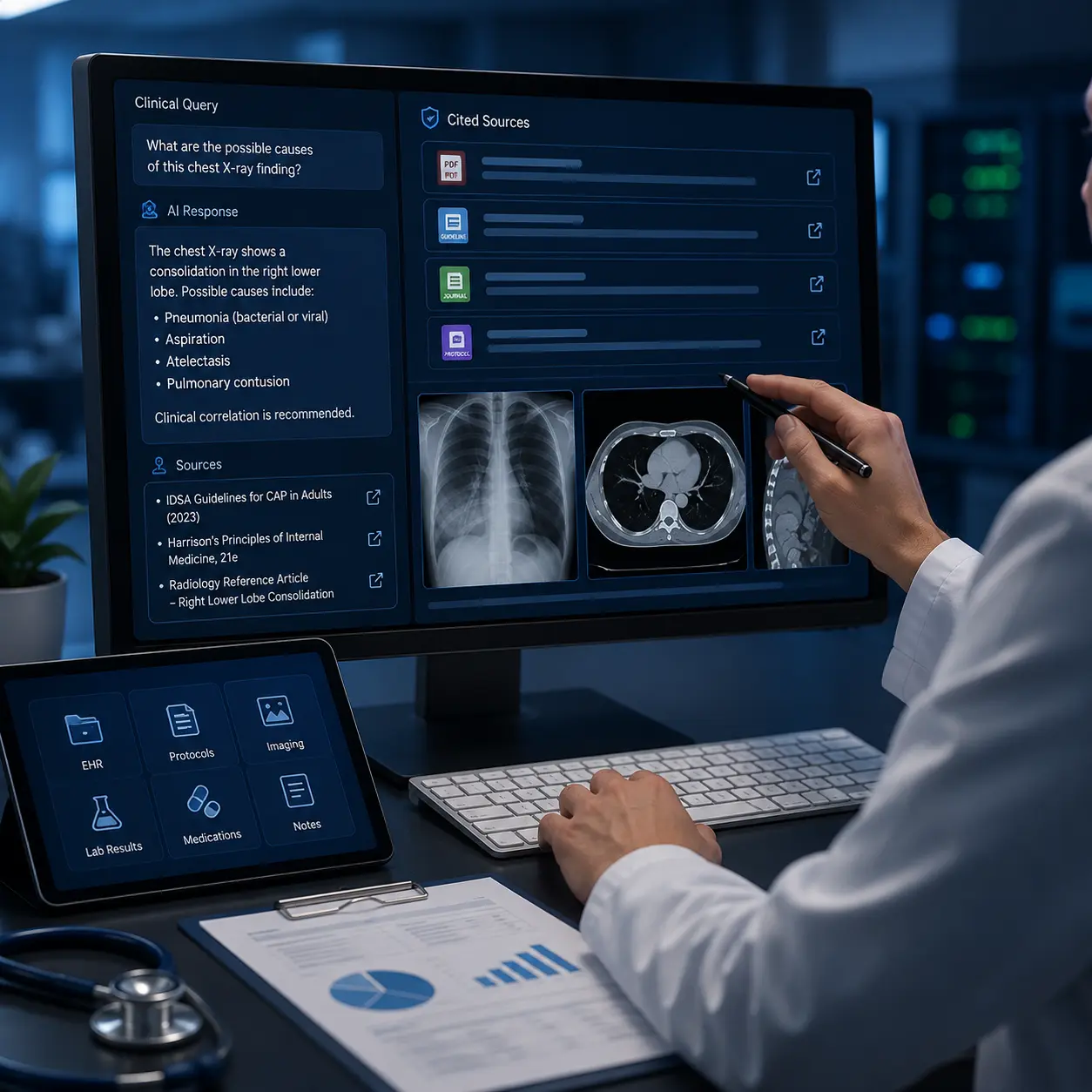
Find similar X-rays, MRIs, and CT scans from previous clinical cases.
View related images alongside the supporting clinical information.
Answers were linked to medical literature, guidelines, and source documents.
Physicians could quickly review the evidence behind each response.
Used available patient and clinical context to deliver more relevant information.
This reduced the need to search across multiple systems manually.

Protected clinical data with access controls, encryption, audit logs, and PHI safeguards.
The solution was deployed in a HIPAA-compliant environment for secure use.
The client’s fragmented knowledge landscape created diagnostic delays and inconsistent care. The engagement addressed each challenge through a purpose-built multimodal RAG architecture.

Physicians had to separately search EHRs, medical journals, and imaging repositories to answer a single clinical question, with no unified interface connecting the three.
Built a multimodal RAG system that integrates EHRs, PubMed, imaging repositories, and internal protocols into one retrieval layer, queryable in natural language.
Time-consuming manual searches across systems delayed diagnoses and pulled physicians away from direct patient care.
Natural-language querying with instant multimodal retrieval reduced clinical information retrieval time from 2 hours to just 3 seconds per query.
Physicians had no fast way to cross-reference a diagnosis against the latest guidelines and research, leading to variable care quality across sites.
Built evidence-backed recommendation generation with direct citations to clinical guidelines and research, giving physicians a verifiable basis for every suggestion delivered instantly at the point of care.
Diagnostically relevant imaging (X-rays, MRIs, CT scans) lived in a separate system from clinical text, so physicians couldn’t retrieve similar past cases alongside supporting literature in one step.
Built multimodal retrieval that surfaces relevant text passages and diagnostically similar images from prior cases side by side, in response to a single query, in 3 seconds.
Access to the latest treatment protocols varied across the 45-hospital network, contributing to inconsistent care standards.
Centralized internal clinical protocols into the same retrieval layer as EHRs and literature, ensuring every physician across every site queries the same up-to-date source.
We delivered the multimodal clinical RAG solution through a structured 14-week process, from clinical workflow discovery and secure data integration to multimodal retrieval, workflow integration, and clinical validation.
Weeks 1–2: Mapped physician workflows across EHRs, medical literature, imaging systems, and clinical protocols to identify key use cases and integration requirements.
Weeks 3–5: Connected EHRs, PubMed, imaging repositories, and internal protocols into a secure unified data layer.
Weeks 6–9: Built semantic and keyword retrieval, clinical query processing, reranking, and similar-image search for X-rays, MRIs, and CT scans.
Weeks 10–11: Integrated a natural-language clinical assistant with source citations, secure access, and existing physician workflows.
Week 12: Implemented access controls, encryption, audit logging, PHI protection, citation validation, and system testing.
Weeks 13–14: Tested the system with 50–75 physicians, measured retrieval quality and response time, incorporated feedback, and prepared the phased network rollout.
Hire dedicated developers & shape your business journey with our top-rated website & mobile app development services.