Key Takeaways
- An AI clinical decision support system (CDSS) turns EHR/EMR data into real-time, explainable recommendations for clinicians.
- Building a production AI CDSS typically costs $100,000–$500,000+.
- Typical timeline: [6–12 months] for production; a single-use-case pilot is faster.
- Build steps: define the use case, integrate data via FHIR/HL7, train the model, add explainability (SHAP/LIME), validate clinically, deploy, monitor drift.
- Three CDSS types: knowledge-based, machine learning-based, and hybrid.
- Compliance depends on intended use: HIPAA, GDPR and DPDP for data; FDA, EU AI Act or CDSCO if classed as a medical device.
- An AI CDSS supports clinicians and never replaces them. A clinician makes the final call.
- The same architecture powers AI agents for insurers: prior authorization, claims review and utilization management.
– AleaIT Solutions builds AI CDSS with EHR integration, explainable models and audit trails.
To build an AI clinical decision support system (CDSS), define one clinical use case, integrate EHR data through FHIR/HL7, train and validate a model with an explainability layer, then deploy under human oversight and the right regulatory controls (HIPAA, GDPR, and FDA or EU AI Act where applicable).
A production CDSS typically costs $100,000–$500,000+ and takes 6–12 months.
Building one for your hospital, health network or insurance product? Get a free CDSS cost & timeline estimate →
The adoption of AI in clinical decision support systems is accelerating as the Clinical decision support system market grows at a projected 8–10% CAGR, with over 60% of providers already using decision support tools. This shift is driven by rising clinical overload, diagnostic errors, and fragmented patient data, which traditional rule-based systems struggle to handle.
AI in clinical decision support system overcomes these limitations by using machine learning and predictive analytics to deliver real-time, data-driven insights.
As healthcare increasingly relies on predictive models for faster and more accurate decisions, AI Clinical decision support system is evolving from a support tool into a core healthcare infrastructure component.
What is an AI Clinical Decision Support System (Clinical Decision Support System)?
An AI clinical decision support system is an advance healthcare solution that combines AI algorithms, EHR/EMR data, clinical knowledge bases, and predictive models to assist clinicians in making accurate, data-driven decisions.
Leveraging AI in clinical decision support, these systems analyze large volumes of patient data in real time to deliver actionable insights.
There are three main types of clinical decision support systems: knowledge-based systems that use rule engines and clinical guidelines, non-knowledge-based systems powered by machine learning models trained on historical data, and hybrid systems that merge both approaches for higher accuracy and adaptability.
Today, AI clinical decision support systems are widely used for diagnosis support, drug interaction alerts, ICU risk prediction, and radiology AI, helping improve clinical outcomes and streamline healthcare workflows.
Market Size, Trends & Survey Insights
The global clinical decision support AI market is witnessing strong growth, driven by increasing demand for data-driven healthcare solutions and rising investments in AI technologies.
The Clinical Decision Support System market is projected to grow at a CAGR of 8–10%, reaching multi-billion-dollar valuation over the next decade, with strong momentum in predictive analytics and AI-driven healthcare platforms.
According to Global Growth Insights (2025) and PMC, PubMed Central research studies, adoption of AI clinical decision support is steadily increasing across healthcare systems. Over 60% of hospitals are already using Clinical Decision Support Systems, while nearly 55% of clinicians trust AI-driven recommendations for decision-making.
Data-driven implementations of AI clinical decision support have demonstrated measurable clinical impact, including a reduction in medical errors by up to 65%, improvement in diagnosis accuracy by around 50–55%, and time savings of 30–40% per clinician, making them critical for modern healthcare optimization.
Build, Buy or Partner: Which Route Fits Your Organization?
| Off-the-shelf CDSS module | Build in-house | Partner with a development company | |
|---|---|---|---|
| Time to first value | Weeks | 12+ months incl. hiring | Months, with a fixed scope |
| Control over models and data | Low | Full | Full: you own the code and data |
| Fit with your EHR and workflows | Limited to vendor connectors | Full | Full, built around your workflows |
| Cost profile | Licence per user, recurring | Team, tooling and compliance overhead | Project cost, then optional support |
| Best for | Standard alerts (drug interactions) | Large health systems with an AI team | Startups, HealthTech founders and providers needing a differentiated product |
Developing an AI Clinical Decision Support System
Ensuring regulatory compliance and security is critical when developing a clinical decision support system. Adhering to standards like HIPAA, GDPR, and NABH, along with implementing strong data protection measures, helps safeguard patient information while maintaining system integrity, trust, and reliability in healthcare environments.
Step |
Process |
Key Activities |
Estimated Cost (USD) |
Define Clinical Use Case |
Identify scope | Disease-specific vs workflow-specific clinical decision support system, stakeholder alignment | $5,000 – $15,000 |
Data Acquisition & Integration |
Data collection & interoperability | APIs for EHR/EMR integration, FHIR/HL7 standards, data governance frameworks | $20,000 – $60,000 |
Data Preprocessing |
Data preparation | Handling missing clinical data, normalization, data labeling, feature engineering | $15,000 – $40,000 |
Model Development |
AI/ML model building | Algorithms (Random Forest, Gradient Boosting, Neural Networks), model training, evaluation (ROC-AUC, Precision/Recall, F1 Score) | $30,000 – $100,000 |
Explainability (XAI Layer) |
Model transparency | SHAP, LIME implementation, interpretability dashboards for clinician trust | $10,000 – $30,000 |
Clinical Validation |
Testing & verification | Retrospective validation, prospective trials, performance benchmarking | $25,000 – $80,000 |
Deployment |
System rollout | Cloud (AWS, Azure Health) vs on-premise setup, edge deployment for real-time decisions | $20,000 – $70,000 |
Continuous Learning & Monitoring |
Post-deployment optimization | Model drift detection, feedback loops, performance monitoring, updates | $10,000 – $50,000 (annual) |
Essential Technology Stack for Building AI-Powered Clinical Decision Support Systems
Building an effective clinical decision support system requires a robust and scalable technology stack that supports data integration, real-time processing, and advanced analytics.
From AI/ML frameworks to cloud infrastructure and interoperability standards, each layer plays a critical role in ensuring accuracy, performance, and seamless healthcare system integration.
Layer |
Technologies & Tools |
Purpose / Use Case |
|---|---|---|
| Backend | Python (TensorFlow, PyTorch, Scikit-learn) | AI model development & integration |
| Node.js / Java | Scalable APIs & backend services | |
| Frontend | React / Angular | Interactive clinician dashboards |
| Data visualization tools | Real-time insights & reporting | |
| Data Layer | PostgreSQL | Structured healthcare data storage |
| MongoDB | Unstructured data storage | |
| Data lakes | Large-scale EHRs, imaging, and logs | |
| AI/ML Layer | NLP: spaCy, BioBERT | Clinical text processing |
| Imaging: CNN frameworks | Radiology & diagnostics | |
| Predictive models | Risk analysis & decision-making | |
| Integration Layer | HL7 | Legacy healthcare system integration |
| FHIR APIs | Modern interoperability & data exchange | |
| Cloud & Infrastructure | AWS HealthLake | Healthcare data management |
| Google Cloud Healthcare API | Scalable & secure processing | |
| Compliance Standards | HIPAA (US) | Protects patient health info & secure handling |
| GDPR (EU) | Data privacy, consent, and rights for health data | |
| NABH (India) | Quality & compliance for healthcare providers | |
| Data Security | Encryption (AES-256) | Secures sensitive data in storage & transit |
| Role-Based Access Control (RBAC) | Limits system access by user role | |
| AI Ethics | Bias Detection | Identifies & minimizes algorithmic bias |
| Transparency | Ensures explainable AI decisions | |
| Auditability | Maintains logs for regulatory & clinical standards |
Benefits of AI Clinical Decision Support Systems
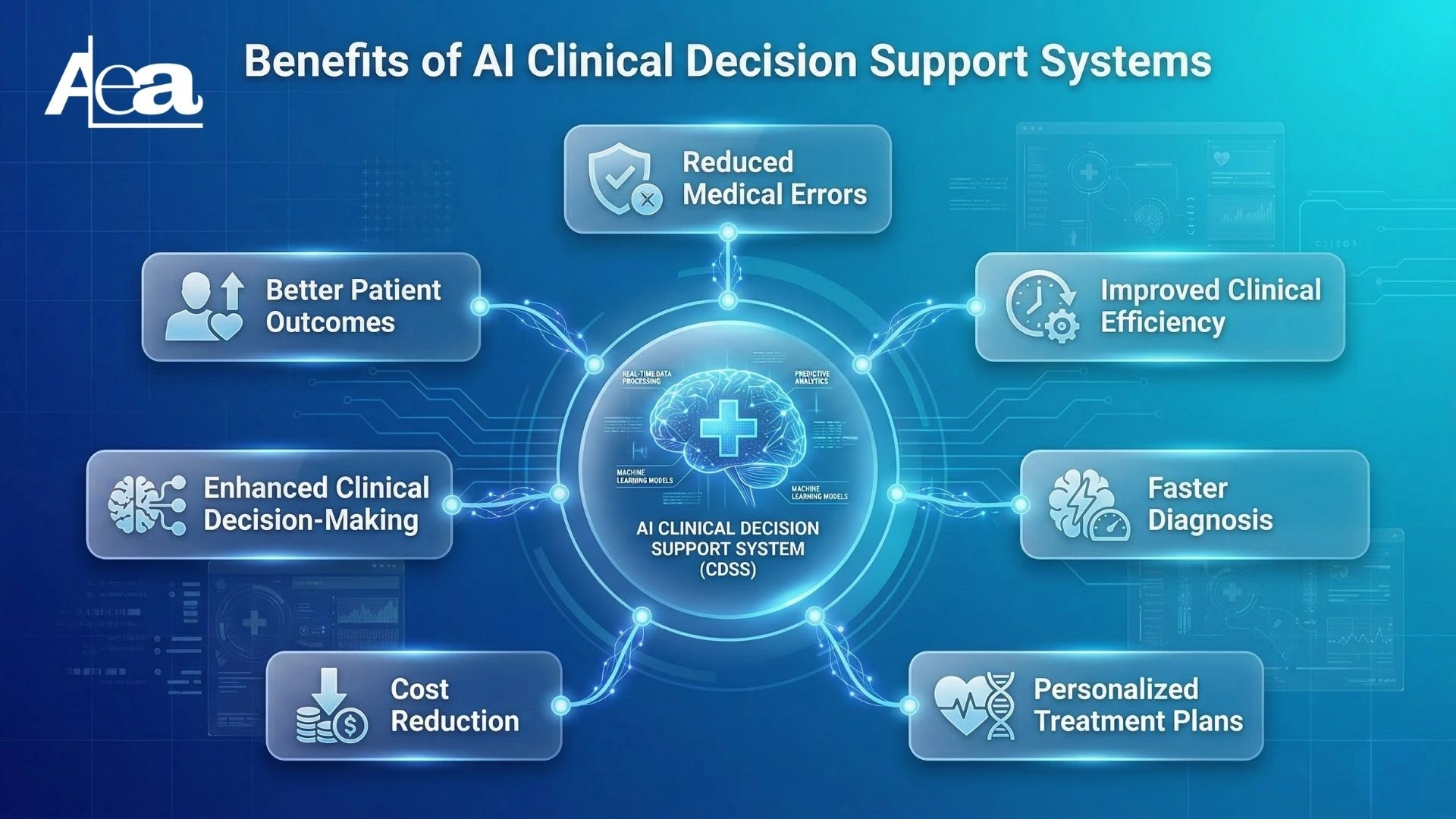
- Reduced Medical Errors: Minimizes diagnostic and treatment mistakes through data-driven recommendations powered by clinical decision support AI and advanced analytics.
- Improved Clinical Efficiency: Streamlines workflows and reduces manual workload for healthcare professionals using an AI clinical decision support system.
- Faster Diagnosis: Enables real-time analysis of patient data for quicker clinical decisions with the help of clinical decision support AI.
- Personalized Treatment Plans: Delivers tailored recommendations based on patient history and predictive insights through an AI clinical decision support system.
- Cost Reduction: Optimizes resource utilization and reduces unnecessary tests and procedures, improving overall operational efficiency.
- Enhanced Clinical Decision-Making: Provides evidence-based insights to support more accurate and confident decisions across care teams.
- Better Patient Outcomes: Improves quality of care through timely interventions and continuous monitoring.
Related Insights: Role of AI in Healthcare: Revolutionising Medicine and Patient Care
Future Trends in AI Clinical Decision Support
-
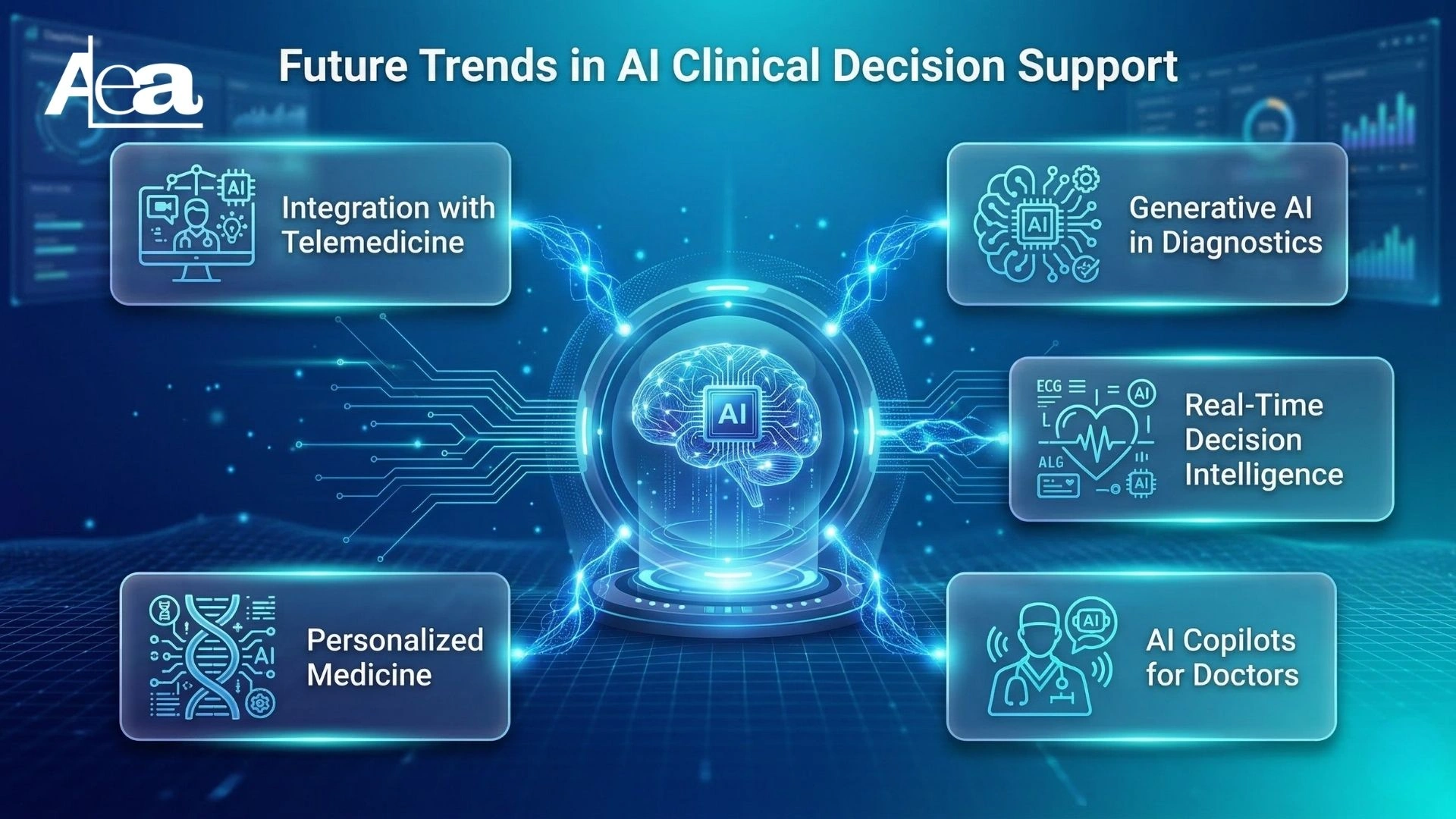
Generative AI in Diagnostics:
Advanced generative models are enabling automated clinical documentation, diagnostic suggestions, and summarization of patient records. These systems support AI for clinical documentation by helping doctors generate structured reports and extract critical insights from unstructured medical data.
-
Real-Time Decision Intelligence:
AI systems are evolving to process live patient data from EHRs, wearables, and monitoring devices, allowing clinicians to make faster, data-driven decisions in critical care and emergency scenarios, reflecting the growing role of AI in healthcare.
-
Personalized Medicine:
AI-driven clinical decision support is moving toward highly individualized care by analyzing genetic data, medical history, and lifestyle factors to recommend precise treatment plans and predict disease risks.
-
AI Copilots for Doctors:
Intelligent AI assistants are enhancing AI for medical diagnosis by supporting clinical decision-making, reducing documentation burden, suggesting treatment pathways, and improving overall productivity.
-
Integration with Telemedicine:
AI-powered decision support systems are being embedded into telehealth platforms, enabling remote diagnosis, virtual monitoring, and real-time clinical recommendations, expanding access to quality healthcare.
How AleaIT Builds Your AI Clinical Decision Support System
With 22+ years of software delivery and healthcare, EHR and AI teams in-house, we build CDSS as a controlled clinical support layer, not a black box.
- Scope and risk: one clinical use case, success metrics, intended-use documentation
- Data and integration: FHIR/HL7 integration with your EHR/EMR, data quality checks and governance
- Model and explainability: ML, NLP or RAG over your clinical knowledge base, with SHAP/LIME explanations
- Validation: retrospective testing, clinician review, performance benchmarks
- Deployment and monitoring: AWS, Azure or Google Cloud, drift detection, audit trails
Conclusion
AI-powered Clinical Decision Support Systems are transforming healthcare by enabling faster, more accurate, and data-driven clinical decisions. From reducing medical errors to improving efficiency and patient outcomes, these systems are becoming an essential part of modern healthcare infrastructure.
As the demand for intelligent healthcare solutions continues to grow, investing in advanced AI-driven systems is no longer optional it’s a strategic necessity.
Frequently Asked Questions
An AI clinical decision support system (CDSS) is software that combines EHR/EMR data, clinical knowledge bases and machine learning models to give clinicians real-time, explainable recommendations at the point of care. It supports diagnosis, treatment selection, drug interaction checks and risk prediction, while the clinician makes the final decision.
There are three types of CDSS: knowledge-based systems that use rule engines and clinical guidelines, non-knowledge-based systems that use machine learning models trained on historical data, and hybrid systems that combine both for higher accuracy and adaptability.
Building a production AI CDSS typically costs $100,000–$500,000+. The main cost drivers are model development ($30,000–$100,000), clinical validation ($25,000–$80,000), EHR/EMR integration ($20,000–$60,000) and deployment ($20,000–$70,000). Ongoing monitoring adds roughly $10,000–$50,000 per year.
A production AI CDSS typically takes [6–12 months], depending on the number of integrations, data readiness and the scope of clinical validation. A focused single-use-case pilot can be delivered in a shorter timeframe.
The build sequence is: (1) define one clinical use case, (2) integrate data through FHIR/HL7, (3) prepare and label data, (4) develop and train the model, (5) add an explainability layer such as SHAP or LIME, (6) validate clinically, (7) deploy on cloud or on-premise infrastructure, and (8) monitor for model drift and retrain.
A typical CDSS stack uses Python (TensorFlow, PyTorch, scikit-learn) for models, NLP tools such as spaCy and BioBERT for clinical text, HL7 and FHIR APIs for integration, PostgreSQL or MongoDB for data, React or Angular for clinician dashboards, and AWS, Azure or Google Cloud for hosting, with AES-256 encryption and role-based access control.
Accuracy depends on data quality, model design and validation, not on AI alone. A properly trained and clinically validated AI CDSS can outperform rule-based alerts, but it must be tested on your own patient population, benchmarked with metrics such as ROC-AUC, precision and recall, and monitored continuously after launch.
Yes. An AI CDSS integrates with any EHR or EMR that supports HL7 or FHIR interfaces, and legacy systems can be connected through integration layers. Integration scope, data mapping and security requirements are defined in the discovery phase before development starts.
Yes. The same architecture supports AI agents for health insurers and TPAs, covering prior authorization pre-screening, clinical claims review and utilization management. Every recommendation is explainable and logged for audit, and human reviewers keep final sign-off.
Buy an off-the-shelf module for standard alerts such as drug interactions. Build in-house if you have a dedicated AI and clinical informatics team. Partner with a development company if you need a differentiated product, integration with your own workflows, and full ownership of code and data. [Confirm AleaIT’s code and data ownership terms before publishing.]