Key Takeaways
- AI is transforming medical diagnosis by analyzing imaging, laboratory results, EHR data, and other clinical information to improve diagnostic speed, accuracy, and consistency.
- AI has evolved from rule-based systems to advanced machine learning, deep learning, computer vision, and predictive analytics, making diagnostic solutions more scalable and enterprise-ready.
- EHR, LIS, and RIS integration is essential for real-time data exchange, automated reporting, and seamless AI adoption within clinical workflows.
- Multimodal AI combines imaging, lab results, patient history, and demographic data to identify anomalies and provide more comprehensive diagnostic insights.
- AI-powered workflow automation reduces diagnostic turnaround time through automated triage, case prioritization, preliminary reporting, and intelligent data processing.
- AI helps address traditional reporting challenges, including manual documentation, reporting delays, diagnostic variability, human error, and clinician administrative workload.
- Medical AI has applications across multiple specialties, including radiology, pathology, laboratory medicine, cardiology, oncology, neurology, dermatology, ophthalmology, pulmonology, and emergency care.
- AI-powered diagnostic technologies such as computer vision, NLP, genomics analysis, liquid biopsy analytics, and point-of-care systems are expanding diagnostic capabilities.
- Security and regulatory compliance are critical for healthcare AI, with measures such as encryption, access controls, MFA, audit trails, HIPAA, and GDPR supporting protected health information.
- FDA regulation is evolving alongside AI adoption, including the Predetermined Change Control Plan (PCCP), which supports certain planned AI model updates without requiring a new clearance for every change.
- AI is designed to augment not replace clinicians, providing clinical decision support, second-read validation, predictive insights, and standardized interpretation while supporting physician expertise.
- The future of AI-driven diagnostics includes generative AI reporting, voice-enabled documentation, predictive diagnostics, personalized treatment recommendations, continuous learning, and wearable-device integration.
- AI-powered diagnostics are becoming an important part of future-ready healthcare infrastructure, helping providers improve patient outcomes, streamline workflows, optimize resources, and scale clinical operations.
Healthcare systems are generating more diagnostic data than ever from imaging and pathology to labs and wearables yet many still rely on manual report workflows that slow turnaround times and delay clinical decisions.
The AI in medical diagnostics market is growing rapidly, expected to reach over $7.7 billion by 2028 as providers adopt automation to improve speed and accuracy.
By early 2026, the FDA’s AI/ML-enabled device list had crossed roughly 1,500 authorizations up from under 1,000 just two years earlier with radiology accounting for nearly 76% of all clearances. That pace signals a shift: AI in diagnostics has moved from pilot projects to standard infrastructure across major health systems.
AI-powered report generation is now reshaping clinical workflows by reducing reporting time, standardizing outputs, and enabling faster, data-driven decisions making it essential for scalable, efficient, modern healthcare delivery.
The Evolution of AI in Medical Diagnosis
The evolution of AI in medical diagnosis has progressed from early rule-based expert systems, which relied on predefined clinical rules and decision trees, to advanced machine learning and deep learning models capable of processing large-scale, multi-modal healthcare data.
While rule-based systems provided structured support, they lacked adaptability and scalability. Machine learning introduced data-driven pattern recognition, improving accuracy through continuous learning from historical records.
Today, deep learning and computer vision enable highly precise image analysis in radiology, pathology, and cardiology. With predictive analytics and seamless EHR, LIS, and RIS integration, AI-driven diagnostics in healthcare are now scalable, efficient, and enterprise-ready.
How is AI used in Medical Diagnosis
AI in healthcare industry revolutionized medical AI diagnosis by analyzing complex patient data, medical images, and lab results with high accuracy.
Machine learning algorithms detect patterns, predict diseases, and assist clinicians in early diagnosis. AI supports decision-making in radiology, pathology, and cardiology, improving speed, reducing errors, and enabling personalized treatment plans for better patient outcomes.
1. AI Integration with Clinical Systems
Scalable medical AI diagnosis depends on seamless integration with EHR, LIS, and RIS systems to enable real-time data exchange and automated reporting within clinical workflows.
Interoperability standards like HL7 and FHIR ensure structured communication. Deployment models cloud, on-premise, or hybrid provide flexibility, scalability, and secure data management.
2. Data Aggregation & Multimodal Processing
AI-driven diagnostics integrate data from imaging, lab results, patient history, and demographics to generate comprehensive insights.
Through real-time synchronization and multimodal analysis, AI systems cross-correlate clinical findings, detect anomalies instantly, and enhance diagnostic accuracy, supporting faster, evidence-based clinical decision-making across healthcare workflows.
3. Workflow Automation Through AI
AI integration modernizes diagnostic workflows by automating triage and case prioritization. Severity scoring algorithms flag high-risk cases, optimizing queues and reducing critical delays.
AI-generated preliminary reports support a hybrid AI-clinician review model, maintaining quality while cutting documentation time. Continuous feedback loops further enhance model accuracy and performance.
4. Security & Compliance in AI Integration
AI deployment in healthcare prioritizes security and regulatory compliance, adhering to HIPAA and GDPR standards for protected health information (PHI).
Measures include role-based access controls, multi-factor authentication, end-to-end encryption, audit trails, and activity logging, ensuring data protection, transparency, traceability, and integrity throughout diagnostic and clinical workflows.
5. AI in Diagnostic Reporting
AI in diagnostic reporting is transforming how clinical insights are generated and delivered in modern healthcare. Traditionally, diagnostic reporting relies on manual interpretation of medical imaging, lab results, and patient records to create structured reports that guide treatment decisions. These conventional workflows often lead to delays, inconsistencies, and inefficiencies.
With growing data volumes and increasing demand for faster, accurate diagnoses, AI-driven diagnostics in healthcare use machine learning, computer vision, and natural language processing to assist in image analysis, anomaly detection, and automated report generation.
This improves speed, accuracy, and standardization, making AI a critical enabler of efficient and high-quality clinical decision-making.
Challenges in Traditional Diagnostic Reporting and AI-Integrated Solutions in Healthcare
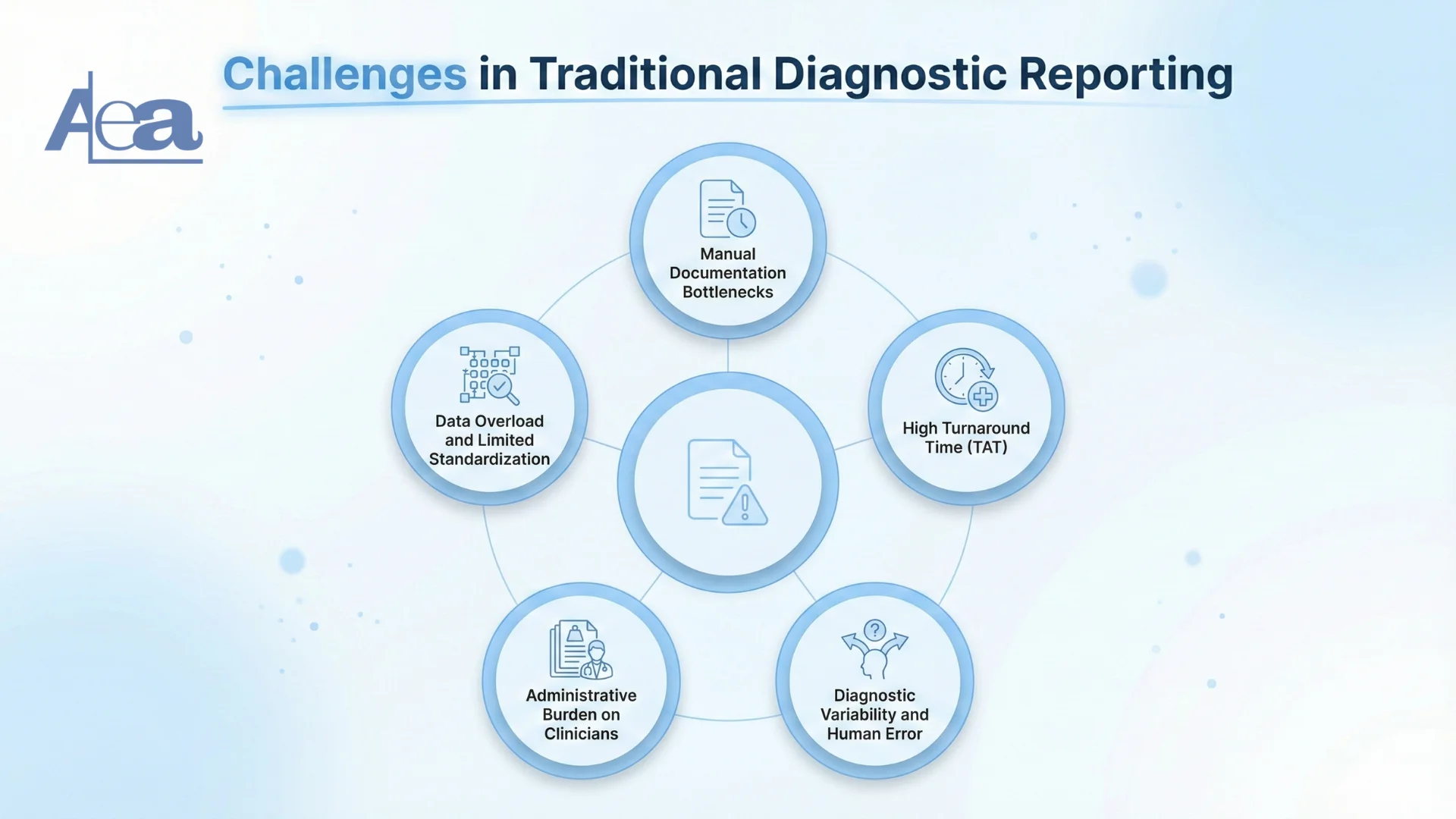
1. Manual Documentation Bottlenecks
Dependence on dictation, transcription, and manual data entry slows workflows and increases the risk of incomplete or inconsistent reports.
AI-Integrated Solution: Automated report generation using NLP-powered systems and pre-structured templates reduces manual input, improves documentation accuracy, and standardizes reporting formats.
2. High Turnaround Time (TAT)
Manual interpretation and formatting delay diagnosis, affecting treatment decisions and emergency response timelines.
AI-Integrated Solution: Real-time data processing, automated image analysis, and AI-generated preliminary reports significantly reduce turnaround time and accelerate clinical decision-making.
3. Diagnostic Variability and Human Error
Differences in clinician interpretation and reporting styles create inconsistencies and increase the risk of overlooked findings.
AI-Integrated Solution: AI-driven diagnostics in healthcare provide standardized analysis, anomaly detection, and second-read validation to enhance accuracy and consistency.
4. Administrative Burden on Clinicians
Extensive time spent on documentation limits clinician availability for complex case evaluation and patient care.
AI-Integrated Solution: Workflow automation, intelligent data auto-population, and smart reporting tools reduce administrative load and allow clinicians to focus on high-value medical judgment.
Growing volumes of imaging, laboratory data, and patient history overwhelm manual systems, while inconsistent templates fragment reporting across departments.
AI-powered data aggregation, multimodal analysis, and standardized reporting frameworks unify diagnostic information across EHR, LIS, and RIS systems, ensuring consistency, scalability, and faster clinical insights.
Use Cases of AI in Medical Diagnosis
| Use Case | Description | How AleaIT Solutions Helps |
|---|---|---|
| Radiology | AI-powered interpretation of X-rays, CT scans, and MRIs for detecting fractures, tumors, hemorrhages, and other abnormalities. Enables urgent case prioritization and structured report generation. | AleaIT develops AI-integrated radiology platforms with automated anomaly detection, smart triage systems, and seamless RIS/EHR integration to reduce turnaround time and improve reporting accuracy. |
| Pathology | Digital slide analysis for tumor grading, biomarker quantification, and cellular abnormality detection with AI-assisted second reads. | AleaIT builds scalable pathology AI solutions that enhance slide interpretation, standardize reporting, and reduce inter-observer variability through intelligent automation. |
| Laboratory Medicine | Automated lab result interpretation, abnormal value flagging, and trend analysis with real-time EMR integration. | AleaIT integrates AI engines with LIS systems to enable real-time reporting, automated alerts, and predictive insights for faster clinical decisions. |
| Cardiology | ECG auto-reporting, arrhythmia detection, cardiac risk scoring, and predictive heart disease monitoring. | AleaIT delivers AI-driven cardiology modules that automate ECG analysis, generate structured reports, and provide predictive risk analytics. |
| Emergency & Critical Care | AI-based triage systems that analyze vitals, imaging, and lab data to prioritize critical patients and generate instant alerts. | AleaIT implements intelligent triage automation and ICU workflow optimization systems to reduce response time and improve patient outcomes. |
| Oncology | Tumor detection, genomic analysis for personalized treatment, therapy response prediction, and AI-assisted cancer staging. | AleaIT develops oncology-focused AI solutions integrating imaging, pathology, and genomics to support precision medicine and structured cancer reporting. |
| Neurology | Stroke detection in CT/MRI scans, seizure recognition in EEG, and predictive modeling for neurodegenerative diseases. | AleaIT builds AI-based neuro-diagnostic tools that accelerate stroke triage, automate EEG interpretation, and enhance neurological reporting accuracy. |
| Dermatology | AI-based classification of skin lesions, melanoma risk assessment, and tele-dermatology diagnostic support. | AleaIT creates AI-powered dermatology platforms with image recognition capabilities and remote consultation integration for scalable screening. |
| Ophthalmology | Automated retinal imaging analysis for diabetic retinopathy and glaucoma detection with risk stratification tools. | AleaIT integrates AI vision models into ophthalmology systems to enable automated screening and standardized reporting workflows. |
| Pulmonology | AI detection of pneumonia, tuberculosis, COPD, and COVID-related abnormalities in chest imaging; pulmonary function test interpretation. | AleaIT delivers AI-enhanced pulmonary diagnostic systems with imaging analytics, predictive risk assessment, and integrated reporting dashboards. |
| Agentic & Conversational AI in Care Coordination | AI agents that interact directly with patient data to support real-time care coordination, structured intake, and follow-up scheduling. | AleaIT designs compliant conversational AI layers that integrate with EHR/RIS systems while maintaining full audit trails and regulatory traceability. |
AI-Powered Diagnostic Tools and Technologies
AI-powered diagnostic tools leverage machine learning, deep learning, natural language processing (NLP), and computer vision to analyze medical imaging, laboratory results, genomic datasets, and electronic health records.
These systems automate report generation, detect anomalies, enable predictive analytics, and enhance clinical decision support.
By integrating seamlessly with custom EHR solutions, LIS, and RIS platforms, AI improves efficiency, scalability, and diagnostic precision across modern healthcare systems
1. AI in Medical Imaging Analysis
AI-driven imaging solutions use convolutional neural networks (CNNs) to analyze X-rays, CT scans, MRIs, and digital pathology slides. They identify tumors, fractures, hemorrhages, and subtle abnormalities with high sensitivity. Acting as a second reader, AI reduces diagnostic variability and significantly lowers turnaround time.
2. AI in Liquid Biopsy Analysis
AI enhances liquid biopsy diagnostics by analyzing circulating tumor DNA (ctDNA), biomarkers, and blood-based indicators.
Advanced algorithms detect early cancer signatures, monitor disease progression, and assess treatment response using minimally invasive methods.
3. AI in Genomics and Genetic Testing
AI accelerates genomic sequencing interpretation by identifying mutations, gene variants, and inherited risk markers. It supports precision medicine by enabling personalized therapy selection based on molecular profiles.
- Machine learning models correlate genetic variants with clinical data to predict disease susceptibility, hereditary conditions, and long-term health risks, strengthening preventive care strategies.
- AI evaluates genetic markers, metabolic profiles, and historical treatment outcomes to predict patient-specific drug responses, reducing adverse effects and improving therapeutic success rates.
4. AI in Point-of-Care Diagnostics
AI-enabled point-of-care systems deliver rapid diagnostic insights in emergency departments, rural clinics, and outpatient settings. Real-time analysis supports immediate clinical decision-making without reliance on centralized laboratories.
5. AI-Powered Devices for Rapid Diagnosis
Smart diagnostic devices embedded with AI algorithms provide instant evaluation of imaging, vitals, and lab samples. These tools enhance early detection and streamline acute care workflows.
6. Improving Accessibility to Diagnostics
AI-driven telehealth platforms and mobile diagnostic tools expand healthcare access in underserved regions. Cloud-based analytics enable remote interpretation, reducing geographical barriers to quality diagnostics.
AI Medical Device Regulation: What’s Changed in 2026
Regulatory clarity is catching up with adoption. The FDA’s Predetermined Change Control Plan (PCCP) framework, finalized in late 2024, now lets manufacturers update AI models in production without triggering a new clearance for every change a major shift for continuously learning diagnostic systems.
Most AI/ML devices (95%+) still clear through the 510(k) pathway rather than De Novo or PMA, and radiology continues to dominate authorizations, led by GE HealthCare, Siemens Healthineers, and Philips.
For healthcare providers evaluating AI vendors, this means asking pointed questions: How does the vendor handle model updates post-clearance? What does their post-market surveillance process look like? Is there a documented Quality Management System behind the submission? Getting this right early avoids costly rework later something AleaIT’s healthcare software development team builds into every AI diagnostics engagement from day one.
The Role of AI in Modern Diagnostics
AI functions as an intelligent clinical decision-support partner, augmenting physician expertise with data-driven insights. It standardizes reporting, enhances predictive accuracy, and ensures consistent interpretation across departments.
Through multimodal data analysis and deep learning, AI identifies complex patterns often undetectable by manual review. It enhances early disease detection, minimizes reporting errors, and improves diagnostic consistency in radiology, pathology, and laboratory medicine.
Case Studies: Successful AI Implementations in Diagnostics
Hospitals implementing AI-based stroke detection systems have reduced critical response times. AI-assisted radiology platforms have improved cancer detection rates, while automated pathology analysis tools have enhanced reporting standardization and efficiency across enterprise networks.
Key Features of AI in Medical Diagnosis Platforms
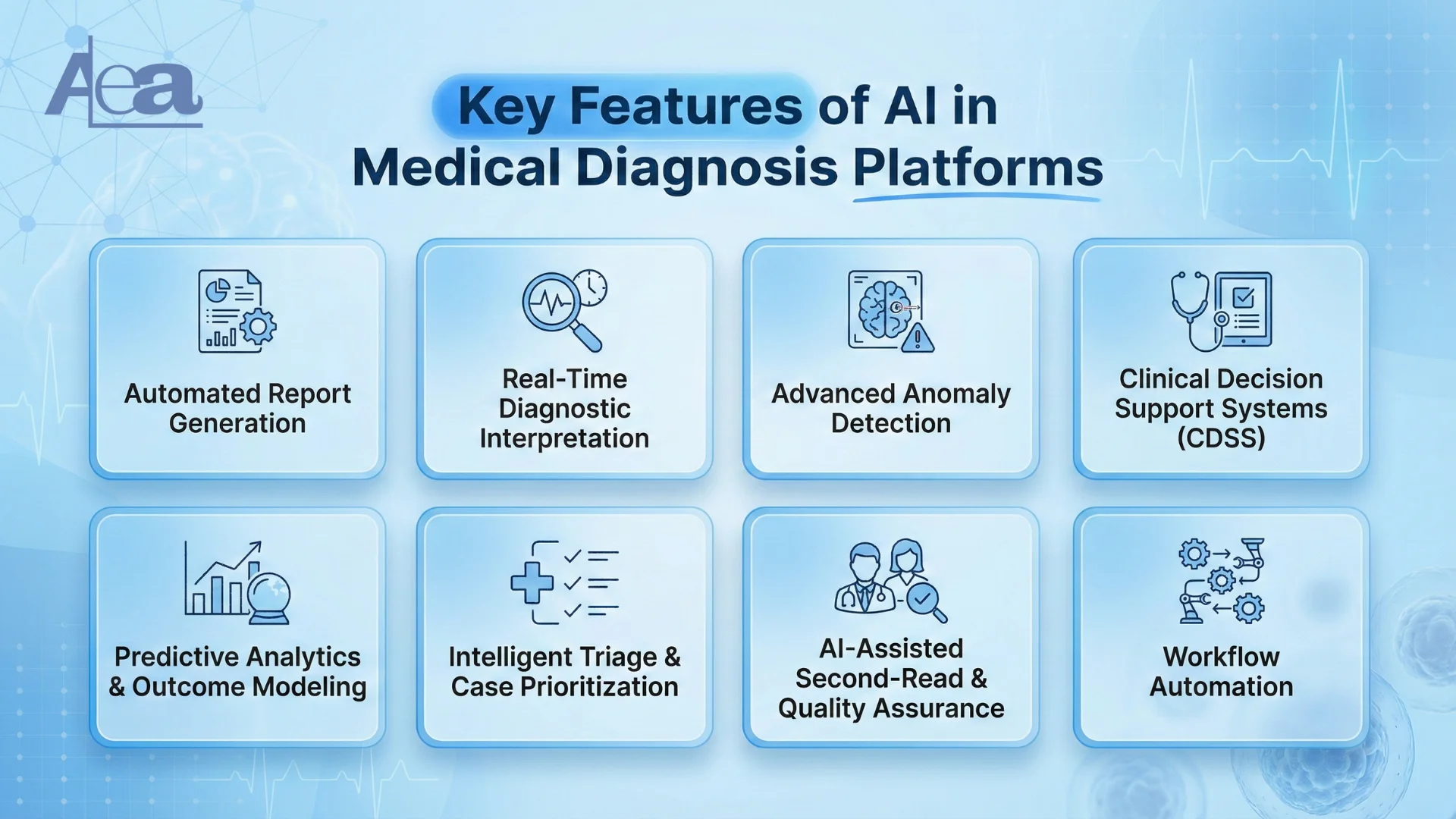
- Automated Report Generation – AI-driven structured reporting with specialty-specific templates and NLP-generated clinical narratives to ensure consistency, accuracy, and faster documentation.
- Real-Time Diagnostic Interpretation – Continuous analysis of imaging, laboratory results, and patient vitals to deliver instant insights and reduce diagnostic turnaround time.
- Advanced Anomaly Detection – Machine learning models capable of identifying subtle abnormalities such as lesions, fractures, tumors, and critical lab deviations with high precision.
- Clinical Decision Support Systems (CDSS) – Embedded risk scoring, severity grading, and evidence-based recommendations to assist clinicians in making data-driven decisions.
- Predictive Analytics & Outcome Modeling – AI algorithms that forecast disease progression, readmission risks, and treatment responses using historical and real-time datasets.
- Intelligent Triage & Case Prioritization – Automated urgency classification that ensures high-risk or critical cases are flagged and escalated immediately.
- AI-Assisted Second-Read & Quality Assurance – Verification tools that reduce inter-observer variability, detect inconsistencies, and improve diagnostic confidence.
- Workflow Automation – Streamlined administrative processes including documentation, coding, and reporting to reduce clinician workload and operational delays
Future of AI-Driven Diagnostics in Healthcare
The next phase of AI-driven diagnostics will move beyond workflow automation toward intelligent clinical collaboration, predictive care, and precision medicine.
Emerging technologies will reshape how diagnostic data is synthesized, interpreted, and translated into actionable clinical insights across healthcare ecosystems.
1. Generative AI for Clinical Narratives
Future platforms will use generative AI to create context-aware diagnostic reports that integrate imaging, lab results, patient history, and physician notes into structured, evidence-backed narratives.
These systems will summarize longitudinal data, highlight disease progression, and recommend follow-up actions reducing documentation burden while improving clarity and consistency.
2. Voice-Enabled and Conversational Documentation
AI-powered voice assistants will streamline documentation by converting real-time dictation into structured EHR-ready reports.
This category is no longer purely speculative 2026 has already seen early FDA clearances for patient-facing conversational AI tools in bounded clinical domains like chronic disease management, signaling a regulatory path for broader conversational documentation tools in the near term.
Conversational interfaces will allow clinicians to retrieve patient trends, imaging comparisons, and risk scores instantly, improving workflow efficiency and reducing administrative fatigue.
3. Predictive and Preventive Diagnostics
AI will increasingly support proactive healthcare by analyzing multimodal datasets including imaging, genomics, wearables, and lab data to identify disease risks before symptoms appear. This predictive capability enables early intervention and lowers long-term healthcare costs.
4. Personalized Treatment Recommendations
Advanced AI decision engines will recommend individualized treatment pathways based on genetic markers, comorbidities, and historical outcomes. This precision-driven approach will significantly impact oncology, cardiology, and chronic disease management.
5. Continuous Learning Systems
Next-generation AI platforms will continuously learn from new clinical data, physician feedback, and updated medical research, ensuring evolving accuracy and alignment with current guidelines.
6. Wearables and Remote Monitoring Integration
AI ecosystems will integrate real-time data from wearable devices and remote monitoring tools, enabling early detection of physiological changes and supporting timely remote interventions.
Conclusion
Artificial Intelligence diagnosis is a strategic investment that goes beyond automation it fundamentally strengthens clinical capability and organizational performance.
By augmenting clinician expertise with real-time analytics, predictive modeling, and intelligent decision support, AI enhances diagnostic speed, accuracy, and consistency while reducing variability and errors.
A focused, use-case–driven adoption approach enables healthcare providers to improve patient outcomes, streamline workflows, optimize resource utilization, and accelerate reimbursement cycles.
As patient volumes grow and clinical complexity increases, AI-powered diagnostic systems become essential for building scalable, resilient, and future-ready healthcare infrastructure.
Frequently Asked Questions
AI in medical diagnosis uses machine learning and data analytics to analyze imaging, lab results, and clinical data to support faster and more accurate diagnoses.
AI is used for medical image interpretation, automated report generation, anomaly detection, risk scoring, predictive analytics, and real-time clinical decision support.
AI-driven diagnostics in healthcare reduce turnaround time, improve accuracy, lower clinician workload, and enhance patient outcomes.
Future trends include generative AI reporting, voice-enabled documentation, predictive diagnostics, personalized treatment recommendations, and explainable AI systems.
No. AI augments clinicians by providing decision support and second-read validation while final decisions remain with medical professionals.
Organizations typically achieve ROI within 6–18 months through improved efficiency, reduced errors, and higher diagnostic throughput.
Yes. AI systems follow HIPAA/GDPR compliance with encryption, access control, and audit trails to protect patient data.
As of early 2026, the FDA has cleared over 1,500 AI/ML-enabled medical devices, with radiology accounting for roughly three-quarters of all authorizations.
A PCCP is an FDA framework that allows manufacturers to pre-specify and implement certain AI model updates without seeking a new clearance for each change critical for diagnostic tools that continuously learn from new data.