Key Takeaways
- What it is: pharmacy management software development means building custom software that runs prescriptions, dispensing, inventory, billing, insurance claims and compliance.
- Core modules: prescription management, inventory, POS and billing, claims, compliance reporting, analytics.
- Cost: benchmarks run from about $15K for small builds to $400K–$1M+ for enterprise, with maintenance at roughly 15 to 20% a year.
- Timeline: about 6 to 10 months depending on scope.
- Compliance: HIPAA, DEA/EPCS and NCPDP in the US, with different rules in other regions.
- Trend: AI agents now handle refills, interaction checks and demand forecasting alongside core modules.
- Next step: define scope and integrations first, then price. AleaIT builds custom pharmacy platforms.
Pharmacy management software development has moved from a back-office IT project to a core business decision. Pharmacies now juggle e-prescriptions, tighter audit rules, thin margins and patients who expect refills to work like any other app.
This guide covers features, cost, compliance, integrations and AI, so you can scope a build with confidence.
What Is Pharmacy Management Software Development, and Who Needs It?
Pharmacy management software development is the process of designing and building custom software that manages prescriptions, dispensing, inventory, billing, insurance claims and regulatory compliance for a pharmacy.
The result is one system of record. Pharmacists verify and fill prescriptions, technicians track stock, cashiers close sales and owners see margins, all without re-keying data between tools.
Pharmacy software development of this kind is different from installing a packaged product, because workflows, integrations and reports are shaped around how your pharmacy actually runs.
Pharmacy management software vs generic retail POS
A generic point of sale tracks items and payments. Pharmacy systems must also handle patient profiles, prescriber data, drug databases, lot and expiry control, controlled-substance logs and payer adjudication.
A retail POS cannot reject a dangerous interaction, split-fill a prescription or produce a DEA audit trail. For that reason, pharmacy POS integration should be treated as one module of the platform rather than the platform itself.
Which pharmacies benefit: retail, hospital, specialty, compounding, long-term care, chains
- Retail pharmacies and chains: high prescription volume, front-store sales, multi-location inventory and loyalty programs. Retail pharmacy software must keep queues short and reporting consolidated.
- Hospital pharmacies: inpatient orders, unit-dose dispensing, formulary control and tight EHR links. Hospital pharmacy software leans heavily on interoperability.
- Specialty pharmacies: cold-chain handling, prior authorizations and patient adherence programs.
- Compounding pharmacies: formulas, batch records, beyond-use dating and ingredient traceability.
- Long-term care: cycle fills, blister packing, facility billing and medication administration records.
How Big Is the Pharmacy Management Software Market in 2026?
The pharmacy management software market is growing as pharmacies, hospitals, and healthcare providers invest in digital tools to manage prescriptions, track inventory, automate billing, and improve daily operations.
According to ResearchAndMarkets, the global pharmacy management system market is projected to reach $35.62 billion in 2026 and grow to $83.69 billion by 2032, at a compound annual growth rate (CAGR) of 15.25%. These estimates highlight the growing demand for technology that helps pharmacies manage complex workflows more efficiently.
Why Do Pharmacy Management Software Market Estimates Differ?
Not every research firm measures the market in the same way. Some reports focus on pharmacy management software, while others cover broader pharmacy management systems, including services, cloud platforms, and integrated operational solutions. Differences in research methods, market definitions, and forecast periods can also affect the reported figures.
For example, Mordor Intelligence estimates that the pharmacy management system market will grow from $101.07 billion in 2025 to $236.28 billion by 2031. Its broader market estimate differs from ResearchAndMarkets’ forecast, so the two figures should not be treated as directly comparable.
What does this mean for healthcare businesses? Market forecasts point to growing investment in pharmacy technology. For pharmacies and healthcare providers, this creates opportunities to modernize prescription processing, improve inventory visibility, streamline billing, and connect pharmacy operations with other healthcare systems.
When comparing market statistics, always check the report’s scope, base year, and forecast period before using the figures in business planning or investment decisions.
Cloud and AI adoption trends
Cloud held 63.4% of the market in 2024 (Mordor, via Leanware). A cloud-based pharmacy management system removes on-premise servers, speeds up updates and makes multi-store reporting simple. AI is the second shift, covered in its own section below.
Core Features and Modules of Pharmacy Management Software
Core modules are prescription management, inventory, POS and billing, insurance claims, compliance reporting and analytics, plus integrations with EHR systems and wholesalers.
These are the essential features of pharmacy management software, and the list below shows what each should deliver.
1. Prescription management and e-prescribing
The prescription module covers intake, data entry, pharmacist verification, dispensing, labeling and counseling notes. It should include drug-interaction and allergy checks, dose validation and refill rules.
E-prescribing / EPCS integration receives electronic prescriptions, including controlled substances, with two-factor authentication and signed audit records. It reduces transcription errors and speeds up fills.
2. Inventory, expiry and lot tracking
Pharmacy inventory management software should track stock by lot and expiry, trigger reorder points, support returns and recalls, and sync with wholesaler catalogs.
Automated expiry alerts cut write-offs, and barcode scanning reduces counting errors. If your pharmacy sits inside a wider distribution network, the same principles apply to healthcare supply chain management systems, where visibility across locations matters most.
3. Billing, claims and PBM support
This module prices prescriptions, adjudicates claims in real time, handles copays, rejects and reversals, and reconciles payments.
PBM support means processing NCPDP-standard transactions and managing formularies, prior authorizations and DIR-style fees. Strong claims logic is often where custom builds repay their cost first.
4. Controlled-substance tracking and audit trails
Controlled drugs need perpetual inventory, double-count workflows, prescriber and patient verification, and immutable logs of who touched what and when. Build audit trails in from day one, because retrofitting them is expensive.
5. Reporting and analytics dashboards
Owners need margin by drug class, dispensing volume, days of supply, adherence rates and shrinkage. Dashboards should be role-based, so a technician sees queues while an owner sees profitability.
Which Modules Does Each Pharmacy Type Need?
| Module | Retail / chain | Hospital | Specialty | Compounding | Long-term care |
| Prescription management | Core | Core | Core | Core | Core |
| Inventory and lot tracking | Core | Core | Core | Core (ingredients) | Core |
| POS and billing | Core | Optional | Core | Core | Facility billing |
| Claims and PBM | Core | Limited | Core | Optional | Core |
| Controlled-substance logs | Core | Core | Core | Core | Core |
| EHR integration | Optional | Core | Core | Optional | Core |
| Prior authorization | Optional | Optional | Core | Optional | Optional |
| Batch and formula records | No | Optional | Optional | Core | No |
| Cycle fills / blister packs | Optional | No | No | No | Core |
| Analytics | Core | Core | Core | Core | Core |
Need the Right Pharmacy Software Modules?
Build Features Around Your Pharmacy’s Needs.
How Do You Develop Pharmacy Management Software Step by Step?
Developing pharmacy management software starts with understanding your pharmacy’s workflows, business goals, and compliance requirements.
The process typically includes requirement planning, system architecture, user-friendly design, core module development, third-party integrations, testing, deployment, and ongoing maintenance.
A phased approach helps control development costs, reduce risks, and ensure the software meets the needs of pharmacists, staff, and patients.
1. Discovery and compliance scoping
Start with workflow mapping alongside pharmacists and technicians. List every integration, every regulated process and every report. Map compliance duties by region before design begins. Expect this phase to take several weeks and to prevent the costliest rework later.
2. Architecture and tech stack
Choose a modular, API-first architecture so modules can ship and scale independently. Typical choices include a web front end, a service-based backend, an encrypted relational database, a message queue for integrations and a cloud host with regional data residency.
Role-based access, encryption at rest and in transit, and full audit logging are non-negotiable. Co-design screens with pharmacists, because a slow dispensing screen costs time on every single fill.
3. Data migration from legacy systems
Migrating patient profiles, prescription history, inventory and pricing is the riskiest step. Cleanse data first, run trial migrations, reconcile counts and keep the old system read-only during the transition.
4. Testing, validation and go-live
Test clinical logic (interactions, dose limits), claims, security and load. Use real pharmacist scenarios, then roll out store by store or in phases, with a rollback plan and floor support during the first weeks. Maintenance, updates to drug databases and rule changes continue after launch.
Integrations and Interoperability: EHR, e-Prescribing, Wholesalers and PBMs
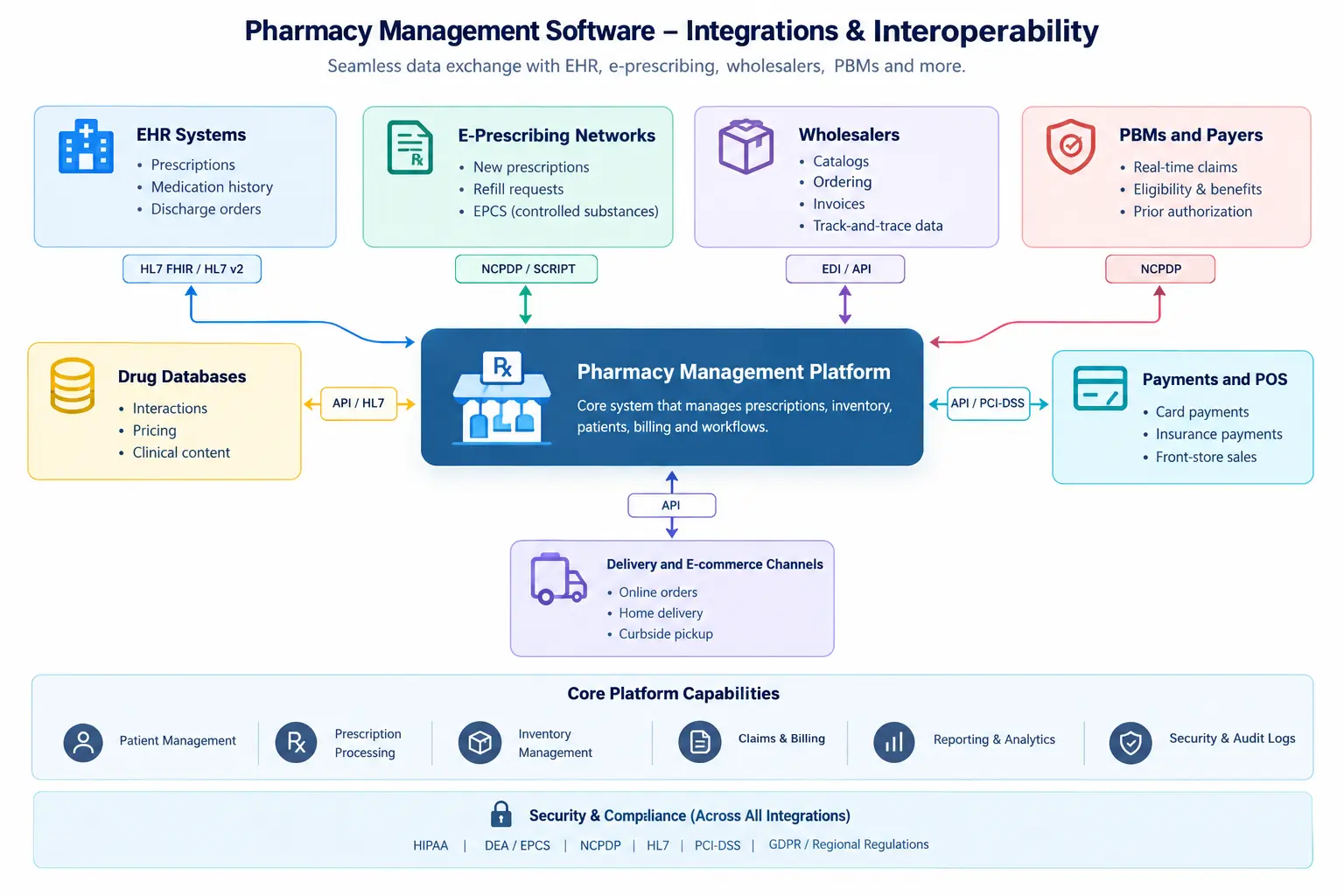
Pharmacy platforms succeed or fail on integrations. The core platform sits in the middle and exchanges data with:
- EHR systems via HL7 FHIR or HL7 v2 for prescriptions, medication history and discharge orders.
- E-prescribing networks for new prescriptions, refill requests and EPCS.
- Wholesalers for catalogs, ordering, invoices and track-and-trace data.
- PBMs and payers for real-time claims using NCPDP standards.
- Drug databases for interactions, pricing and clinical content.
- Payments and POS hardware, where pharmacy POS integration keeps front-store and prescription sales reconciled.
- Delivery and e-commerce channels. If you also sell online, see our retail e-commerce development work for storefront considerations.
Compliance and Security Requirements by Region
HIPAA-compliant pharmacy software needs administrative, physical and technical safeguards: access controls, encryption, audit logs, breach procedures and signed business associate agreements with vendors. To make a system HIPAA-compliant, bake these in during design instead of adding them at the end.
| Area | US | UK / EU | India |
| Health data privacy | HIPAA | UK GDPR / EU GDPR | Digital Personal Data Protection Act, 2023 |
| Controlled substances | DEA rules, EPCS | National controlled-drug registers and prescribing rules | Narcotic Drugs and Psychotropic Substances Act, state records |
| Claims and data standards | NCPDP | NHS and national dictionaries (e.g., dm+d in the UK) | Evolving national digital health standards |
| Medicine authentication | DSCSA track-and-trace | EU Falsified Medicines Directive | Regulatory serialization requirements (verify current status) |
| Pharmacy regulation | State boards of pharmacy | GPhC (UK) and national regulators | Pharmacy Council of India and state rules |
How Are AI Agents Changing Pharmacy Management Software?
AI agents add automation to pharmacy workflows, from refill handling and prior-authorization support to inventory forecasting and drug-interaction lookup, with pharmacist approval kept in the loop. AI in pharmacy management software is moving from pilot to standard feature.
Use cases with guardrails
- Refill agents contact patients, confirm details and queue refills for pharmacist review.
- Prior-authorization support gathers documents and drafts submissions.
- Demand forecasting predicts stock needs by season, location and trend.
- Interaction and counseling lookups surface relevant warnings from approved drug databases.
- RAG assistants answer staff questions from your own SOPs and formularies. Retrieval-based generative AI development services ground answers in your documents, and our healthcare RAG case study (see the project) shows the approach in practice.
If you want to explore automation, our AI agent development company page explains how agents are designed, tested and monitored.
Guardrails include role-based permissions, logged decisions, source citations, confidence thresholds and human sign-off on anything clinical.
Where AI should not decide
AI should not approve dispensing, override interaction alerts, change doses, verify controlled-substance prescriptions or make final clinical judgments. A licensed pharmacist stays accountable for every one of those decisions.
Ready to Add AI to Your Pharmacy Software?
Automate Workflows with Custom AI Solutions.
How Much Does Pharmacy Management Software Development Cost in 2026?
Pharmacy management software typically costs from about $15,000 for small builds to $400,000–$1M+ for enterprise systems, depending on scope, integrations, compliance and team location.
Pharmacy management software development cost is driven more by integrations and compliance than by screen count.
Cost by scope tier
| Tier | Typical scope | Indicative cost |
| Small | Single store, prescriptions, basic inventory and billing | From about $15K |
| Mid-size | Multi-module platform, claims, e-prescribing, reporting | Roughly $60K–$250K |
| Enterprise | Chains or hospitals, many integrations, AI, advanced compliance | $400K–$1M+ |
Cost by team region and hourly rates
| Region | Indicative hourly rate |
| United States | $100–$200 |
| Western Europe | $80–$150 |
| Eastern Europe | $40–$80 |
| India | $25–$50 |
Rates are indicative and vary by seniority and engagement model. Lower rates help only when quality, domain knowledge and communication hold up.
Maintenance, hosting and total cost over three years
Budget about 15 to 20% of the build cost each year for maintenance, updates, drug-database licenses, support and compliance changes, plus cloud hosting.
Over three years, the total cost of ownership is the build plus roughly half again in running costs. Timelines of about 6 to 10 months are typical, depending on scope.
What drives cost up or down
- Up: many integrations, EPCS, multi-region compliance, data migration, AI agents, hospital workflows, native mobile apps.
- Down: a narrower first release, reusable components, a single region, a cloud-based pharmacy management system rather than on-premise, and a clear scope up front.
Payback and ROI
Payback usually comes from fewer dispensing errors, less expired stock, faster claims, lower licensing fees and staff time saved. Model these against your current software spend and shrinkage to estimate break-even.
Looking for Cost-Effective Pharmacy Software?
Find the Right Fit for Your Budget.
Custom vs Off-the-Shelf Pharmacy Software: Which Should You Choose?
Custom pharmacy management software suits pharmacies with unusual workflows, integrations or growth plans. Off-the-shelf suits a standard single-store operation that needs to start fast.
| Factor | Custom | Off-the-shelf |
| Upfront cost | Higher | Lower |
| Fit to workflow | Exact | Configured, with limits |
| Time to launch | Months | Days to weeks |
| Integrations | Built to your stack | Vendor’s supported list |
| Ownership | You own the IP | Subscription, vendor lock-in |
| Scaling | Designed for growth | Tied to vendor roadmap |
| Best for | Chains, specialty, hospitals, new products | Standard independents |
A practical rule: if your processes are the same as everyone else’s, buy. If your process is your advantage, or you plan to sell software as a product, build.
Common Challenges in Pharmacy Software Projects and How to Avoid Them
- Scope creep: lock a first release, then add phases.
- Weak compliance mapping: involve legal and a regulatory specialist during discovery.
- Poor pharmacist adoption: test screens with real staff early.
- Messy legacy data: budget real time for cleansing and trial migrations.
- Integration delays: secure sandbox access to EHR, PBM and wholesaler systems early.
- Underestimated maintenance: plan the 15 to 20% annual budget from the start.
How to Choose a Pharmacy Software Development Partner
A pharmacy software development company should prove domain knowledge, not only coding skill. Ask these eight questions:
- Have you built healthcare or pharmacy platforms before, and can you show cases?
- How do you handle HIPAA, DEA/EPCS, NCPDP and regional rules?
- Which integrations have you delivered (EHR, PBM, wholesaler)?
- How do you involve pharmacists in design and testing?
- What is your approach to data migration and go-live support?
- Who owns the code and IP?
- How do you price, and what is excluded from the estimate?
- What maintenance and SLA options do you offer?
If you need to extend your team, you can also hire AI developers with healthcare experience for the intelligent features of your platform.
Looking for a Reliable Pharmacy Software Partner?
Get a Solution Tailored to Your Business.
How AleaIT Builds Pharmacy Management Platforms
AleaIT is a pharmacy software development company that designs custom platforms from discovery through launch and maintenance.
Our teams combine healthcare domain knowledge, compliance-first architecture and AI engineering. Our work includes a healthcare ERP case study and healthcare AI projects, backed by our broader custom AI solutions practice. To see how we work and what sets us apart, read why AleaIT.
The approach is simple: scope first, price second, build in phases, and keep pharmacists in the loop at every stage.
Where to Start Your Pharmacy Software Project
Pharmacy management software development works best when scope comes before price. Define your pharmacy type, modules, integrations and compliance region, then decide between custom and off-the-shelf, and add AI where it removes repetitive work without touching clinical judgment. AleaIT can help you scope, estimate and build.
Frequently Asked Questions
It is the process of designing and building software that manages prescriptions, dispensing, inventory, billing, claims and compliance for pharmacies. Pharmacy management system development can be a full custom build or a tailored platform built on proven components.
Pharmacy management software development cost ranges from about $15K for small builds to $400K–$1M+ for enterprise systems, plus roughly 15 to 20% a year for maintenance. Integrations and compliance are the biggest drivers.
Most projects take about 6 to 10 months, depending on modules, integrations, migration and compliance work.
The must-have features of pharmacy management software are prescription management, inventory and expiry tracking, POS and billing, claims and PBM support, controlled-substance logs, compliance reporting and analytics, with EHR and wholesaler integrations.
Off-the-shelf is faster and cheaper for standard stores. Custom pharmacy management software is better for chains, specialty and hospital pharmacies, and anyone with distinct workflows or product plans.
Use access controls, encryption, audit logging, breach response procedures, signed business associate agreements and regular risk assessments. HIPAA-compliant pharmacy software treats these as design requirements, not add-ons.
Yes. AI agents can support refills, forecasting, prior authorizations and interaction lookups, with pharmacist approval on every clinical decision.
Check healthcare references, compliance experience, integration history, IP ownership and support terms, using the eight-question checklist above.